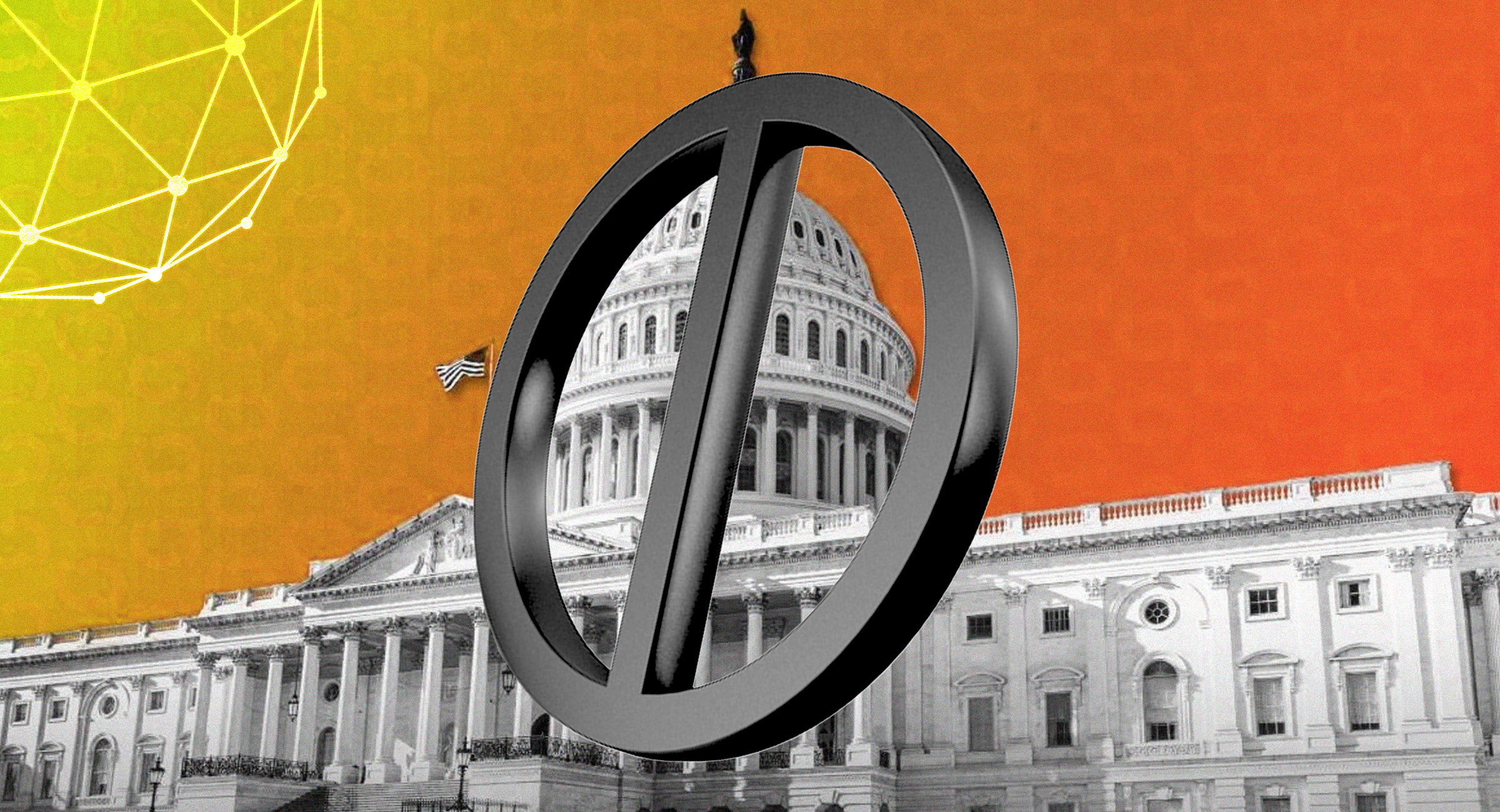
The U.S. House has added a CBDC ban to the 2026 National Defense Authorization Act.
The ban prohibits the Federal Reserve from creating or testing any digital currency.
Stablecoins are not affected, provided they are dollar-denominated, open, and private.
The move was part of a political bargain with House conservatives.
The bill’s future in the Senate is uncertain, especially as it tackles a highly polarizing issue.
The CBDC ban was embedded within the House’s version of the National Defense Authorization Act (NDAA) for the 2026 fiscal year.
The bill, HR 3838, was revised and published by the House Rules Committee to include language that explicitly prohibits the Federal Reserve from developing, testing, or implementing a digital currency.

Source: www.congress.gov
While the NDAA primarily focuses on national security and military spending, it is common practice for lawmakers to attach controversial or otherwise stalled measures to such “must-pass” bills.
The move is a result of a political bargain. In July, House Republican leaders made a deal with conservative members to include the CBDC ban in the NDAA, ending a legislative standoff.
Some Republicans had blocked progress on three crypto-related bills unless assurances were made to prohibit any future Fed-issued digital currency.
This agreement eventually allowed floor debates to move forward after nearly nine hours of delay, the longest in recent House history.
The newly added provision would ban the Federal Reserve from issuing a CBDC and prevent the central bank from offering digital financial products or services directly to individuals.
No issuance of a digital currency or asset by the Federal Reserve.
No testing, studying, or developing of a CBDC.
No implementation of any digital currency infrastructure by the central bank.
No direct-to-consumer services by the Fed involving digital assets.
Interestingly, the provision carves out an exception for dollar-backed stablecoins, so long as they remain open, permissionless, and private.
This suggests that decentralized, non-government-controlled digital currencies may still operate under the new law.
The push to ban CBDCs isn’t new. House Republicans, led by Representative Tom Emmer, introduced the CBDC Anti-Surveillance State Act in early 2023. That version failed to gain traction in the previous Congress and ultimately died without a vote.
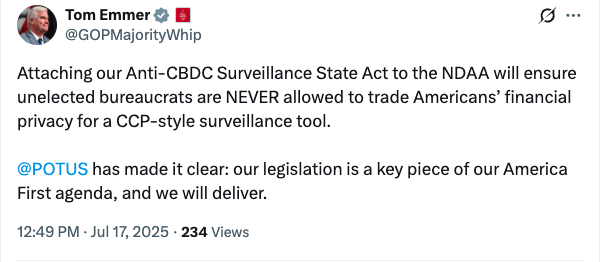
Source: X (@GOPMajorityWhip)
However, in 2024, Emmer reintroduced the bill, and it passed the House by a narrow margin of 219–210. Despite this small victory, the bill’s future in the Senate remains uncertain, with resistance expected from Democrats and moderate lawmakers.
Republicans claim the effort aligns with President Donald Trump’s executive order issued in January, which also opposes the creation of a U.S. CBDC, framing it as a surveillance tool that could infringe on personal financial privacy.
Some critics argue that using the NDAA to pass non-defense provisions like a CBDC ban undermines the legislative process. Others see it as a strategic move to ensure ideologically driven policies are enacted without needing bipartisan support.
Whatever the intent, the strategy appears to be working, at least in the House.
A Central Bank Digital Currency (CBDC) is a digital version of a country’s official currency, issued and regulated by the central bank. In the U.S., this would mean a digital dollar issued by the Federal Reserve.
As of now, the Federal Reserve has only explored the possibility of a CBDC. No official plans have been announced to issue one, and this ban could halt those efforts entirely.
No, this provision specifically targets Fed-issued digital currencies. Cryptocurrencies like Bitcoin, Ethereum, and private stablecoins are not directly affected.
That remains unclear. While the House passed the provision, the Senate is less likely to support the measure, especially if it remains attached to the NDAA without bipartisan consensus.