Circle is selling a simple claim: an AI agent can now find a paid API, read the price, and settle in USDC without a human wiring the integration. On 9 September it published a public Discovery API for its Agent Marketplace — one unauthenticated GET that returns live x402 listings, each with a machine-readable payment contract.
That is a real piece of market infrastructure. It is not a trustless registry. Circle still decides what gets listed, what stays healthy, and which seller wallets survive a sanctions screen.
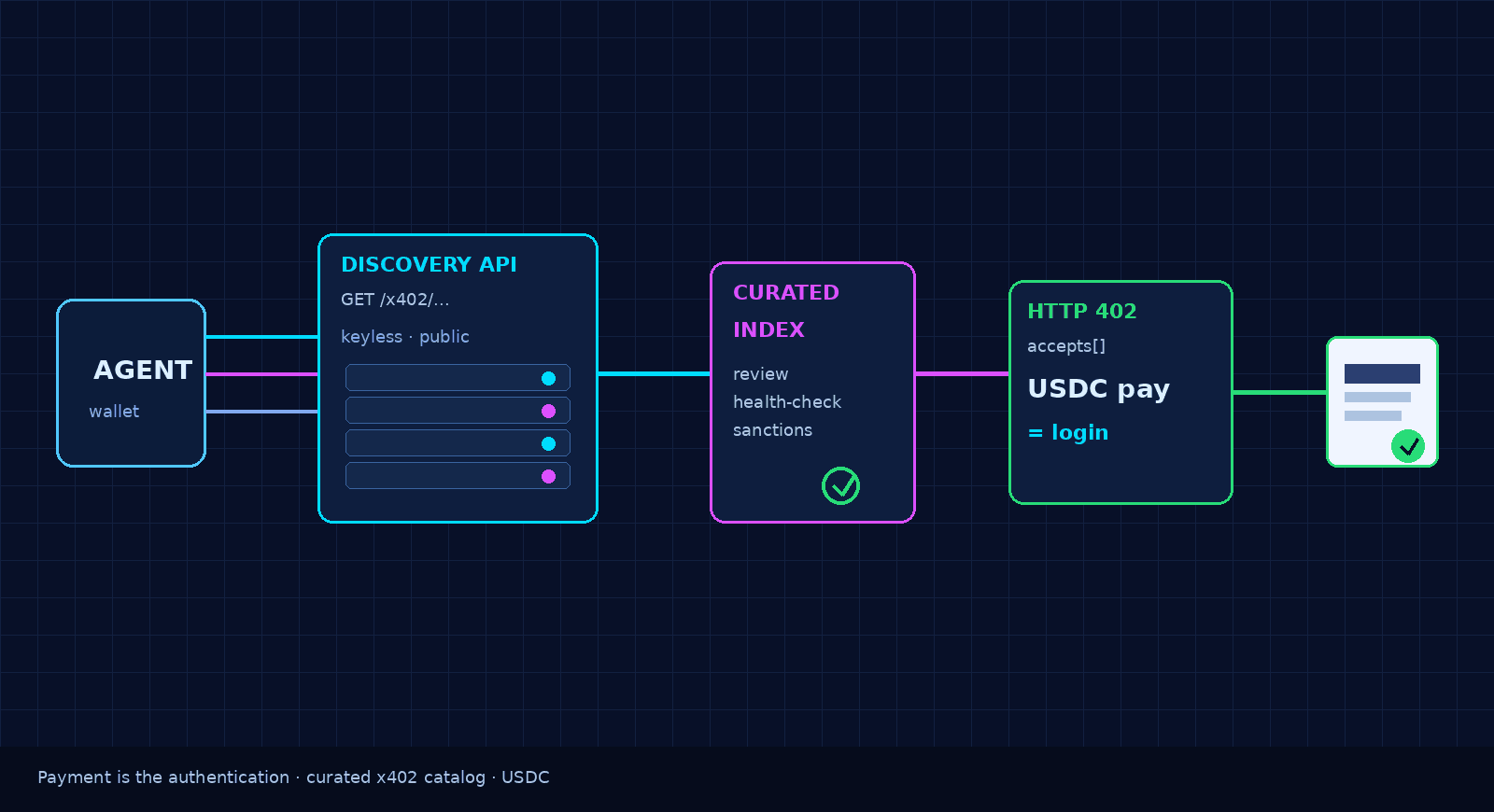
x402, an open protocol that originated at Coinbase, puts HTTP 402 back to work. An agent calls a service with no payment. The service answers 402 Payment Required and attaches an accepts list: which token, on which chain, how much, and which address to pay. The agent signs a USDC payment, retries with the proof attached, and the service returns the data after settlement. Coinbase’s own explainer is blunt about the middleman: a facilitator verifies the payload and settles it.
Circle’s Discovery API does not replace that handshake. It publishes a phone book for it.
GET https://api.circle.com/v2/x402/discovery/resources needs no API key and no Circle account. Each listing carries the accepts block plus JSON Schema for the request, so a wallet or agent can construct the call without reading human docs. Circles own example is a CoinGecko price wrapper on Base: 8000 atomic units of USDC, which is $0.008.
Two rails sit behind the same catalog. Vanilla x402 is a signed onchain USDC transfer that any USDC wallet, including a custodial one, can produce. Circle Gateway is offchain, batched settlement for gasless nanopayments — Circle’s May launch said transfers as small as $0.000001. Each listing flags which rail it takes. Payment is the authentication. There is no subscription and no API key for the buyer.
The marketplace itself is older than this week’s post. Circle launched Agent Stack on 11 May (CLI, policy-controlled Agent Wallets, the marketplace, and Gateway nanopayments). Release notes put the curated catalog and the public Discovery endpoint in July. 9 September is the moment Circle told builders the whole catalog was one call away.
Circle’s docs still say “600+ live services across 15+ blockchain networks.” The OpenAPI example on the same docs site shows a pagination.total of 636. A live query of the public endpoint on 12 September 2026 at 17:52 UTC returned x402 v2 and pagination.total of 1,139.
That is a catalog count, not volume, not unique buyers, and not proof that agents are paying. It is the number of listings Circle’s index was willing to return at that moment. Listings are curated and continuously health-checked; unreachable endpoints are dropped. So the total can move without anyone shipping a new product.
The first page of that response advertised payment options on Base (eip155:8453), Ethereum, Polygon, Arbitrum, Optimism, Avalanche, Solana, and several other EVM networks. Categories in the schema are fixed: social intelligence, financial analysis, web search, prediction-market data, creative generation, and infrastructure. We are not treating those labels as a usage breakdown. We did not get clean per-category totals before the endpoint rate-limited a follow-up sweep.
Circle’s May product post cited x402 volume of $24.24 million in the 30 days to 29 April, 99.8% of it USDC, attributed to x402 and Artemis. That figure is four months old. It is an early-rail signal, not a current market size.
Discovery is the difference between a payable endpoint that exists and one an agent can find. The design choice that matters is who is allowed to be in the book.
Circle is explicit. Sellers submit for review. Approved listings appear in the catalog and the API. Each seller payout wallet is continuously sanctions-screened; blocked sellers drop out. Buyers inherit that watchlist. That is a compliance product, not a neutral crawl of the open x402 set.
Gateway adds a second trust surface. Vanilla x402 still settles onchain, usually through a facilitator. Gateway batches offchain. An agent paying through Gateway is trusting Circle’s settlement path as well as the seller. Policy-controlled Agent Wallets — time-bound USDC limits, allowlists, blocklists are the intended brake. They are also a reminder that “autonomous” here means autonomous inside a human-set envelope.
The catalog will also index things most newsrooms will want to over-read. Prediction-market data is a first-class category. Commodity web utilities sit next to market-data APIs. None of that makes this a token story, and none of it makes the index a measure of agent GDP.
The useful test is not how many listings Circle can display. It is whether an agent can complete find, price, pay, and receive against a service that still exists an hour later, on a rail the operator actually intended, without the curator silently rewriting the set.
CryptoWeekly will update the listing count if the public total moves in a way that changes the story.
GET https://api.circle.com/v2/x402/discovery/resources?limit=1 on 12 September 2026 at 17:52 UTC (x402Version 2, pagination.total 1139)Subscribe to stay informed and receive latest updates on the latest happenings in the crypto world!
Subscribe to stay informed and receive latest updates on the latest happenings in the crypto world!
 Bitcoin(BTC)$77,127.00-0.06%
 Ethereum(ETH)$2,520.81-0.93%
 Tether(USDT)$1.000.01%
 BNB(BNB)$727.840.55%
 XRP(XRP)$1.360.88%
 USDC(USDC)$1.000.01%
 Solana(SOL)$101.590.38%
 TRON(TRX)$0.3398041.00%
 Figure Heloc(FIGR_HELOC)$1.00-2.71%
 Zcash(ZEC)$1,126.39-2.62%
 Hyperliquid(HYPE)$79.94-0.22%
 Dogecoin(DOGE)$0.0847250.77%
 Rain(RAIN)$0.015628-0.05%
 Monero(XMR)$534.223.50%
 USDS(USDS)$1.000.02%
 WhiteBIT Coin(WBT)$80.18-0.24%
 Chainlink(LINK)$11.52-0.42%
 LEO Token(LEO)$9.11-0.54%
 Cardano(ADA)$0.2073811.37%
 Stellar(XLM)$0.1803081.28%
 Ethena USDe(USDE)$1.000.01%
 Dai(DAI)$1.00-0.01%
 Bitcoin Cash(BCH)$227.03-0.04%
 USD1(USD1)$1.000.00%
 Litecoin(LTC)$53.741.07%
 Uniswap(UNI)$6.314.28%
 Gram (prev. Toncoin)(GRAM)$1.381.88%
 Canton(CC)$0.096831-1.51%
 Global Dollar(USDG)$1.000.00%
 Hedera(HBAR)$0.0746630.58%
 Avalanche(AVAX)$7.38-0.92%
 Shiba Inu(SHIB)$0.0000052.77%
 NEAR Protocol(NEAR)$2.35-6.82%
 Sui(SUI)$0.72-0.29%
 Cronos(CRO)$0.0584164.02%
 PayPal USD(PYUSD)$1.000.00%
 BlackRock USD Institutional Digital Liquidity Fund(BUIDL)$1.000.00%
 MemeCore(M)$1.180.44%
 Tether Gold(XAUT)$4,350.120.00%
 Circle USYC(USYC)$1.140.00%
 Ripple USD(RLUSD)$1.000.01%
 OKB(OKB)$113.350.21%
 Bittensor(TAO)$232.07-0.85%
 Ondo US Dollar Yield(USDY)$1.140.14%
 Aave(AAVE)$126.371.91%
 PAX Gold(PAXG)$4,355.360.03%
 Mantle(MNT)$0.57-2.69%
 Aster(ASTER)$0.691.40%
 World Liberty Financial(WLFI)$0.0574667.71%
 Polkadot(DOT)$1.03-1.82%