Kazakhstan launches its first national stablecoin, Evo (KZTE), pegged to the tenge.
Issued by Intebix and Eurasian Bank with the support of Solana and Mastercard.
Evo stablecoin is live in the National Bank’s Digital Assets Regulatory Sandbox.
Use cases include crypto-fiat exchange, payments via Mastercard, and digital card integration.
Kazakhstan continues to advance its digital asset agenda, including a CBDC and national crypto reserve
The National Bank of Kazakhstan (NBK) announced the launch of the Evo stablecoin (KZTE) as part of its Digital Assets Regulatory Sandbox program.
The pilot initiative is designed to explore real-world applications of stablecoins within a compliant, controlled environment.
The Evo stablecoin is issued by Intebix, a Kazakhstan-based cryptocurrency exchange, in partnership with Eurasian Bank. The project is being implemented with strategic support from Solana, which provides the blockchain infrastructure, and Mastercard, which aims to connect KZTE with global payment systems and stablecoin issuers.
Talgat Dossanov, founder of Intebix, said:
“This is the first instance of a central bank playing an active role in supporting the issuance and regulation of a stablecoin.”
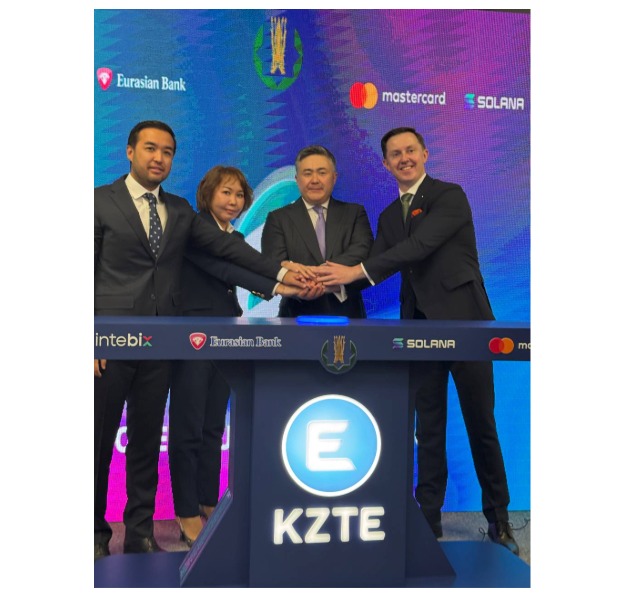
(From Left To Right) Intebix Founder Talgat Dossanov, Eurasian Bank CEO Lyazzat Satiyeva, National Bank Governor Timur Suleimenov, Mastercard CIS Executive Rafal Trepka
Source: Solana Superteam
Designed as a “national stablecoin,” Evo serves as a bridge between the world of cryptocurrency and traditional finance (TradFi). The stablecoin supports a range of use cases including:
Facilitating crypto-to-fiat conversions
Enabling stablecoin-backed payments through Mastercard’s global network
Supporting crypto card transactions
Enhancing the digital payment infrastructure within Kazakhstan
The project reflects the NBK’s broader strategy to build a robust digital asset ecosystem, one that supports innovation, regulatory clarity, and international collaboration.
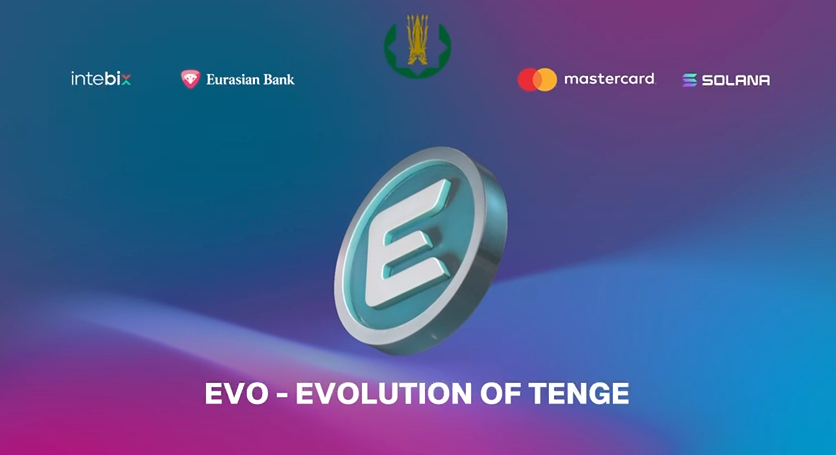
Promotional Image Of The Evo Stablecoin
Source: Intebix
Timur Suleimenov, Governor of the National Bank, said:
“Digital assets and blockchain are critical to improving financial services and increasing financial inclusion in Kazakhstan.”
The use of the Solana blockchain ensures that the Evo stablecoin benefits from high-speed, low-cost transactions, essential for real-world financial use cases. Solana’s involvement also signals growing blockchain adoption in state-level fintech projects.
Meanwhile, Mastercard’s role in the project ensures that KZTE is not limited to domestic use. The payments giant is actively working to integrate the Evo stablecoin into its global network, allowing seamless interactions with other regulated stablecoins worldwide.
While the Evo stablecoin is not directly issued by the government, the National Bank of Kazakhstan plays a key role by providing a regulatory framework that allows the testing and deployment of KZTE.
This cooperation between regulators and innovators is seen as a model for other emerging markets. The Evo launch also follows a series of digital finance initiatives in Kazakhstan:
The launch of the digital tenge CBDC in November 2023
Authorization of USD-pegged stablecoins like Tether (USDT) for regulatory fee payments
Ongoing development of a national crypto reserve by 2026
With these moves, Kazakhstan is positioning itself as a regional leader in digital finance and blockchain adoption.
The Evo stablecoin (KZTE) is a digital asset pegged to Kazakhstan’s national currency, the tenge. It is designed to bridge cryptocurrency and traditional financial systems.
Evo is issued by Intebix and Eurasian Bank, with support from Solana (blockchain infrastructure) and Mastercard (payment integration). It operates within the National Bank of Kazakhstan’s regulatory sandbox.
No, Evo is not a CBDC. It is a private stablecoin regulated and tested under government oversight, while Kazakhstan’s CBDC is the digital tenge, launched separately in 2023.
Evo stablecoin can be used for crypto-to-fiat conversions, cross-border payments, crypto card transactions, and merchant payments, among other financial services.
Unlike global stablecoins like Tether (USDT) which are pegged to the U.S. dollar, Evo is pegged to the tenge and is regulated within Kazakhstan, making it more suitable for domestic financial integration.