JPMorgan forecasts Stripe could access a $350 billion market by 2030 through AI and crypto.
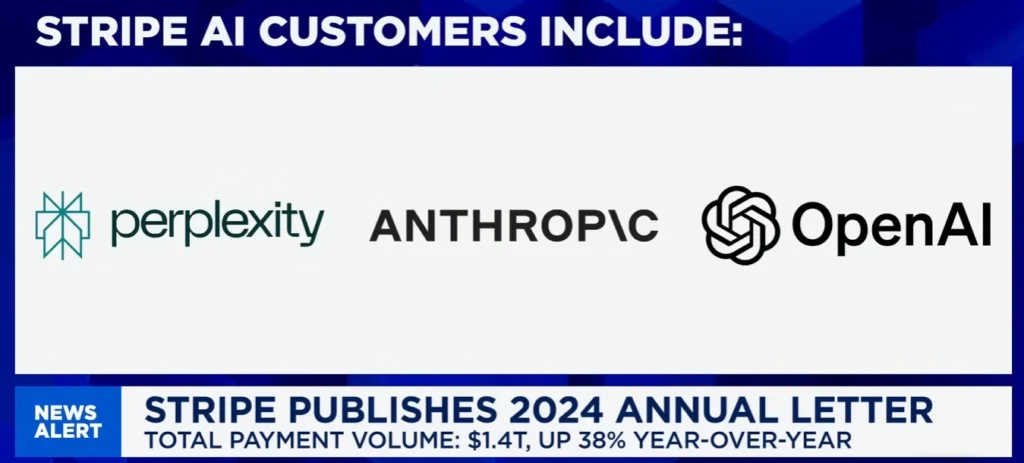
Stripe processed $1.4 trillion in 2024, representing 1.3% of global GDP.
Investments in Tempo blockchain and AI startups position Stripe as a fintech infrastructure leader.
Visa, JPMorgan, and others are pushing into the same AI-crypto frontier.
MiCA rules and U.S. stablecoin policies remain major wildcards for Stripe’s global expansion.
JPMorgan analysts believe Stripe’s fintech fortune could soar to new heights as the company positions itself at the intersection of AI-driven commerce and digital payments.
In a recent report, the bank projected that Stripe could tap into a $350 billion market by 2030, fueled by its aggressive moves in artificial intelligence and cryptocurrency infrastructure.
The research highlights Stripe’s rapid expansion across digital finance. In 2024, the payments giant processed an estimated $1.4 trillion in transactions, roughly 1.3% of global GDP, and became profitable, generating $5.1 billion in net revenue, a 28% year-over-year increase.
With more than 1.35 million websites using its platform globally, Stripe’s latest private valuation sits near $91.5 billion as of early 2025.
Source: CNBC
According to JPMorgan, two simultaneous financial revolutions, AI-powered commerce and digital money, are converging. Stripe, with its deep integrations across both, stands to gain the most.
The report calls this shift a “twin revolution in intelligence and money movement,” driven by agentic commerce (AI systems making autonomous purchasing decisions) and programmable money (crypto-enabled transactions).
By combining these forces, Stripe could leverage its existing network to dominate a market expected to grow into the hundreds of billions by the end of the decade. JPMorgan analysts argue that Stripe’s early partnerships with AI startups give it a structural advantage over traditional financial players.
Stripe’s fintech fortune is being built on an ambitious blockchain strategy. In 2025, the company acquired Bridge, a stablecoin infrastructure provider, and Privy, a crypto wallet firm.
Most notably, Stripe launched Tempo, a new Layer-1 blockchain purpose-built for payments. Developed with backing from Paradigm, Tempo raised $500 million at a $5 billion valuation and is designed as an Ethereum-compatible network optimized for real-world financial transactions.
CEO Patrick Collison said:
“This initiative can best be described as The payments-oriented blockchain for practical finance. We intend to make crypto usable, not speculative.”
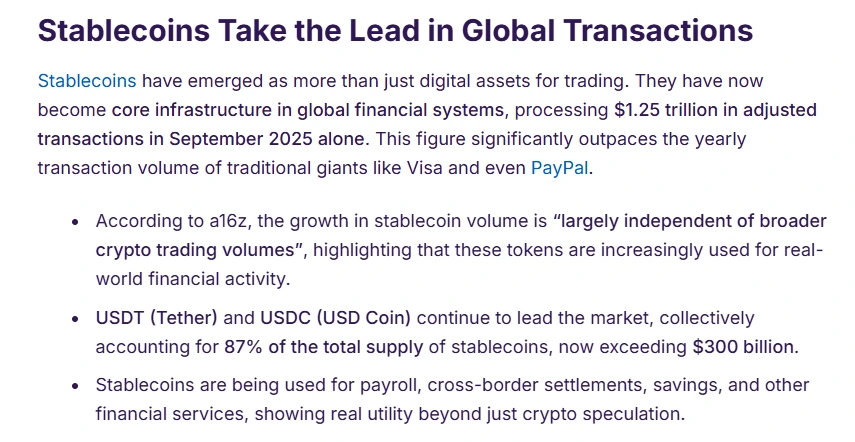
With stablecoins now processing over $46 trillion annually, surpassing Visa’s transaction volume, Stripe’s blockchain expansion positions it to capture a significant share of programmable money flows in global trade.
Stripe’s involvement in AI goes beyond buzzwords. The company recently led a $50 million round for Precedent AI, a legal-tech firm using natural language processing to automate financial contracts.
Beyond investing, Stripe also powers payments for hundreds of AI startups, embedding itself into the new digital economy. As AI agents begin conducting autonomous transactions, Stripe’s existing tools and APIs could become the foundation of this next-generation “agentic economy.”
JPMorgan’s report emphasizes that this dual play, combining AI-driven purchasing with crypto-native payment rails, gives Stripe a unique edge as commerce becomes increasingly intelligent and borderless.
While Stripe remains private, public peers like Visa and JPMorgan are watching closely. Visa’s stock trades near $345, up roughly 10% year-to-date, partly thanks to its own crypto and AI initiatives, including stablecoin remittances and AI shopping bots.
Industry data from Andreessen Horowitz shows that stablecoin transactions now exceed Visa’s annual network volume, signaling a fundamental realignment in how value moves online.
Source: SQ Magazine
Analysts maintain bullish targets for major payment networks, expecting both incumbents and disruptors like Stripe to benefit from fintech’s rapid evolution.
Despite JPMorgan’s optimism, analysts warn that regulatory uncertainty could slow progress. The EU’s MiCA framework and U.S. stablecoin oversight remain unresolved, potentially creating friction for cross-border payments and crypto compliance.
However, Stripe’s blend of scale, profitability, and technical innovation could allow it to navigate these challenges better than most. Its early moves in AI and blockchain suggest it’s not just adapting to financial transformation, it’s helping lead it.
It’s based on the expected convergence of AI-driven commerce and blockchain-based payments, areas where Stripe is investing heavily.
Tempo is Stripe’s new Layer-1 blockchain designed for fast, real-world payments using stablecoins and programmable money.
Stripe is funding and integrating AI tools for commerce automation, legal contract analysis, and autonomous purchasing systems.
Reports suggest Stripe has filed confidential IPO paperwork for a potential 2025 listing, though no official date has been announced.