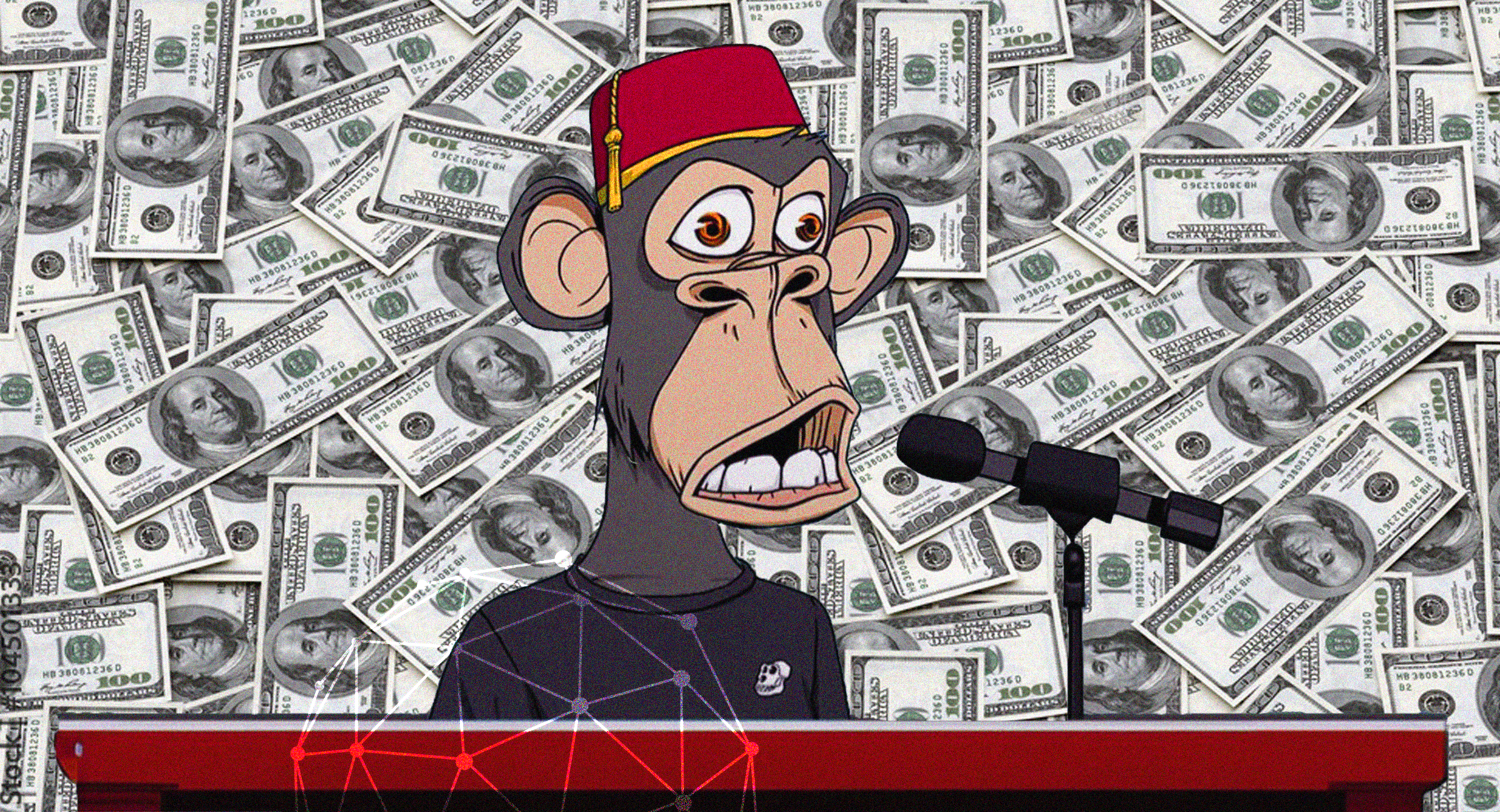
In 2022, Yuga Labs, the company behind the iconic Bored Ape Yacht Club (BAYC) NFT collection, filed a lawsuit against Ryder Ripps and Jeremy Cahen.
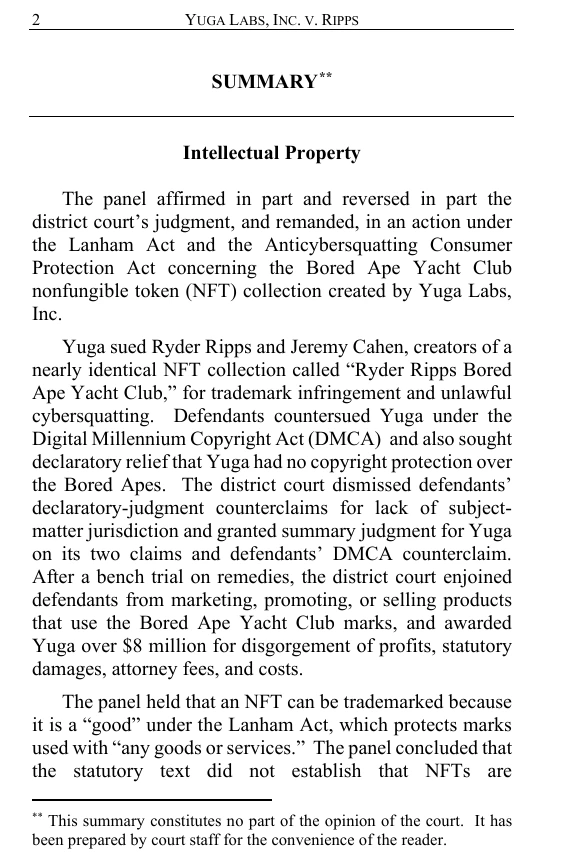
Executive Summary Of The Lawsuit
Source: uscourts.gov
Yuga Labs claimed that their NFT project, titled “Ryder Ripps Bored Ape Yacht Club,” was a direct copy or counterfeit of Yuga’s original BAYC collection. Yuga Labs alleged that this collection infringed on its trademarks and created confusion among consumers.
Ripps, however, argued that his project was intended as a form of satire criticizing what he described as racist imagery used by Yuga Labs in their NFTs. He maintained that his work was a form of expressive speech protected under the First Amendment.
On Wednesday, the US Ninth Circuit Court of Appeals issued a landmark ruling reversing the $9 million judgment initially granted to Yuga Labs. The three-judge panel concluded that Yuga Labs had not sufficiently proven that Ripps and Cahen’s NFT collection was “likely to cause consumer confusion.”
Source: X (@CryptoGarga)
The court sent the case back to the California federal district court for a full trial to examine Yuga’s claims of trademark infringement and cybersquatting more thoroughly.
This decision means that while the initial monetary award was overturned, the core legal dispute has not been resolved and will proceed to trial.
Despite the reversal, the court made an important ruling affirming that NFTs can be considered “goods” under US trademark law. This means NFT projects like Bored Ape Yacht Club may have stronger grounds to protect their intellectual property rights in the future, setting a legal precedent for the NFT industry.
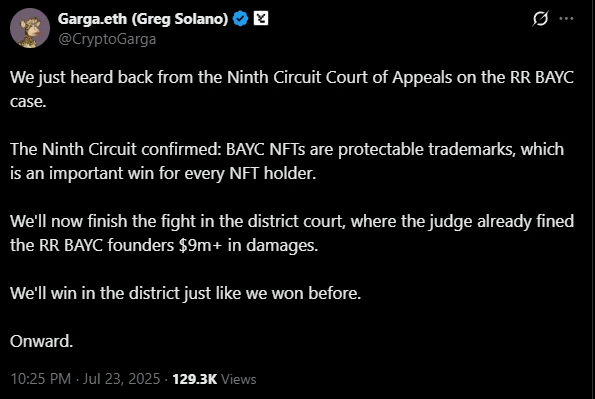
Greg Solano, co-founder of Yuga Labs, acknowledged the ruling on social media platform X (formerly Twitter), stating, “We’ll now finish the fight in the district court.”
He also hailed the decision confirming that Bored Ape NFTs are protectable trademarks, which is an important win for every NFT holder.
Earlier in 2023, a federal court sided with Yuga Labs, finding that Ripps and Cahen’s NFTs were likely to cause market confusion with the original BAYC collection. Initially, the court awarded Yuga Labs $1.6 million in damages, which later escalated to $9 million after the defendants lost a counterclaim.
However, the Ninth Circuit Court disagreed with this conclusion, noting that the previous ruling did not prove as a matter of law that Ripps and Cahen’s NFTs were likely to confuse consumers.
The appellate judges emphasized that a trial is necessary to examine the trademark claims more thoroughly.
Interestingly, the court upheld the lower court’s view that Ripps and Cahen’s use of Yuga Labs’ trademarks did not qualify as nominative fair use nor as expressive work protected under the First Amendment.
This suggests that although Ripps claimed his project was a satirical critique, it may not receive protection on these grounds in this legal context.
The case will now return to the federal district court, where a trial will determine whether Ripps and Cahen’s NFT collection infringes on Yuga Labs’ trademarks or constitutes cybersquatting.
In any case, this trial will be closely watched by the NFT community, artists, and intellectual property experts, as it could have wide-reaching implications for how NFTs are treated under trademark law.
The $9 million judgment was awarded to Yuga Labs for alleged trademark infringement and damages caused by Ryder Ripps and Jeremy Cahen’s NFT collection, which Yuga Labs claimed was a direct copy of their Bored Ape Yacht Club NFTs.
The Ninth Circuit Court found that Yuga Labs had not sufficiently demonstrated that the defendants’ NFTs were likely to cause consumer confusion, which is a key element in trademark infringement cases.
The ruling establishes that NFTs are legally considered “goods” under US trademark law, which could empower NFT creators to protect their brands and collections more effectively in future legal disputes.
No, the court ruled that the defendants’ use of Yuga’s trademarks was not protected as expressive work or nominative fair use under the First Amendment in this case.
The case is being sent back to a lower federal court for a full trial on Yuga Labs’ claims of trademark infringement and cybersquatting.