Key Takeaways
- Meta’s AI gamble involves $72 billion in projected capital expenditure for 2025, mostly to support AI development.
- The company launched Meta Superintelligence Labs, attracting top AI talent and building vast infrastructure.
- Meta’s AI tools are already embedded in its platforms, with over 1.5 billion users interacting with them.
- The initiative represents a major shift away from the metaverse toward a vision of personalized AI assistants.
- Public reaction is cautiously optimistic, with concerns about whether this gamble will pay off or repeat past missteps.
Inside Meta’s $72 Billion Bet On AI
During its Q2 2025 earnings call, Meta CEO Mark Zuckerberg confirmed what many had already suspected: Meta’s AI gamble is massive, risky, and meant to reshape how humans interact with technology.

Source: X (@AIatMeta)
With $17 billion spent in Q2 alone and projections of $72 billion in total capital expenditures this year, Meta is betting big, arguably bigger than any other tech firm, on what it calls “personal superintelligence.”
The Pivot to Superintelligence
Zuckerberg’s Vision: AI That Understands You
In his earnings call, Zuckerberg emphasized that Meta is no longer just about connecting people through social networks or immersive VR experiences. Instead, it’s about building AI that understands individuals deeply, an assistant, a coach, a collaborator.
Meta’s new AI division, Meta Superintelligence Labs, was quietly launched in June 2025. The company has been actively recruiting top talent, acquiring startups, and investing in infrastructure to support next-gen AI training.
Prometheus & Hyperion: Titan Clusters Of AI
To support this ambition, Meta is building massive data clusters named Prometheus and Hyperion, after figures from Greek mythology.
Prometheus is expected to be the world’s first 1GW+ compute cluster, coming online in 2026, while Hyperion is designed to scale up to 5GW over the next several years.
This hardware push reflects Meta’s intent to become a hardware-software powerhouse in the AI race.
Talent Wars: Meta Poaches The Best In AI
Assembling A Dream Team Of Researchers
Meta’s new lab has already made headlines for its aggressive hiring strategy. Key figures include:
- Alexandr Wang – Founder of Scale AI
- Nat Friedman – Former CEO of GitHub
- Shengjia Zhao – Former OpenAI researcher
These hires suggest that Meta is not just playing catch-up, it’s looking to leapfrog competitors like OpenAI, Google DeepMind, and xAI.
Reaching 1.5 Billion Users, Quietly
While much of the attention has been on back-end development, Meta AI is already deeply embedded across its product suite:
- Instagram and WhatsApp now include AI-driven assistants.
- The Meta app features chatbots and content recommendations powered by Llama models.
- Even Ray-Ban Meta smart glasses come equipped with voice-activated AI.
In July 2025, Meta launched a standalone Meta AI app, bringing its generative models to new users beyond Facebook or Instagram. The strategy is clear: embed AI into every user interaction.
Public Reaction: Hope, Skepticism, & Memes
Is This The New Metaverse?
Reactions on social media have been mixed. Some see it as a historic leap, others as another high-stakes experiment akin to the metaverse investment that fizzled out.
Critics question whether Meta’s massive investment will yield genuinely useful breakthroughs or simply boost engagement metrics under the guise of innovation.
“Superintelligence Should Be Shared With the World”
In a blog post released the same day as the earnings call, Zuckerberg offered a broader vision:
“We believe the benefits of superintelligence should be shared with the world as broadly as possible.”
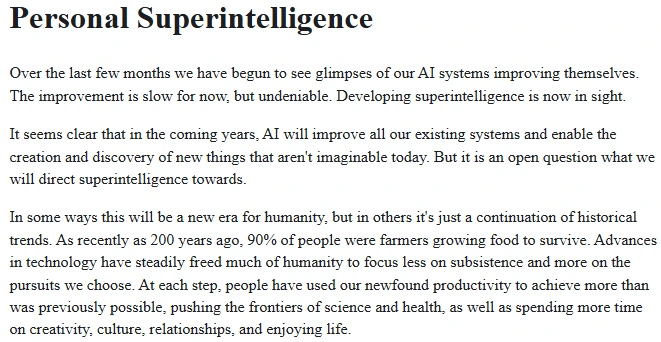
Mark’s Comments On Meta Shifting Its Focus To Superintelligence
Source: www.meta.com
Yet he also acknowledged the potential dangers:
“We’ll need to be rigorous about mitigating these risks and careful about what we choose to open source.”
His closing message: build a freer society by empowering individuals through powerful, personalized AI tools.
FAQ
What is Meta’s Superintelligence Labs?
It’s a new internal division focused on developing next-gen AI models and infrastructure, including multi-gigawatt compute clusters.
How much is Meta spending on AI?
Meta is on track to spend $72 billion in 2025 on infrastructure, much of which supports AI development.
What are Prometheus and Hyperion?
These are massive AI training clusters currently in development, designed to support next-gen Llama models and broader AI systems.
Is this another metaverse situation?
That remains to be seen. While Meta’s metaverse pivot didn’t yield the impact it promised, AI adoption is more immediate and already reaching billions of users.