Ethereum transaction volumes have reached its highest level in over a year.
Over 36 million ETH is now staked, around 30% of total supply.
Liquid staking is gaining popularity despite regulatory ambiguity.
The SEC’s new statement has been both praised and criticized by its own commissioners.
Global regulatory frameworks for DeFi remain in development, with major decisions pending in both the U.S. and EU.
According to Dune Analytics, over 36 million ETH is now staked on the Ethereum network, representing nearly 30% of the total supply.
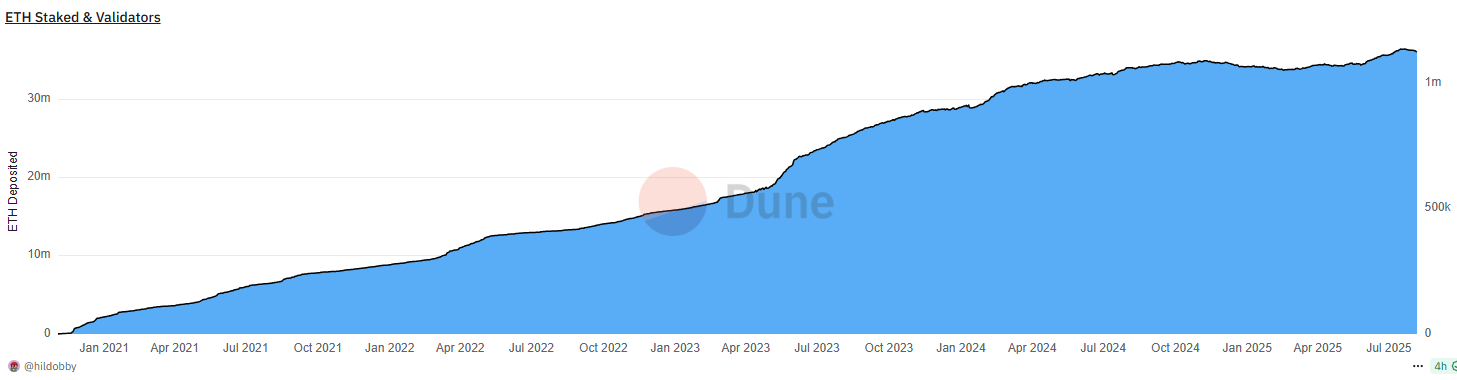
ETH Staked & Validators Since November 2020
Source: Dune
This significant volume of staked Ether correlates with a rise in overall Ethereum transaction volume, as more users interact with staking protocols and related DeFi applications.
The recent spike also coincides with fresh commentary from the U.S. Securities and Exchange Commission (SEC) regarding the legality of liquid staking tokens (LSTs).
One of the primary contributors to Ethereum’s rising transaction volume is the explosive growth in staking.
In just the first half of June, over 500,000 ETH, worth nearly $1.8 billion, was staked, indicating a clear uptick in user engagement despite regulatory uncertainty.
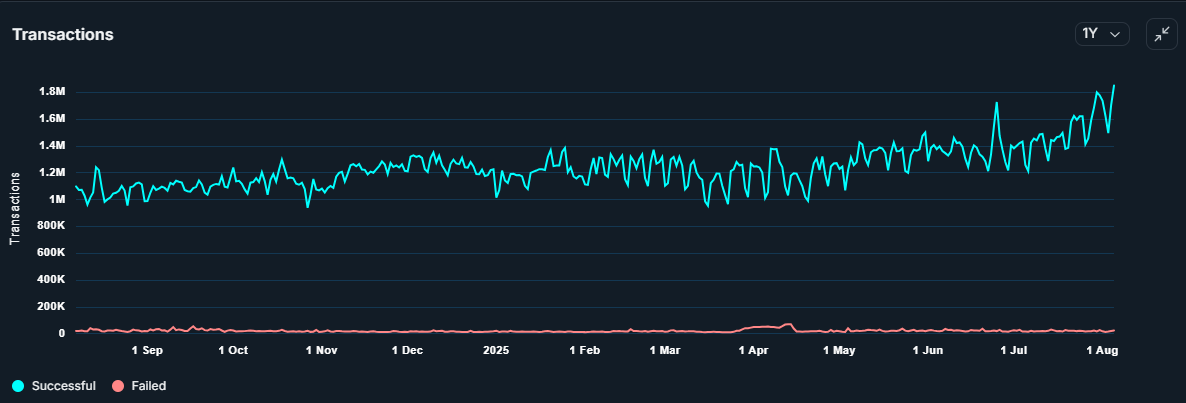
Ethereum Network Transactions Over The Last Year
Source: Nansen
Liquid staking allows users to stake their ETH and receive a token in return that represents the staked asset.
These staking receipt tokens can then be used across DeFi platforms while still earning rewards from the underlying staked ETH.
This innovation offers flexibility and additional yield opportunities, contributing to higher Ethereum transaction volumes as users actively trade, lend, or invest these tokens across the network.
On August 6th, the SEC’s Division of Corporation Finance released a statement clarifying that certain liquid staking activities do not constitute the offer or sale of securities, provided specific conditions are met.
In essence, if a protocol issues LSTs that are not investment contracts, they may not need SEC registration. This could pave the way for increased institutional adoption and mainstream DeFi use.
However, SEC Commissioner Caroline Crenshaw expressed strong disagreement with the statement. She criticized it for relying on a “wobbly wall of facts,” suggesting that it doesn’t reflect the realities of today’s staking environments.
Crenshaw warned that any deviation from the many assumptions listed in the SEC’s guidance could render the exemption invalid, leaving some DeFi projects in legal limbo.
Not all commissioners shared Crenshaw’s skepticism. SEC Commissioner Hester Peirce, often nicknamed “Crypto Mom,” welcomed the statement, viewing it as a step toward regulatory clarity.
She noted that liquid staking activities tied to protocol-level staking should not be considered securities.
Former SEC Chairman Paul Atkins echoed this sentiment, calling the update a “significant step forward.”
Despite the controversy, Ethereum is proving resilient. The blockchain has witnessed:
A continued rise in staked ETH
Increased activity from long-term holders
Growth in addresses with no selling history, now holding 23 million ETH (roughly $82.6 billion)
All signs point to growing confidence in the Ethereum ecosystem, even as U.S. regulators deliberate over staking rules.
The SEC recently delayed its decision on Bitwise’s proposal to allow staking in its Ethereum exchange-traded fund (ETF), illustrating ongoing hesitancy.
Meanwhile, Europe’s Markets in Crypto-Assets (MiCA) regulation doesn’t yet address DeFi explicitly. However, sources indicate that DeFi will become a priority in the next round of legislation in 2026.
Ethereum transaction volume refers to the total number or value of transactions processed on the Ethereum blockchain over a given period. This includes transfers, smart contract interactions, staking, and more.
According to a recent SEC statement, some forms of liquid staking may not be considered securities if they don’t meet specific criteria. However, this view is not universally shared within the SEC, and the legal standing of LSTs remains partially uncertain.
These are tokens issued to users who stake ETH through a liquid staking protocol. They represent ownership of the staked asset and can be used in DeFi platforms.
As of August 2025, more than 36 million ETH is staked, representing around 30% of Ethereum’s total supply.