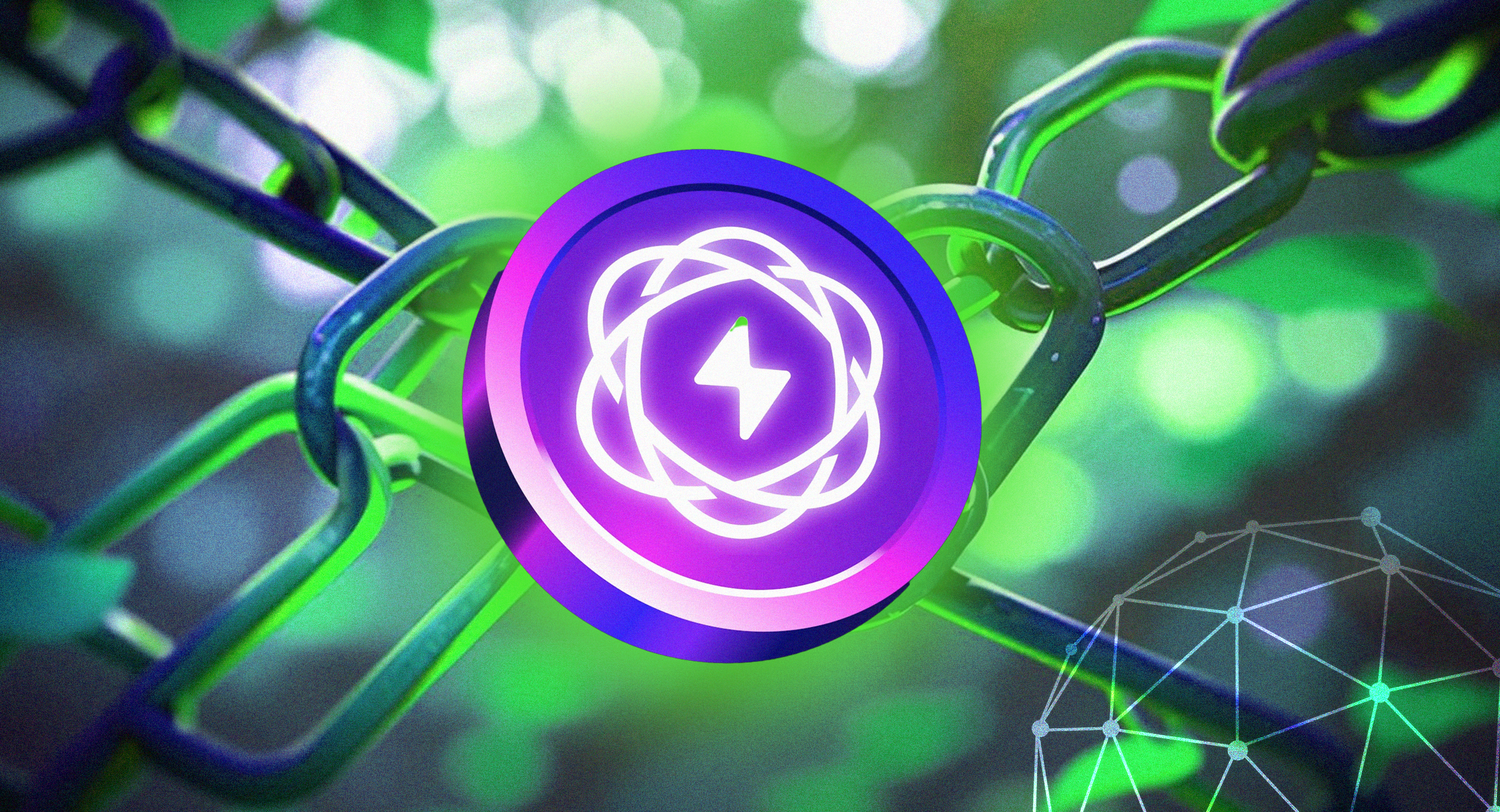
Lightchain AI planned to launch its mainnet in July 2025, introducing a new consensus mechanism, Proof-of-Intelligence. The launch has been delayed to Q4 2025.
It allows real AI computations (not wasteful mining) to validate blocks and rewards nodes for meaningful contributions.
The platform uses a proprietary Artificial Intelligence Virtual Machine (AIVM) to run AI models on-chain with support for common frameworks.
Privacy-first design using federated learning and zero-knowledge proofs enables safe use in regulated industries.
With real-time performance, developer tools, and broad use case potential, Lightchain AI is positioned to be a cornerstone of decentralized AI computing.
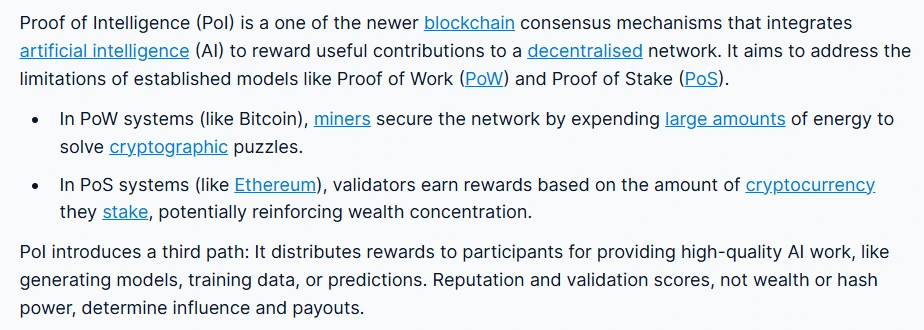
Traditional blockchains rely on mechanisms like Proof-of-Work (PoW) or Proof-of-Stake (PoS), which can be energy-intensive or favor the wealthy.
Lightchain AI flips the script with Proof-of-Intelligence (PoI), a consensus protocol that rewards useful AI computations rather than meaningless cryptographic puzzles.
Source: crypto.com
Nodes on the Lightchain AI network earn rewards for contributing to real AI workloads such as:
Model training
Inference tasks
Data analysis
This novel approach turns blockchain mining into a purpose-driven AI compute engine, making it energy-efficient and highly applicable across industries.
At the heart of the platform lies the Artificial Intelligence Virtual Machine (AIVM), a specialized runtime for AI tasks. The AIVM allows developers to run machine learning models on-chain using familiar tools like:
TensorFlow
PyTorch
ONNX
By integrating popular frameworks, Lightchain AI lowers the barrier to entry for developers while ensuring full decentralization of AI processing.
Current AI systems often rely on centralized cloud platforms, which come with drawbacks such as:
High operational costs
Data vulnerability
Lack of transparency
Lightchain AI provides a decentralized alternative where computations are:
Secure
Transparent
Privacy-preserving
This is particularly valuable in sensitive industries such as healthcare, finance, and logistics, where data security is non-negotiable.
To support secure machine learning, Lightchain AI incorporates advanced techniques like:
Federated Learning
Homomorphic Encryption
These technologies ensure that models can learn from sensitive data without exposing it, making Lightchain AI ideal for regulated environments.
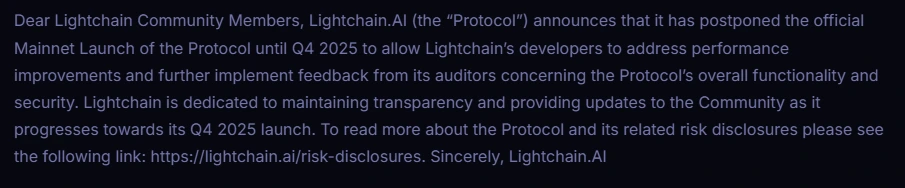
As per Lightchain AI’s official website, the decision was recently made to delay the mainnet launch which was originally scheduled for July of this year.
Source: Lightchain AI
The launch is now scheduled for Q4 2025.
Lightchain AI enables hospitals and research institutions to deploy diagnostic models without ever exposing raw patient data. This aligns with compliance standards and enhances trust in AI-powered healthcare.
By executing fraud detection or risk modeling directly on-chain, financial firms can reduce reliance on third-party infrastructure and ensure tamper-evident audit trails.
Tasks like demand forecasting and route optimization can be run securely and transparently across distributed participants, ensuring full traceability and data integrity.
Future developments will support DeFi integration, cross-chain AI execution, and tools for launching AI-governed community tokens, expanding Lightchain AI’s use cases further.
To ease onboarding, Lightchain AI offers:
Open-source SDKs
RESTful APIs
Community-driven documentation
In addition, developers can participate in technical grants, governance proposals, and bug bounty programs, ensuring a vibrant and secure ecosystem.
Lightchain AI’s architecture supports:
Parallel execution
Dynamic scaling
Response times under 300ms
This performance makes it suitable for real-time use cases such as adaptive content delivery or instantaneous fraud detection.
Lightchain AI is a Layer-1 blockchain platform purpose-built for decentralized AI workloads, offering privacy, efficiency, and transparency.
Instead of traditional mining, Proof-of-Intelligence rewards nodes for completing valuable AI tasks like training and inference.
Lightchain AI’s AIVM is compatible with major AI tools, including TensorFlow, PyTorch, and ONNX.
Yes. Its use of privacy-preserving techniques makes it well-suited for sensitive sectors like healthcare and finance.
Absolutely. It provides SDKs, API access, grants, and community governance for open development.