PYUSD stablecoin is now available on eight new blockchains, including Tron, Avalanche, and Stellar.
The expansion uses LayerZero’s Stargate Hydra bridge to create a permissionless and interoperable version called PYUSD0.
This move significantly enhances cross-chain functionality and positions PYUSD as a competitive force in the stablecoin market.
Despite these advancements, PYUSD still lags behind USDT and USDC in adoption and market share.
The move aligns with broader market trends and recent pro-stablecoin regulations in the U.S.
PayPal recently announced the rollout of a permissionless version of its PYUSD stablecoin on eight additional blockchain networks.
The move is made possible through an integration with LayerZero’s Stargate Hydra bridge, which will act as a conduit for seamless cross-chain transfers.
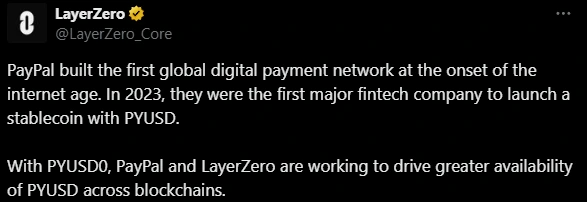
Source: X (@LayerZero_Core)
The new version, called PYUSD0, will be “fully fungible” with the original PYUSD and designed for cross-chain compatibility. The newly supported chains include:
Tron
Avalanche
Aptos
Abstract
Ink
Sei
Stable
Stellar (via a separate integration)
Additionally, existing permissionless versions on Berachain (BBYUSD) and Flow (USDF) will be upgraded to PYUSD0.
Stargate Hydra will serve as the user interface for transferring PYUSD0 across blockchains, enabling a frictionless, permissionless stablecoin experience.
LayerZero will handle the minting, burning, and deployment of PYUSD0 tokens across the various networks, eliminating reliance on centralized banking infrastructure.
Bryan Pellegrino, CEO of LayerZero Labs, said:
“Anyone who self-custodies their PYUSD can move it seamlessly between blockchains.”
The expansion comes at a time of rapid growth in the stablecoin market. In April 2025, the U.S. Treasury projected the market could balloon from $295 billion to $2 trillion by 2028.
Adding fuel to the momentum, President Trump signed the GENIUS Act in July 2025, widely regarded as the most comprehensive stablecoin legislation to date. This regulatory clarity is expected to benefit projects like PYUSD stablecoin.
Despite the expansion, PYUSD stablecoin still trails industry leaders Tether (USDT) and Circle’s USDC in terms of market cap and blockchain support.
Other major players include Ethena (USDE), USDS, and DAI, with market caps ranging from $13.9 billion to $4.5 billion.
On the same day as the LayerZero announcement, Stellar also began supporting PYUSD stablecoin.
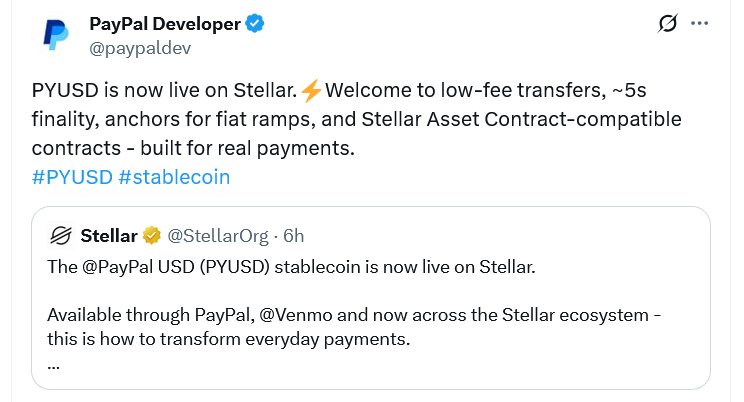
Source: X (@paypaldev)
Known for its low transaction fees and five-second finality, Stellar serves as a strategic addition, especially for users in developing economies who are looking for dollar-backed savings alternatives.
Launched in August 2023, PYUSD stablecoin was created by Paxos and marked PayPal’s first major step into the digital asset space.
With this recent expansion, PayPal is signaling its long-term commitment to building accessible, blockchain-based financial infrastructure.
PYUSD is a U.S. dollar-backed stablecoin issued by Paxos and launched by PayPal in 2023 to facilitate blockchain-based payments and transfers.
PYUSD0 is the permissionless version of PYUSD designed for use across multiple blockchains via LayerZero and Stargate Hydra. It is fully fungible with the original PYUSD.
PYUSD is supported on Ethereum, Solana, Arbitrum, Stellar, and now also on Tron, Avalanche, Aptos, Abstract, Ink, Sei, and Stable.
Yes. PYUSD is issued by Paxos, a regulated financial institution in the U.S., and benefits from increasing regulatory clarity following the GENIUS Act.
Yes, if you self-custody PYUSD, you can seamlessly move PYUSD0 across multiple chains without needing centralized financial institutions.