A comprehensive report from Rena Labs and Insider.Cash found 249 anomalies in MYX trading activity.
The likelihood of these being natural market movements is less than 0.001%.
Illiquidity spikes, trade frequency drops, and narrowing bid-ask spreads contradict expected trading behaviors.
A Sybil attack during the MYX airdrop may have allowed a single actor to exploit the network for $170 million.
MYX Finance has not issued a public statement on the matter.
Spokespersons from Rena Labs stated the likelihood of these anomalies happening simultaneously across four different market dimensions, illiquidity, volume spikes, price ratios, and trade intensity, was less than 0.001%, or one in 100,000.
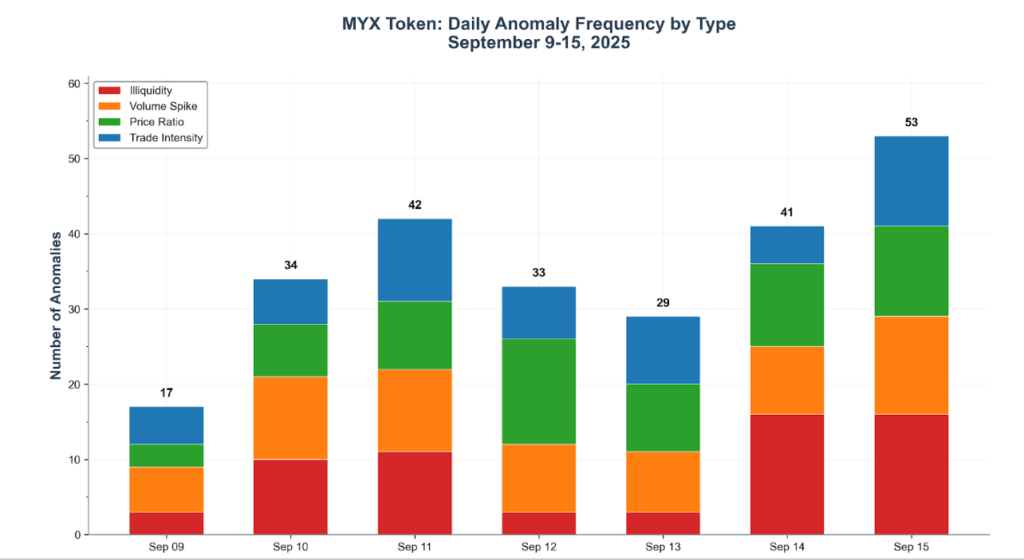
The Different Types Of Trading Anomalies Detected In Rena Labs’ Analysis
Source: Rena Labs
This makes the odds of such activity being organic effectively mathematically impossible. A spokesperson noted:
“This is not just unlikely. It’s statistically impossible without artificial interference.”
The MYX trading data showed a staggering 433% spike in liquidity anomalies on Sept. 9th.
A total of 32 separate illiquidity events were observed over two days, particularly concerning for a decentralized exchange that relies on consistent market activity.
Analysts say this could indicate either:
A mass coordinated manipulation campaign, or
The sudden exit of market makers, who are responsible for providing liquidity and maintaining market stability.
During periods of abnormal trading activity:
Average trade size dropped by 67%
Trade frequency fell by 45%, dropping from 157 trades per minute to just 86
Bid-ask spreads, which usually widen in illiquid conditions, narrowed unexpectedly to 8.2% on Monday from 15.8% on Sept. 9
These behaviors contradict typical market patterns. In normal circumstances, decreased liquidity causes spreads to widen, not shrink.
This paradox was considered a major red flag by the research team:
“The temporal synchronization of these extreme deviations across otherwise independent market microstructure metrics strongly suggests coordinated, multi-vector manipulation strategies, rather than organic trading activity driven by fundamental news or natural market forces.”
In a separate investigation, Bubblemaps raised the alarm over potential manipulation during the MYX token airdrop.
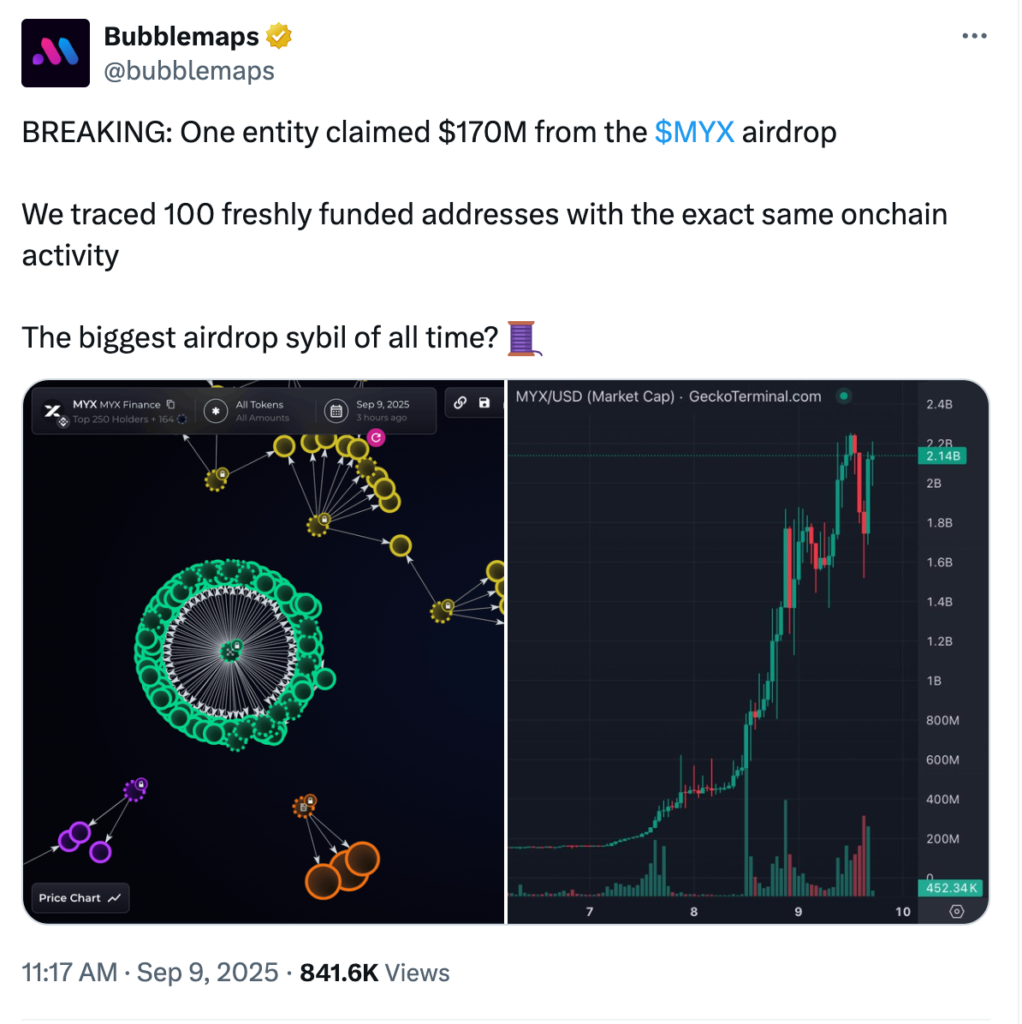
Source: X (@bubblemaps)
According to their findings:
A single entity controlled 100 newly funded wallets
These wallets claimed over 9.8 million MYX tokens
The attacker reportedly profited $170 million
This could be one of the largest Sybil attacks in crypto history, where one person or group creates multiple fake identities to manipulate a system, in this case, the airdrop.
MYX is the native token of the MYX decentralized exchange (DEX), used for trading, liquidity provision, and governance.
It means that, statistically, the trading patterns observed were almost certainly manipulated, rather than driven by real market demand or news.
A Sybil attack occurs when one entity creates multiple fake accounts to deceive a system, often to unfairly gain rewards or influence outcomes.
As of this writing, MYX Finance has not commented on the findings from Rena Labs, Insider.Cash, or Bubblemaps.