Fluorine Fermi update (v0.18.4.3) enhances Monero’s privacy by avoiding known malicious IP ranges.
Spy nodes pose a major threat by linking IP addresses to transactions.
The new update uses smarter peer selection to avoid surveillance subnets.
Tools like Dandelion++ and ban lists are additional defenses against network-level surveillance.
The Monero community remains committed to staying ahead in the ongoing privacy arms race.
The Fluorine Fermi update, or version 0.18.4.3 of Monero’s software, was rolled out with a strong recommendation from the development team.

The V0.18.4.3 Release Of Monero’s Software Is Designed To Combat Spy Nodes
Source: Monero
Announced via X, the update includes key privacy enhancements, improved reliability, and optimizations that make the Monero network more resistant to surveillance.
In particular, it focuses on how Monero nodes interact with each other, especially which peers they connect to, effectively reducing the chances of accidentally linking up with a spy node.
In Monero terminology, spy nodes refer to malicious or compromised nodes on the network that attempt to de-anonymize users. They do this by:
Monitoring connections between IP addresses and transaction broadcasts
Coordinating across large botnets or subnet ranges to triangulate user identities
Logging network metadata for external analysis
Spy nodes have been linked to attempts by blockchain analytics firms and state actors to trace privacy coin transactions—something Monero was designed to resist.
One of the central features of the Fluorine Fermi update is an upgraded peer selection algorithm. Previously, Monero nodes could inadvertently connect to clusters of malicious IP addresses.
Now, nodes actively avoid these high-risk subnets and instead prioritize connections to smaller, verified, and trusted peers.
Alongside its privacy upgrades, this version also introduces several reliability and performance improvements.
These changes are aimed at making the Monero client more stable under various operating conditions while reducing the load on trusted nodes.
The Monero community has long been aware of the risks posed by surveillance infrastructure and has developed multiple strategies to mitigate them.
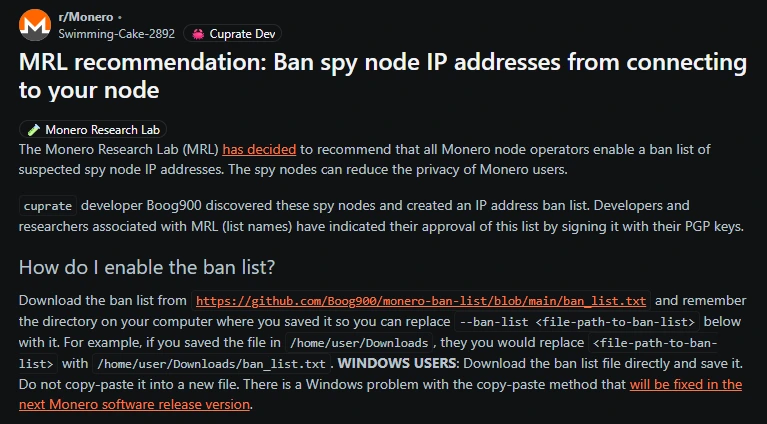
In late 2024, the Monero Research Lab proposed a strategy for node operators to maintain a ban list of known spy node IPs.
Source: Monero (Reddit)
The idea was to automatically reject incoming or outgoing connections from suspect IP addresses, limiting the spread and influence of surveillance nodes.
However, this tactic has limitations. Malicious actors can simply spin up new IP addresses or use rotating proxies to evade blacklists, making ban lists a cat-and-mouse game rather than a lasting solution.
Another key tool in Monero’s anti-surveillance toolkit is Dandelion++, a transaction propagation protocol designed to mask the origin of a transaction.
By routing transactions through a randomized network path before public broadcast, Dandelion++ makes it extremely difficult for a spy node to determine where the transaction originated.
Concerns over Monero’s vulnerability to surveillance were reignited in 2024 when a leaked video from blockchain analysis firm Chainalysis suggested they had been able to track certain Monero transactions dating back to 2021. The video implied the firm had deployed its own malicious Monero nodes to carry out the tracking.
While no concrete evidence has emerged to validate these claims fully, the video served as a wake-up call for the Monero community and further motivated improvements like those seen in the Fluorine Fermi update.
The Fluorine Fermi update (v0.18.4.3) is the latest Monero client release aimed at enhancing privacy and resisting spy node surveillance by improving peer connection algorithms and overall network reliability.
Spy nodes are malicious Monero nodes that attempt to de-anonymize users by linking IP addresses with transactions. They can be part of large subnet clusters or botnets.
It avoids connecting to large, high-risk subnet ranges commonly used by spy nodes, reducing the chance of leaking metadata that could compromise user anonymity.
While no solution is 100% foolproof, Monero’s layered defenses, including Fluorine Fermi, Dandelion++, and ban lists, make it increasingly difficult for surveillance entities to succeed.
Keep your Monero client updated, run your own node when possible, enable Dandelion++ routing, and follow Monero community best practices for privacy.