Key Takeaways
Denmark has officially withdrawn its support for making EU Chat Control mandatory.
The voluntary framework for message scanning remains in place until April 2026.
Tech companies and privacy advocates see this as a major victory for digital rights and encrypted communication.
Critics argue that mass surveillance undermines both human rights and data security.
Future EU presidencies, including Ireland’s in 2026, will determine the long-term fate of EU Chat Control.
Denmark Steps Back
Denmark, currently holding the European Council presidency, has officially withdrawn its proposal to make message scanning mandatory.
The law, known as Chat Control, was initially presented in May 2022 as a way to combat the spread of child abuse material and other illicit content shared through encrypted messaging apps.
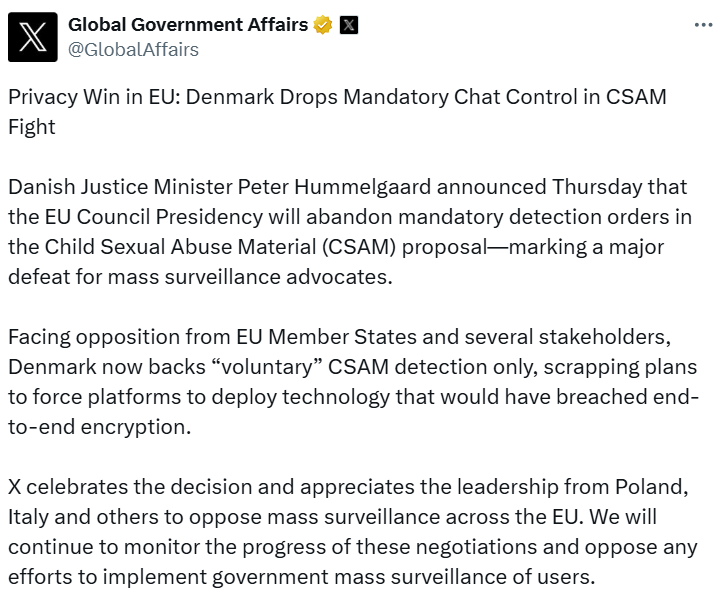
Source: X (@GlobalAffairs)
The Controversial EU Chat Control Proposal
However, privacy experts, digital rights groups, and tech companies have long warned that such a policy would undermine end-to-end encryption, exposing millions of users to potential surveillance and cyber risks.
According to a report by Politiken on October 30th, Danish Minister of Justice Peter Hummelgaard confirmed that the EU Chat Control proposal will not be part of the EU presidency’s new compromise proposal. Instead, message scanning will remain voluntary for now.
Peter further stated:
“It will continue to be voluntary for tech giants to screen encrypted messages.”
Tech Industry & Privacy Advocates React
The decision sparked immediate responses from the tech industry and civil liberty organizations.
A “Major Defeat” For Mass Surveillance
X’s Global Government Affairs team hailed Denmark’s withdrawal as a “major defeat for mass surveillance advocates,” adding that the platform will continue to “oppose any efforts to implement government mass surveillance of users.”
Digital Freedom Supporters Applaud Denmark’s Move
Patrick Hansen, Director of EU Strategy and Policy at stablecoin issuer Circle, called the decision a “major win for digital freedoms in the EU.”
Similarly, the Electronic Frontier Foundation (EFF), a leading digital rights organization, said that strong public opposition had likely “pushed the EU Council to withdraw its dangerous plan to scan encrypted messages.”
Lawmakers Must Stop Attacking Encryption
EFF Urges Focus On Real Solutions
EFF privacy activist Thorin Klosowski criticized ongoing attempts by lawmakers to bypass encryption under the guise of safety.
In a blog post, he urged EU leaders to focus instead on “developing real solutions that don’t violate the human rights of people around the world.”

Different European Countries’ Stance On Chat Control
Blue = Oppose, Yellow = Undecided, Red = Support
Source: EU
He emphasized that encryption is not the enemy, it’s a crucial technology that protects individuals from cybercrime, corporate surveillance, and state overreach.
With Ireland set to assume the EU Council presidency in July 2026, all eyes will be on whether future leadership continues to uphold the right to private communication, or revives the EU Chat Control proposal under a new guise.
What Happens Next?
The current voluntary framework allowing tech platforms to scan communications for illegal content will expire in April 2026. Policymakers fear that without a replacement, the European Union could be left without tools to address serious online crimes.
Hummelgaard suggested that Denmark’s withdrawal was a pragmatic step, ensuring that a workable framework can still be negotiated before the existing one lapses.
Nonetheless, privacy advocates see this as a turning point in the ongoing EU debate about encryption, privacy, and digital rights.
FAQ
What is EU Chat Control?
EU Chat Control refers to a proposed European Union regulation that would require messaging platforms to scan private messages — even those protected by encryption — for illegal or harmful content.
Why did Denmark withdraw its support?
Denmark faced intense public and political backlash over privacy concerns. Critics argued that mandatory message scanning would effectively end end-to-end encryption and enable mass surveillance.
Will message scanning still happen in the EU?
For now, scanning remains voluntary, meaning companies like WhatsApp and Signal can choose whether or not to monitor content under the current legal framework.
What happens after April 2026?
Unless a new framework is agreed upon, the voluntary policy will expire in April 2026 — leaving the EU without a clear mechanism to address illegal online content.