Key Takeaways
Crypto sentiment has plunged to “Extreme Fear” with a score of 21 — its lowest level in nearly seven months.
Bitcoin’s price drop below $106,000 triggered widespread caution among investors.
Contributing factors include reduced institutional demand, weaker blockchain activity, and hawkish Fed policy.
Historical trends show that November has often been a strong month for Bitcoin, offering hope for a rebound.
Understanding and tracking crypto sentiment can help traders navigate volatile market conditions more effectively.
Bitcoin’s Sudden Drop Sparks Market Anxiety
On Tuesday, the Crypto Fear & Greed Index fell by half in a single day, dropping from 42 to 21 out of 100, according to data from Alternative.me.
The steep decline signals “Extreme Fear,” suggesting that investors have grown increasingly cautious amid Bitcoin’s latest price volatility.
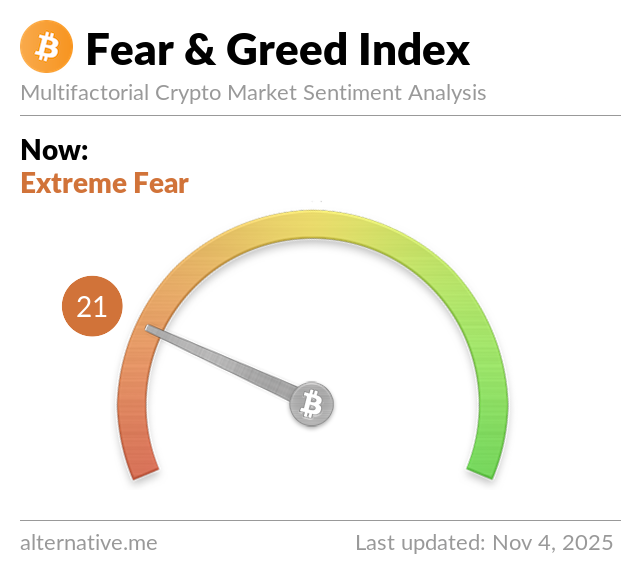
Crypto Fear And Greed Index
Source: Alternative.me
At the time of writing, Bitcoin (BTC) was trading near $106,500, recovering slightly from a 24-hour low of $105,540.
The world’s largest cryptocurrency had earlier peaked above $109,000 before retreating, marking a 2% drop for the day, per data from CoinGecko.
Lowest Sentiment Since April 2025
This week’s crypto sentiment reading represents the lowest level since April 9th, when the index fell to 18 points amid global market turbulence.
That decline came as the U.S. implemented sweeping tariffs under President Donald Trump’s administration, rattling both stock and crypto markets.
Fear Returns To The Crypto Market
Extreme Fear Follows Bitcoin’s Slide
The last time the market entered “Extreme Fear” territory was October 22nd, when the index dropped to 25 after Bitcoin’s slide from $110,000 to below $108,000.
Since early October, the index has fluctuated between “Neutral” and “Extreme Fear,” underscoring ongoing investor uncertainty.

Source: CoinGecko
Earlier in the month, Bitcoin reached a high of $126,000 before the sharp sell-off on October 9th–10th wiped out much of those gains.
Notably, on October 5th, the index had signaled “Greed” with a score of 74, a reminder of how quickly market emotions can change.
Reduced Institutional Demand
One of the main drivers behind the market’s cautious tone has been the decline in institutional demand. Over the past week, Bitcoin-linked ETFs recorded $800 million in net outflows, according to market data.
This marks the first time in seven months that institutional buying fell below the daily mined supply of Bitcoin.
Weaker Blockchain Activity
On-chain data also suggests a slowdown in blockchain activity, including lower transaction volumes and reduced active wallet addresses.
Analysts point to these trends as indicators of waning market participation and confidence.
The Federal Reserve’s Hawkish Stance
The Federal Reserve’s monetary policy has also weighed on crypto sentiment. Although the Fed cut interest rates for the second time this year, officials signaled that additional cuts are unlikely in 2025.
Many investors had expected a more dovish stance, and the market’s disappointment quickly translated into selling pressure across digital assets.
Looking Ahead: Can “Moonvember” Save The Market?
Despite the current downturn, some crypto enthusiasts remain optimistic. Historically, November has been one of Bitcoin’s strongest months — averaging more than 42% gains over the past several years.
Traders have coined the term “Moonvember” to describe this seasonal pattern of late-year rallies.
If this historical trend holds true, improving price action could help stabilize crypto sentiment and attract sidelined investors back into the market. However, analysts warn that continued macroeconomic uncertainty could temper any potential upside.
FAQ
What is crypto sentiment?
Crypto sentiment refers to the overall mood or attitude of investors toward the cryptocurrency market. It’s often measured using tools like the Crypto Fear & Greed Index, which gauges emotions ranging from “Extreme Fear” to “Extreme Greed.”
How is the Crypto Fear & Greed Index calculated?
The index combines data points such as market volatility, trading volume, social media trends, and dominance metrics to produce a score between 0 and 100. Lower scores indicate fear, while higher scores signal greed.
Why does crypto sentiment matter?
Sentiment influences trading behavior. When fear dominates, investors often sell prematurely; when greed rises, they tend to overbuy. Monitoring sentiment can help traders identify potential reversals or periods of consolidation.
Can crypto sentiment predict Bitcoin’s price?
While not a perfect predictor, crypto sentiment can serve as a contrarian indicator — meaning that extreme fear often precedes price rebounds, and extreme greed can signal market tops.