The 2024 Bitcoin halving pushed many Bitcoin miners to diversify into AI cloud services.
Companies like Core Scientific and Hut 8 are turning stranded compute power into sustainable income through AI partnerships.
Firms such as Hive and Iren are proving that hybrid mining/AI models can work, and even thrive.
Some miners, like Canaan, remain focused solely on Bitcoin mining, avoiding AI for now.
Entering the AI space offers significant opportunities, but miners must weigh infrastructure costs, client stability, and regulatory hurdles.
Core Scientific offers a compelling case of a Bitcoin miner successfully pivoting to AI. After filing for Chapter 11 in late 2022 due to falling Bitcoin prices and rising debt, the company rebounded by early 2024 and returned to the Nasdaq.
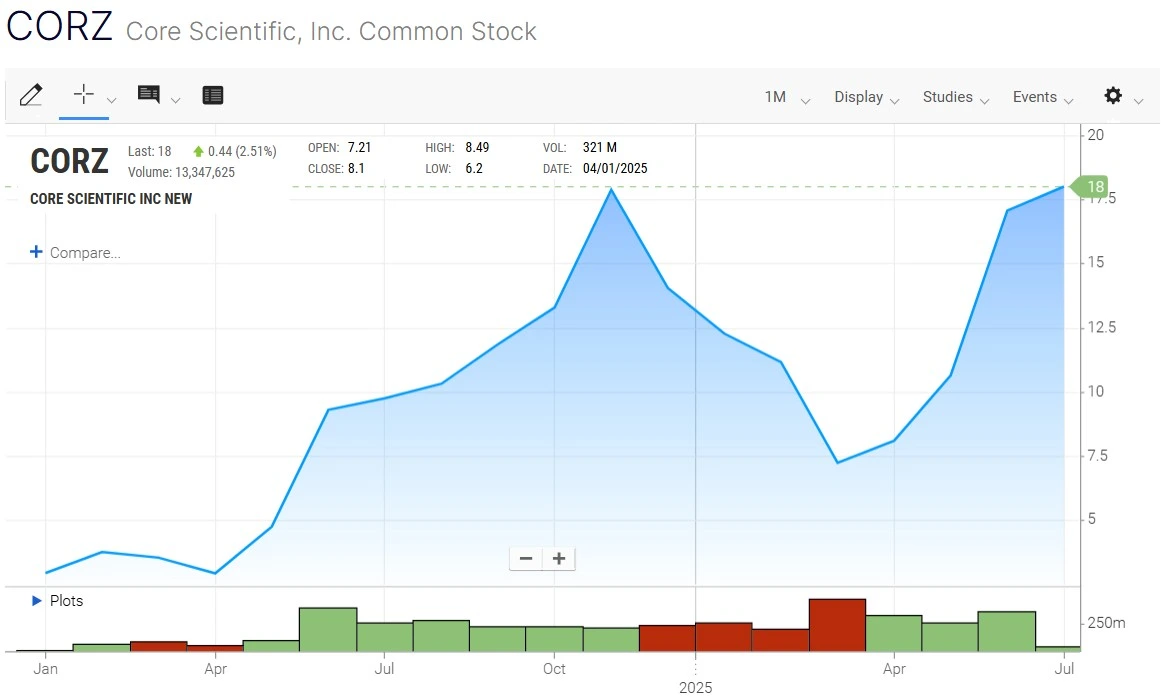
Core Scientific Stock Price In Q1
Source: NASDAQ
In June 2024, Core Scientific signed a 12-year, $3.5 billion deal with CoreWeave, an AI cloud computing firm. This agreement allows Core Scientific to leverage its data centers for AI workloads, marking a significant move beyond just mining Bitcoin.
Despite a drop in quarterly revenue, from $179.3 million in Q1 2024 to $79.5 million in Q1 2025, the AI partnership renewed investor confidence. Its stock rose after the deal announcement, showcasing support for the company’s new direction.
By mid-2025, CoreWeave had even restarted talks to acquire Core Scientific, following a failed $1 billion bid in 2024, signaling AI’s pivotal role in reshaping the Bitcoin miner landscape.
Hut 8 continues to prioritize Bitcoin mining but has strategically added AI services to its portfolio. In September 2024, the company launched Highrise AI, a subsidiary offering GPU-as-a-Service using 1,000+ Nvidia H100 chips. A five-year contract ensures fixed payments plus revenue-sharing based on customer success.
Despite the AI pivot, Hut 8 mined 167 BTC in Q1 2025 (down from 716 BTC in Q1 2024) and maintains a substantial reserve of 10,273 BTC, making it the 9th-largest corporate Bitcoin holder globally. For Hut 8, AI is a supplement—not a replacement—for Bitcoin mining.
Formerly Hive Blockchain, the firm rebranded in 2023 to reflect its AI ambitions. With a $30 million investment in Nvidia GPU clusters, Hive tripled its AI/HPC revenue to $10.1 million in fiscal 2025, around 9% of total revenue. The company aims to hit $100 million in AI income by 2026.
Australian firm Iren began its AI pivot in early 2024 and scaled to 4,300 GPUs by mid-2025. It mined 1,514 BTC in Q3 FY2025 and earned $3.6 million from AI cloud services. However, a class-action lawsuit, claiming it misled investors about a Texas facility, casts a shadow on its progress.
Riot is exploring AI, assessing plans to convert 600 MW at its Corsicana, Texas site into HPC infrastructure. The facility spans 355 acres and can support up to 1 GW of power.
While Riot hasn’t landed major AI contracts yet, it remains a mining powerhouse, producing 1,530 BTC and generating $142.9 million in Q1 2025. It also holds 19,225 BTC, one of the world’s largest reserves among miners.
With 50,000 BTC, MARA boasts the largest treasury of any public Bitcoin miner.
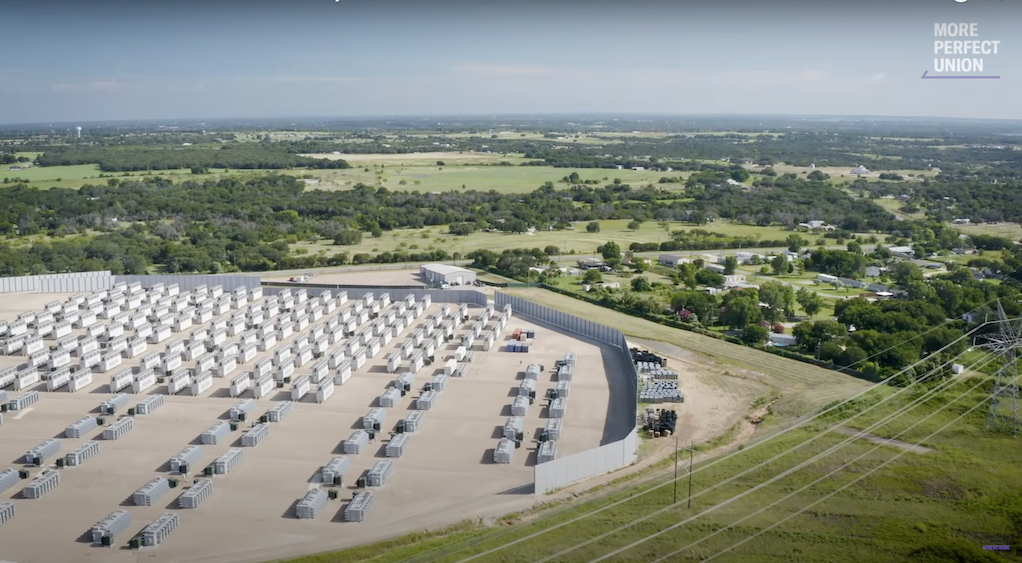
A MARA Holdings Bitcoin Mining Facility
Source: More Perfect Union
Its AI strategy focuses on edge computing, including its proprietary MARA 2PIC700 immersion cooling system. While AI revenue is still on the horizon, the infrastructure is in place.
Contrary to most miners, Canaan exited the AI race in July 2025, shutting down its AI chip division to focus on ASIC development for Bitcoin mining.
While it holds only 2.1% of the global ASIC market, Canaan is doubling down on mining hardware instead of chasing AI dollars.
Expanding into AI isn’t risk-free. Here are key challenges:
Retrofitting ASIC-focused data centers with GPUs requires heavy capital.
ROI depends on securing long-term AI clients.
AI workloads require stable power and advanced cooling systems.
Thermal issues could reduce efficiency or damage equipment.
Hosting AI involves handling sensitive data, IP, and adhering to data sovereignty laws.
Increased competition in the AI compute space may drive prices down.
Client defaults or lack of steady demand could affect cash flow.
Due to falling Bitcoin mining profitability, especially after the 2024 halving, miners are exploring AI as an alternative revenue stream, using their existing infrastructure to offer GPU-powered compute services.
ASICs are specialized for mining Bitcoin, while GPUs are general-purpose processors used in AI, gaming, and scientific computing. GPUs are essential for training large language models and other AI workloads.
Yes, but profitability depends on factors like Bitcoin price, energy costs, mining difficulty, and operational scale. Adding AI services provides an additional layer of financial stability.
Not entirely. Most companies are building hybrid models, where AI complements rather than replaces mining. Bitcoin remains a core revenue stream for many miners.
Risks include high setup costs, unreliable AI clients, increased power demands, legal complexities, and growing competition.

 Skip to content