Typically, conflicts of this magnitude drive investors toward the dollar, yet this time, it appears Bitcoin is absorbing that capital instead.
According to respected macroeconomist Lyn Alden, the dollar has barely attracted any “flight-to-safety” demand despite the escalations.
The U.S. Dollar Index (DXY), which measures the dollar’s performance against a basket of major global currencies, is trading at 97.50, its lowest level since early 2022. The index is down 1.54% over the past month, according to TradingView.
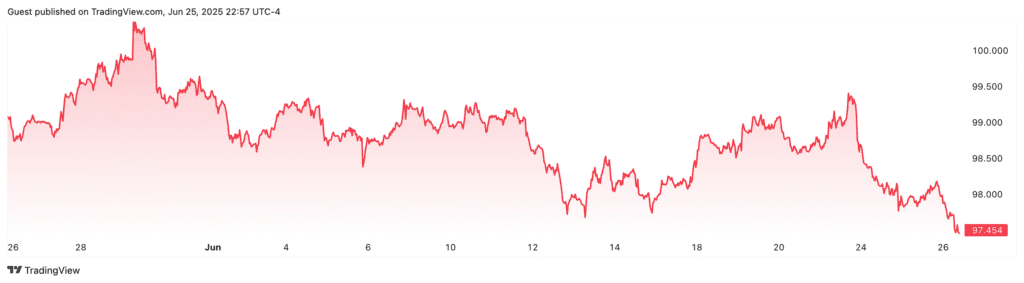
DXY Price Performance
Source: TradingView
This decline comes even as conflict in the Middle East flared, with Israel conducting airstrikes on Iranian targets, typically a scenario where DXY would spike, as it did in October 2024, when similar tensions led to a 2.67% increase.
The flagship crypto saw temporary weakness, briefly dipping below the $100,000 mark on Sunday. However, following a ceasefire brokered by U.S. President Donald Trump, the price rebounded sharply.
At the time of publication, Bitcoin trades at $107,930, according to CoinMarketCap.
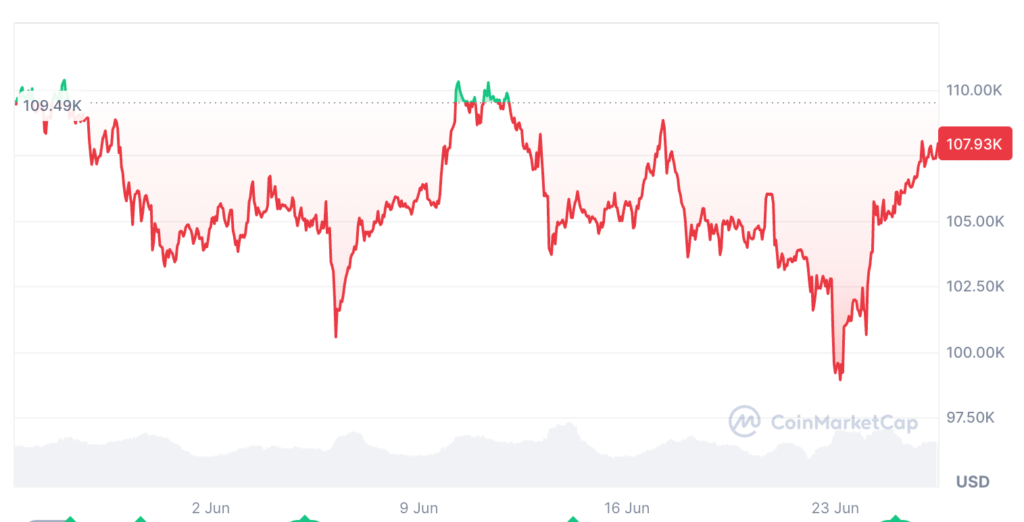
Source: CoinMarketCap
Crypto analyst Matthew Hyland observed that “the bulls are in control,” while Rekt Capital pointed out that Bitcoin has broken two 2-week downtrends in the past month, indicating strong momentum.
Real Vision crypto analyst Jamie Coutts emphasized the larger macro shift underway, declaring that “fiat is fading.” He noted that just like in the early 2000s, when a weakening dollar drove investment into emerging markets (EM), today’s market appears to be rotating into crypto assets.
This perspective aligns with increasing institutional interest in Bitcoin, which some investors now view as a hedge against fiat devaluation and a digital store of value.
Bitcoin’s recent strength amid macro uncertainty has many analysts revisiting their Bitcoin price predictions. With BTC currently trading just shy of its all-time high of $111,970, the market is buzzing with speculation.
Analysts predict that if Bitcoin can maintain support above $105,000, the next leg up could potentially send it beyond $120,000 by late Q3 2025. Technical indicators and macro trends both point toward bullish continuation, assuming market stability holds.
Typically, the USD strengthens in times of geopolitical tension. However, current trends suggest that investor confidence in fiat currencies is waning, possibly due to concerns about debt levels, inflation, and shifting global alliances.
While still volatile, Bitcoin is increasingly being treated like a store of value, especially during periods of monetary instability or fiat weakening. Its decentralized nature and limited supply are appealing to long-term investors.
Analysts are watching the $111K resistance level closely. If BTC breaks above that, many believe it could rally toward $120K–$130K by Q4 2025.
The U.S. Dollar Index (DXY) inversely affects Bitcoin: when the dollar weakens, BTC often strengthens as investors look for alternative stores of value. A falling DXY can be a bullish signal for Bitcoin.