The STREAMLINE Act aims to modernize the Bank Secrecy Act for the first time in over 50 years.
Reporting thresholds for Currency Transaction Reports and Suspicious Activity Reports would increase to reflect inflation.
The reform is designed to reduce regulatory burdens on banks, credit unions, and crypto exchanges.
Lawmakers are also exploring broader digital asset regulation in parallel with AML updates.
Enacted in 1970, the Bank Secrecy Act was designed to help the U.S. government detect and prevent financial crimes such as money laundering, terrorist financing, and other illicit financial activities.

Source: banking.senate.gov
The law requires financial institutions to report certain transactions to the Department of the Treasury’s Financial Crimes Enforcement Network (FinCEN).
Under existing regulations, banks and other financial institutions must file:
Currency Transaction Reports (CTRs) for any cash transaction exceeding $10,000.
Suspicious Activity Reports (SARs) for transactions involving $2,000 to $5,000, depending on the level of suspected criminal activity.
These thresholds have not been updated since the law’s passage more than 50 years ago, despite significant inflation and changes in financial technology.
The STREAMLINE Act would overhaul the Bank Secrecy Act by raising long-standing thresholds and introducing automatic inflation adjustments to keep them relevant.
Currency Transaction Reports (CTRs): Raised from $10,000 to $30,000
Suspicious Activity Reports (SARs): Raised from $2,000–$5,000 to $3,000–$10,000
Inflation Adjustment: The Treasury Department must reassess and adjust thresholds every five years
Republican Senator Pete Ricketts (R-NE), a co-sponsor of the bill, stated that the changes are long overdue:
“After more than 50 years of inflation, the Bank Secrecy Act’s reporting thresholds are badly outdated. They must be modernized.”
He added that the new legislation “cuts red tape for banks and credit unions while ensuring law enforcement still has the tools they need to do their job.”
Both traditional financial institutions and U.S.-based crypto exchanges like Coinbase, Kraken, and Ripple must comply with the Bank Secrecy Act.
Raising thresholds could significantly reduce the number of reports banks and crypto platforms file, allowing them to focus resources on genuinely suspicious activity rather than small, routine transactions.
This move may also streamline compliance operations and reduce costs for regulated entities without compromising oversight.
The proposed reforms come as lawmakers and crypto industry leaders intensify discussions around the future of financial regulation.
Recently, a coalition of fintech and crypto trade groups urged the CFPB to finalize its open banking rule, which reinforces that consumers, not banks, own their financial data. Open banking plays a crucial role in bridging traditional finance with DeFi, crypto payment systems, and digital banking.
Meanwhile, Senate Democrats, including Senator Kirsten Gillibrand, met with crypto executives from Circle, Ripple, Coinbase, Kraken, and Chainlink to discuss the Senate’s version of the digital asset market structure bill.
According to journalist Eleanor Terrett, lawmakers expressed a shared commitment to “getting a bill done.”
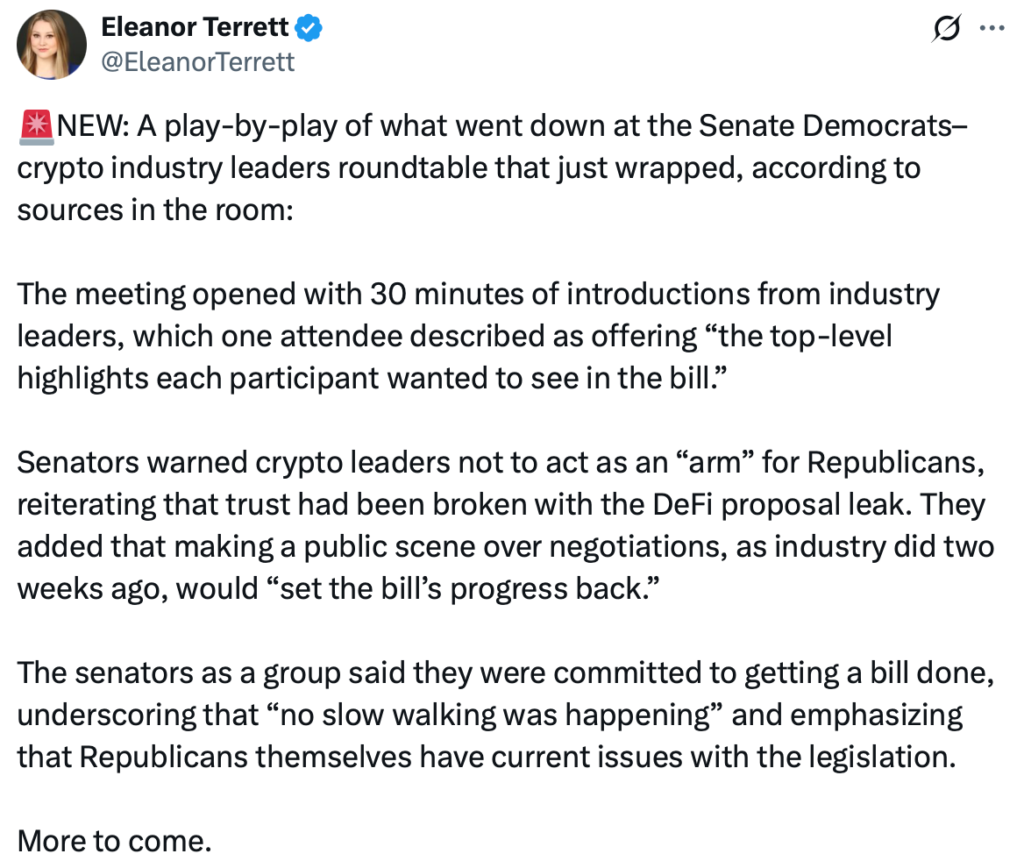
Source: X (@EleanorTerrett)
However, with the ongoing U.S. government shutdown, now one of the longest in history, it’s unlikely any vote on the digital asset framework will occur until operations resume.
The BSA requires financial institutions to assist government agencies in detecting and preventing money laundering and other financial crimes by reporting certain transactions.
Inflation and changes in the financial system have made the existing thresholds outdated, leading to excessive reporting and administrative burdens for banks and crypto firms.
It will reduce compliance workloads by lifting reporting thresholds, enabling crypto firms to focus on identifying genuinely suspicious activities rather than low-value transactions.
The bill must first pass both houses of Congress and be signed by the President. If enacted, the Treasury Department will issue updated regulations and establish the new inflation-adjustment schedule.