Tokenized stocks will remain classified as securities, preserving their integration with existing financial infrastructure.
The Responsible Financial Innovation Act of 2025 aims to divide crypto asset regulation between the SEC and CFTC.
A vote on SEC-related provisions is expected in September, followed by a broader vote possibly by November.
Bipartisan negotiations are ongoing to ensure the bill gains support across the aisle.
Industry leaders are calling for additional legal protections for developers and non-custodial services to prevent innovation flight.
A key provision added to the Senate’s crypto bill ensures that traditional securities, such as stocks, retain their classification even when tokenized on a blockchain.
This addresses a long-standing ambiguity over whether these digital representations should fall under securities law or be treated as commodities.
Senator Cynthia Lummis said:
“We want this on the President’s desk before the end of the year.”
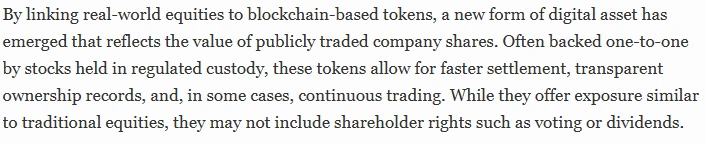
Tokenized Stocks Definition
Source: Forbes
This provision supports continuity in the regulatory approach and helps tokenized stocks remain compatible with existing infrastructures such as:
Broker-dealer frameworks
Clearinghouses
Traditional securities trading platforms
Maintaining this classification is crucial for investor protections and market integrity as tokenized finance continues to grow.
Digital asset firms exploring tokenization technologies now have greater assurance that tokenized versions of equities won’t be reclassified. This helps in:
Avoiding conflicts between the SEC and CFTC over jurisdiction
Ensuring smoother compliance processes
Encouraging further innovation in tokenized financial products
The broader Responsible Financial Innovation Act aims to establish a more coherent framework for regulating digital assets by dividing oversight between the U.S. Securities and Exchange Commission (SEC) and the Commodity Futures Trading Commission (CFTC).
The SEC would continue to regulate digital assets that are classified as securities, including tokenized stocks and other investment contracts.
Provisions related to the SEC are expected to be reviewed by the Senate Banking Committee later this month.
Meanwhile, the Agriculture Committee is expected to vote in October on provisions defining the CFTC’s jurisdiction, particularly over digital commodities.
If all goes according to plan, a full Senate vote could occur by November 2025.
Though the bill hasn’t yet secured full Democratic support, bipartisan negotiations are ongoing.
Senator Lummis confirmed that efforts are underway to build coalitions across party lines on specific sub-issues, aiming to create momentum for a successful vote.
In a parallel development, 112 crypto firms and advocacy organizations, including Coinbase, Kraken, a16z, Uniswap Labs, and Ripple, sent a joint letter to Senate committees.
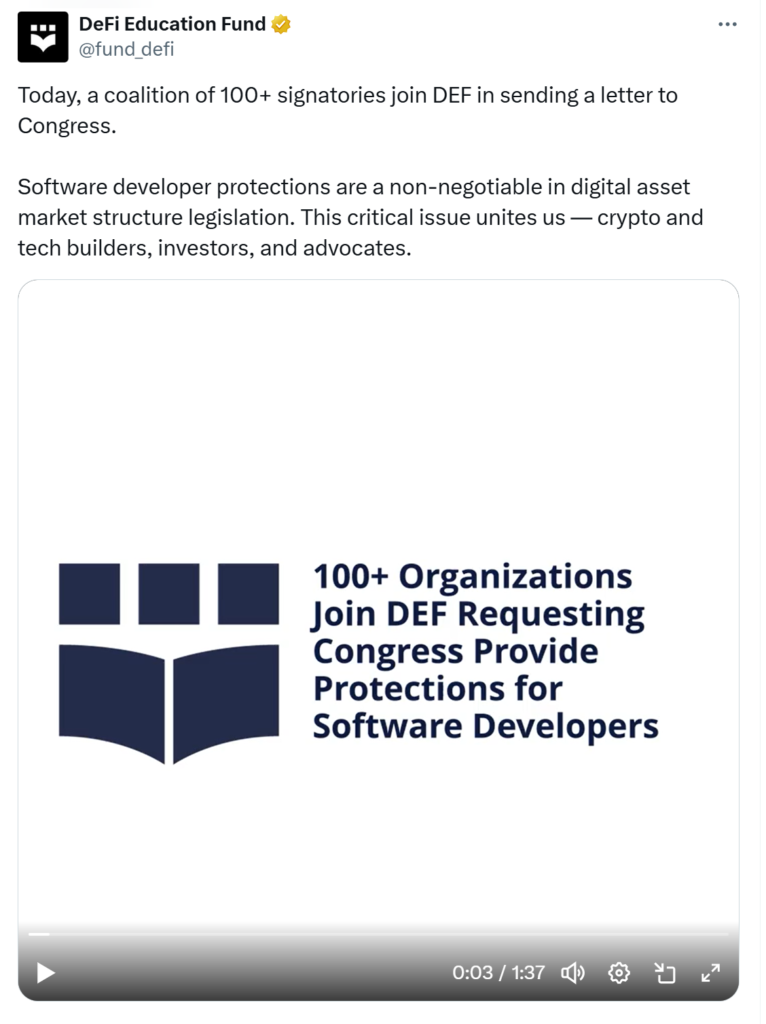
Source: X (@fund_defi)
They urged lawmakers to include legal protections for software developers and non-custodial service providers.
The coalition cited troubling statistics from Electric Capital:
“The U.S. share of open-source blockchain developers has dropped from 25% in 2021 to just 18% in 2025.”
Without proper legal clarity, innovators may continue to flee to more crypto-friendly jurisdictions, further stalling U.S. competitiveness in blockchain technology.
Tokenized stocks are digital representations of real-world stocks that are issued and traded on blockchain platforms. Each token typically mirrors the value of a share in a traditional equity.
Because they represent ownership in an underlying company and mimic the structure of traditional stocks, tokenized stocks meet the SEC’s definition of a security, even when recorded on a blockchain.
The bill clarifies the division of oversight:
The SEC will regulate tokenized securities like tokenized stocks.
The CFTC will regulate digital commodities like certain cryptocurrencies.
Senators aim to have the bill on the president’s desk by the end of 2025, with committee votes starting as early as September.