Web3 alone isn’t enough, as mass adoption requires building on trusted Web2 infrastructure.
User trust is key. 63% of U.S. adults still don’t trust crypto platforms.
Integration is superior to isolation. Web2 giants are already legitimizing blockchain by integrating it.
UX matters. Familiar, user-friendly interfaces will accelerate Web3 growth.
Real-world utility wins, as using Web3 to solve actual problems is better than chasing decentralization for its own sake.
In the push for decentralization, many Web3 advocates argue that legacy Web2 systems should be left behind entirely.
From dApps that mimic Web2 UX, to proposals for fully blockchain-based business models, there’s a common belief that Web3 can only thrive by tearing down what came before.
But this all-or-nothing mindset is not only impractical, it’s a barrier to adoption.
Web3, while promising in theory, remains confusing and intimidating to the average user. According to recent data, 63% of U.S. adults have “little to no confidence” in cryptocurrency systems.
Moreover, despite blockchain’s promise of “trustless” environments, Oxford University describes a persistent trust paradox—a disconnect between what blockchain offers and how the public perceives it.
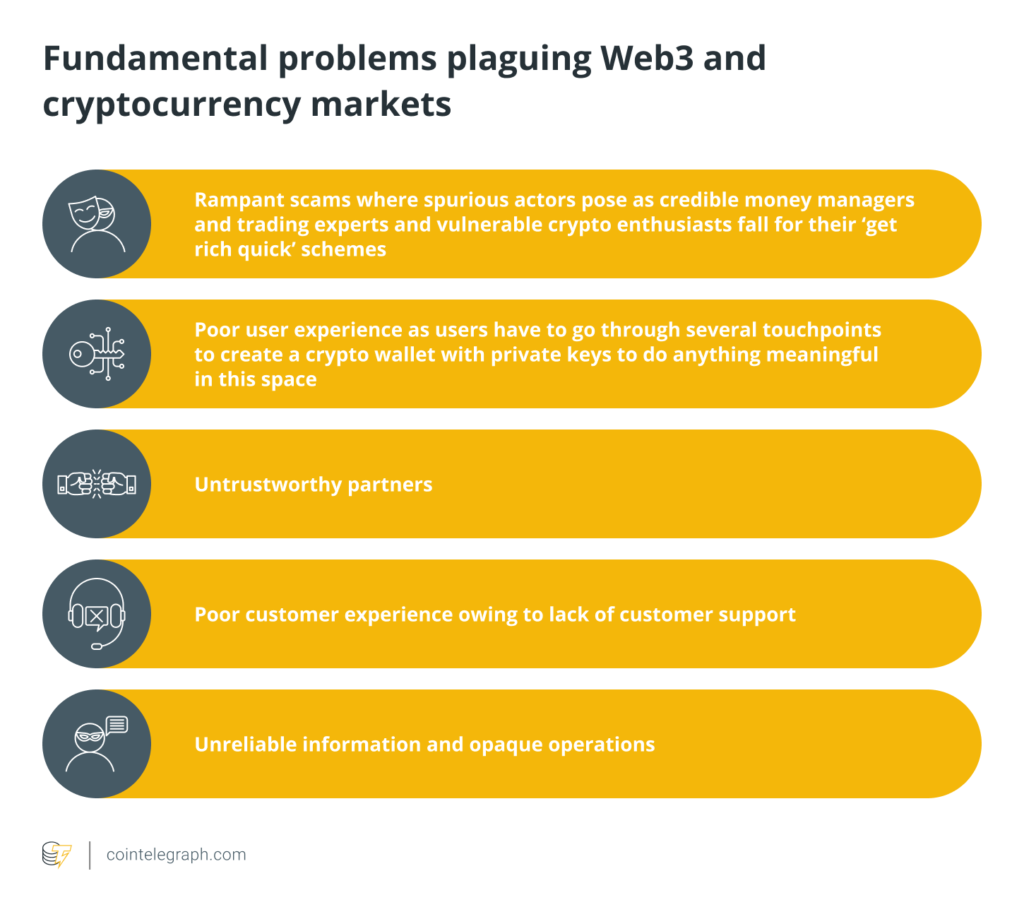
Some Common Web3-Related Issues
Source: CoinTelegraph
This skepticism means users tend to fall back on what they already know: Web2 platforms. If Web3 hopes to scale, it must meet users where they are, inside the Web2 infrastructure they already trust.
Every major tech shift in history, from fax to email, from 3G to 5G, has occurred through gradual integration, not sudden replacement. Web3 is no different.
Dismissing the value of Web2 platforms limits the reach of Web3 tools. On the flip side, leveraging trusted Web2 environments can help Web3 gain legitimacy and onboard users safely and at scale.
Companies like PayPal, Visa, and major banks are already integrating crypto and blockchain technologies. Google Cloud and Amazon Web Services (AWS) are offering Web3 tools and hosting blockchain nodes.
These aren’t fringe experiments, they’re industry giants validating Web3 by embedding it into Web2 ecosystems. Web3 developers should follow suit by collaborating rather than competing with existing platforms.
Web3 tools need to prioritize the user experience (UX) that Web2 users expect, namely sleek interfaces, human-readable domains, and seamless onboarding.
With that in mind, Web3 doesn’t actually need to compromise its principles to be more user-friendly.
Web3 enthusiasts often focus on ideological purity, but the average user just wants a better experience. Whether it’s financial services, social media, or AI tools, users don’t care how something works, they care that it works well.
This applies to companies as well, such as Coinbase which recently announced that 40% of their code is actually AI-generated.
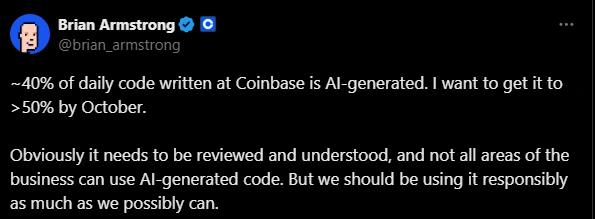
Source: X (@brian_armstrong)
A strong example lies in AI and blockchain integration. If every dataset used to train an AI model was immutably recorded on-chain, transparency and trust in the model’s output would skyrocket. This kind of hybrid solution is what drives real-world impact.
Bringing new technologies to market is more about iterative improvement than anything else. According to Nielsen research, testing with real users improves a product’s success rate by over 500%.
By engaging Web2 users now, Web3 products can undergo real-world testing, gather feedback, and scale with fewer issues.
Users don’t wake up wanting to use “a Web3 app”, they want a faster payment system, a better content platform, or a smarter AI assistant. The most successful projects will use Web3 technologies without needing to market themselves as Web3.
Yes. Web3’s path to mainstream adoption depends on integrating with existing Web2 systems. Web2 provides the trust, familiarity, and infrastructure needed to onboard new users.
Not in the short term. A full replacement is impractical and unnecessary. Hybrid models that combine Web2’s usability with Web3’s transparency are more effective.
Web2 platforms offer convenience, familiarity, and trust—qualities that Web3 is still developing. Most users are cautious about unfamiliar technologies like crypto and decentralized apps.
Not at all. Integration can uphold Web3 principles like decentralization and transparency while improving usability and scaling adoption.