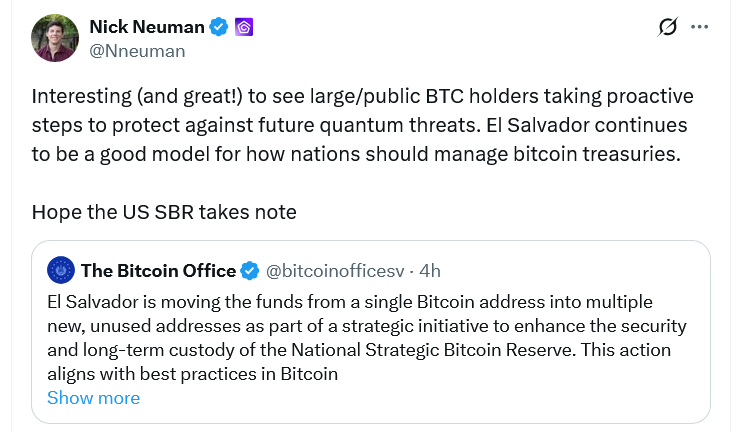
El Salvador moved its 6,274 BTC into 14 new wallet addresses to reduce Bitcoin quantum risk.
The strategy limits exposure to public key vulnerabilities, a major concern in the era of quantum computing.
Despite fears, quantum computers are not yet capable of breaking Bitcoin’s 256-bit encryption.
Industry leaders like Michael Saylor believe any future threats could be mitigated through software and hardware upgrades.
The country’s ongoing tension with the IMF may affect future Bitcoin investment strategies.
Quantum computing, while still in its infancy, holds the potential to break the cryptographic security that underpins modern financial systems, including Bitcoin’s elliptic curve cryptography (ECC).
Source: X (@Nneuman)
Once a quantum computer becomes powerful enough to run Shor’s algorithm at scale, it could, in theory, reverse-engineer private keys from public ones. This poses a risk to any Bitcoin that has had its public key exposed, which typically occurs after a transaction is made.
On August 30th, El Salvador’s Bitcoin Office confirmed that the country had redistributed its BTC holdings into 14 separate wallets, each containing a maximum of 500 BTC.
The move is designed to limit the exposure of public keys and reduce the impact of a potential future quantum computing breakthrough.
The Bitcoin Office said:
“By splitting funds into smaller amounts, the impact of a potential quantum attack is minimized.”
Previously, El Salvador’s entire stash was stored in a single address, a setup that would have posed a higher security risk if quantum technology ever advanced enough to target exposed keys.
Currently, quantum computing is nowhere near capable of breaking ECC used by Bitcoin. According to Project Eleven, a quantum research organization, no quantum computer has even cracked a 3-bit encryption key using Shor’s algorithm.
For perspective, a Bitcoin private key uses 256-bit encryption, a scale of complexity far beyond current capabilities.
Experts believe that functional quantum threats may still be decades away, but governments and organizations are starting to take preemptive action to avoid worst-case scenarios.
Project Eleven has warned that over 6 million BTC, roughly $650 billion, could become vulnerable if quantum computing ever reaches that level of sophistication.
While El Salvador’s redistribution strategy was widely praised by the crypto community, not everyone sees Bitcoin quantum risk as urgent.
Michael Saylor, a popular Bitcoin advocate, downplayed the threat:
“Quantum computing’s threat to Bitcoin is more hype than reality, and if it ever becomes real, the Bitcoin network can upgrade, just like Microsoft, Google, or the U.S. government do regularly.”
His sentiment is echoed by many in the tech world who believe that software and hardware upgrades could be implemented swiftly to reinforce Bitcoin’s encryption when necessary.
Blockchain explorers, including Mempool.space, verified the movement of the 6,274 BTC across 14 different wallet addresses on Friday.
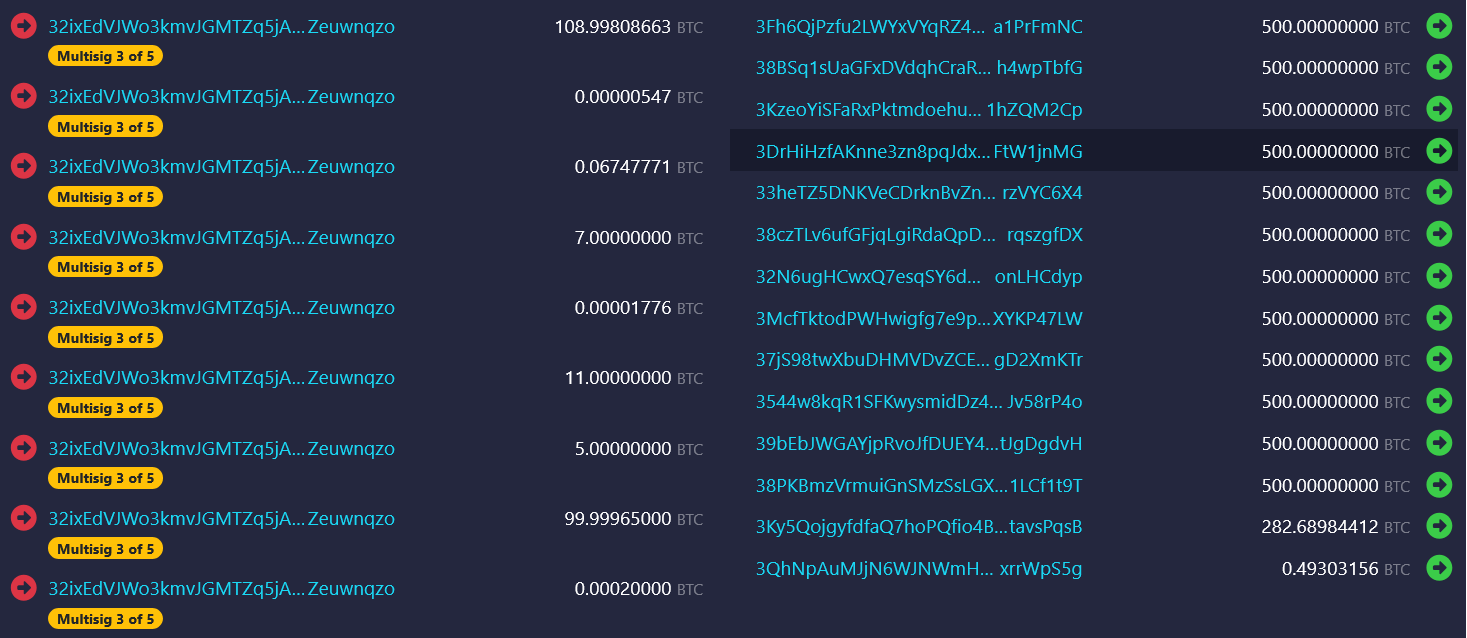
El Salvador’s Bitcoin Transfers To 14 New Bitcoin addresses
Source: Mempool.space
Despite its proactive stance on Bitcoin security, El Salvador’s overall Bitcoin strategy continues to generate global scrutiny.
In July 2025, the International Monetary Fund (IMF) published a report claiming the country hasn’t made any new Bitcoin purchases since February, a claim El Salvador’s Bitcoin Office has neither confirmed nor denied.
In December 2024, El Salvador secured a $1.4 billion loan agreement with the IMF. One of the conditions reportedly involved scaling back its Bitcoin initiatives.
However, ongoing disputes between El Salvador and the IMF have raised questions about the exact terms and future commitments.
Bitcoin quantum risk refers to the theoretical threat that quantum computers could break the encryption that secures Bitcoin wallets, particularly after their public keys have been exposed.
To reduce the exposure of any single address and minimize the impact if quantum computing ever becomes powerful enough to crack Bitcoin’s encryption.
Not serious yet. No existing quantum computer has come close to breaking even the most basic ECC, let alone Bitcoin’s 256-bit encryption.
Yes. Experts suggest that if the need arises, Bitcoin’s network can undergo hardware and software upgrades to switch to post-quantum cryptography.
Possibly. El Salvador’s $1.4B IMF loan reportedly came with conditions involving a scale-back of Bitcoin initiatives, but the specifics remain under dispute.