Willow quantum processor marks Google’s first verifiable quantum advantage.
Completed a complex molecular mapping 13,000x faster than supercomputers.
Demonstrated the potential, and the risks, of quantum computing for cybersecurity.
Experts warn of future encryption vulnerabilities, urging adoption of post-quantum cryptography.
Represents a transformative milestone for science, technology, and digital security.
Google researchers have confirmed that Willow, their latest quantum processor, completed a complex molecular mapping task in record time.
The experiment used a novel approach known as “quantum echoes”, a process that sends and retrieves targeted quantum signals to image structures at the molecular level.
In simple terms, a ‘qubit’, the basic unit of quantum information, is targeted with a precise wave signal.
The signal interacts with the qubit, then reverses direction, creating an “echo” that scientists can measure to extract detailed information.
This process allows Willow to capture data that traditional computing systems would take years, or even centuries, to calculate.
One of the most significant aspects of Google’s experiment is that it is verifiable. This means any other quantum computer with equivalent technical specifications could reproduce the same results.
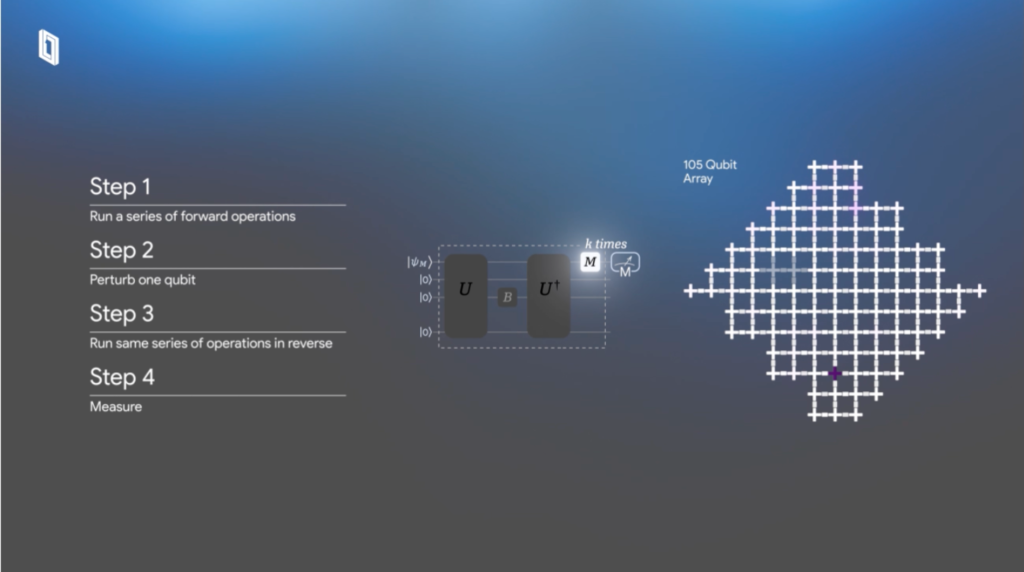
The 4 Steps In Google’s Recent Quantum Computer Experiment
Source: Google
That verifiability is crucial for establishing true quantum advantage, proof that quantum systems can outperform classical ones beyond doubt.
The success of Willow has implications far beyond academic research. Quantum computers have long been viewed as a potential threat to encryption, the backbone of digital security.
From cryptocurrency to banking and defense, a reliable encryption mechanism protects nearly all digital communication and transactions.
If quantum systems like Willow continue to advance, they could theoretically crack encryption algorithms used today, such as those safeguarding Bitcoin (BTC) wallets, financial transactions, and medical records.
Experts warn that once quantum computers reach sufficient power, they could render elliptic curve digital signature algorithms (ECDSA) obsolete, potentially as early as 2030.
David Carvalho, founder and chief scientist at Naoris, claimed:
“This is the biggest single threat to Bitcoin since its inception.”
Despite this threat, quantum computers aren’t yet powerful enough to break modern encryption standards. Today’s most advanced models can only break keys up to 22 bits, while typical security keys range from 2,048 to 4,096 bits.
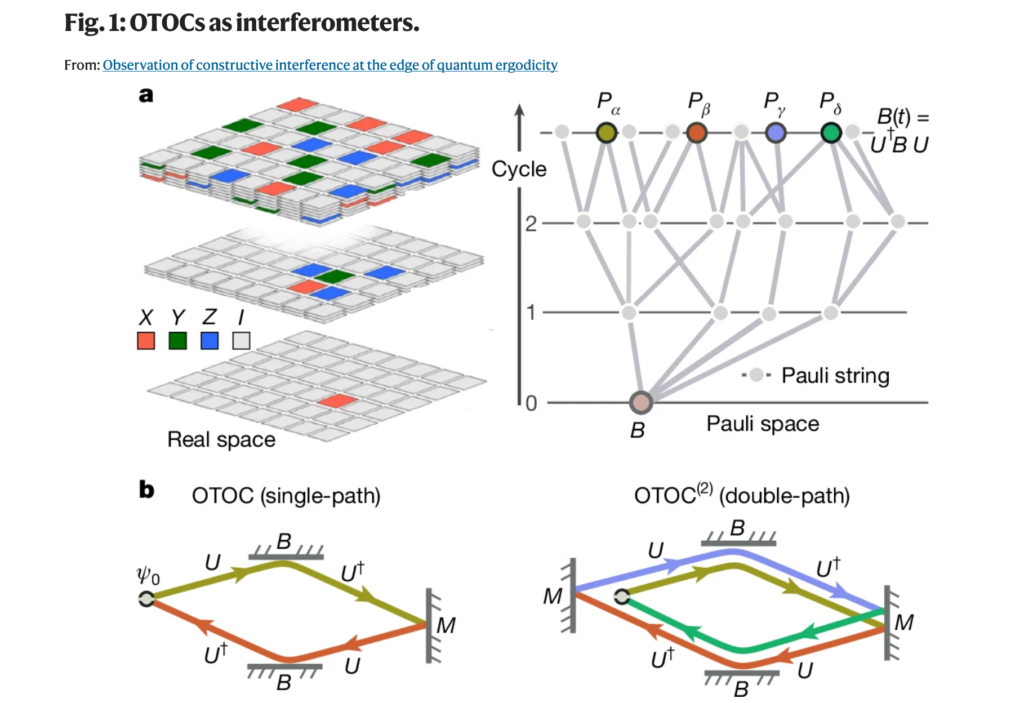
Interference Can Enhance The Quantum Echo And Reliably Map Out Information
Source: Nature
Still, experts and regulators are preparing for what’s next. The U.S. Securities and Exchange Commission (SEC) recently received a proposal outlining a roadmap toward quantum-resistant encryption standards by 2035, a proactive step toward future-proofing cybersecurity.
Willow’s achievement represents a dual-edged sword: immense potential for progress, and a new set of challenges for global digital infrastructure.
With performance thousands of times faster than supercomputers, Willow opens the door for unprecedented breakthroughs in fields like drug discovery, material science, and climate modeling.
Complex problems that once required supercomputing clusters may soon be solvable in seconds.
The next frontier involves developing post-quantum cryptography, security protocols resilient to quantum attacks.
Global efforts are already underway to implement such systems before fully capable quantum processors like Willow become widespread.
Willow is Google’s latest quantum computer processor, designed to perform complex calculations exponentially faster than traditional computers.
Willow achieved verifiable quantum advantage, meaning its experiment can be independently reproduced by other systems with similar specifications—a first in quantum computing.
In Google’s experiment, Willow completed molecular mapping 13,000 times faster than the most powerful supercomputers.
Not immediately. While Willow demonstrates quantum superiority, current encryption remains safe. However, industries are already working on quantum-resistant encryption standards to prepare for future advancements.

 Skip to content