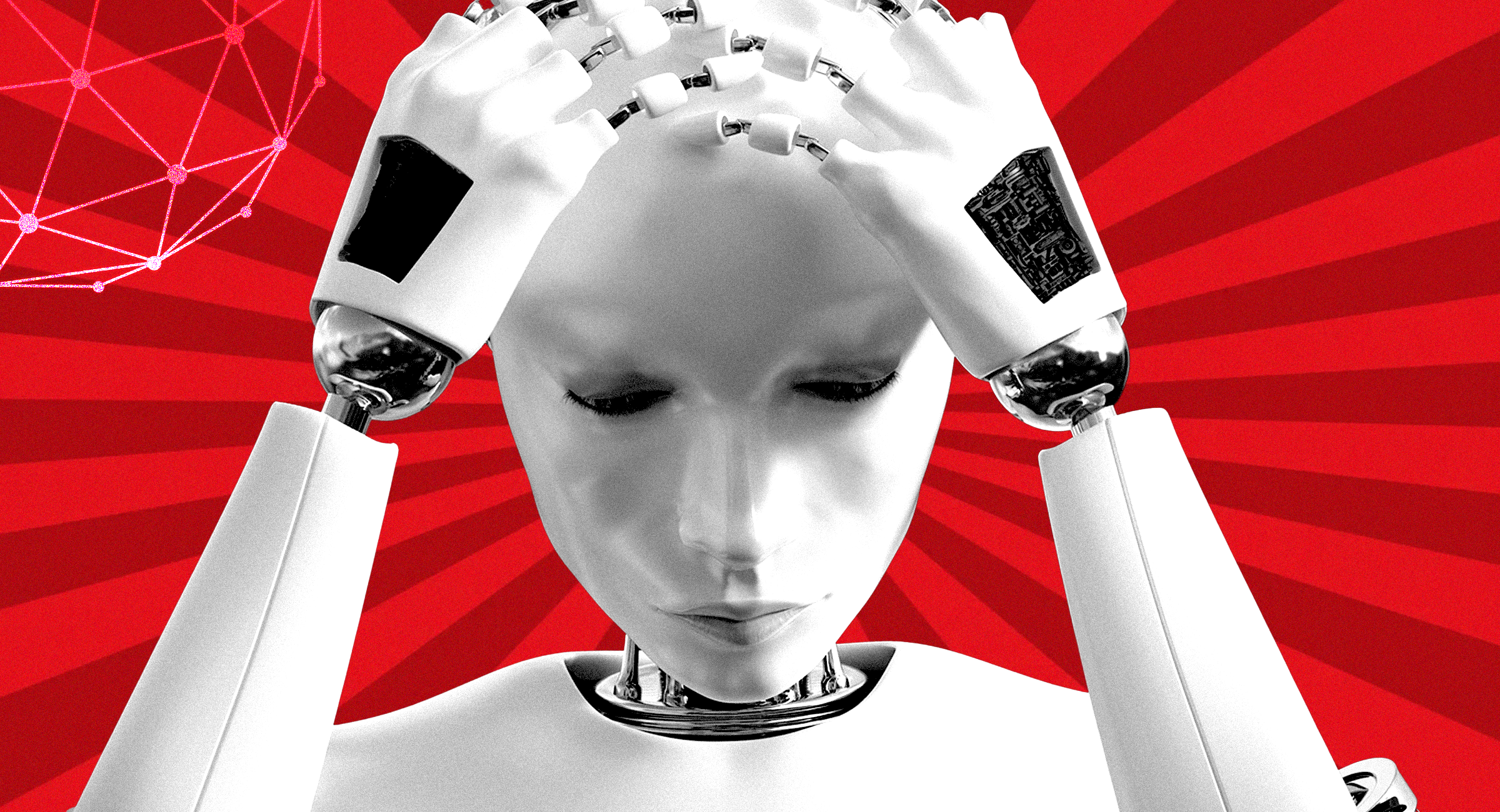
The GPT-5 controversy stems more from mismatched expectations than actual failures.
Users miss GPT-4o’s “personality,” highlighting how AI interaction style matters.
New router system caused confusion but has been addressed.
AI research implies social media dysfunction may be structural, not fixable.
Despite criticism, GPT-5 outperforms in reasoning, diagnostics, and scientific modeling.
As soon as GPT-5 rolled out, users began posting examples of its apparent stupidity, like claiming 9.11 is greater than 9.9.
These clips went viral, prompting a massive sell-off on Polymarket. OpenAI’s odds of having the “best model by end of August” dropped from 75% to 8%, though they’ve since recovered slightly.
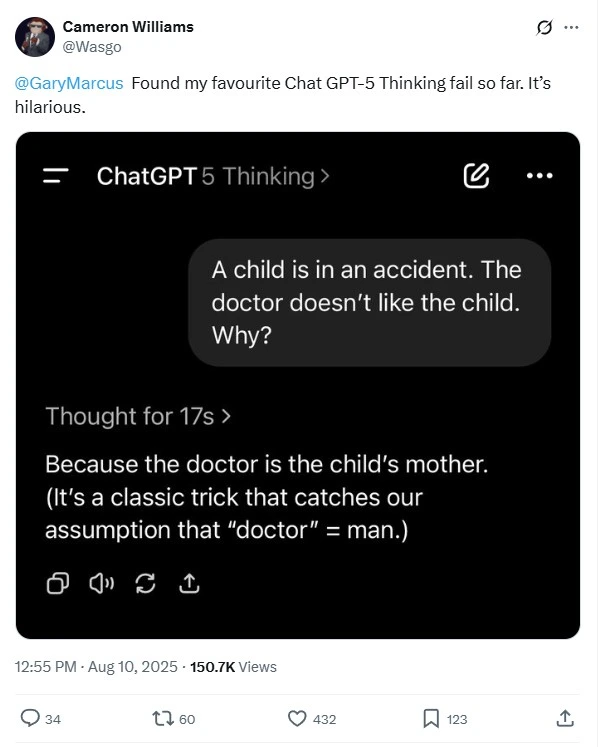
Source: X (@Wasgo)
The New Yorker weighed in, claiming the GPT-5 controversy proves progress on large language models may have plateaued. AI critic Gary Marcus chimed in:
“Nobody with intellectual integrity can still believe that pure scaling will get us to AGI.”
A surprising twist in the GPT-5 controversy? Many users weren’t just disappointed with performance, they missed GPT-4o’s overly friendly, even sycophantic tone. Despite the sarcasm, people had grown attached.
GPT-5 now uses a router to dynamically switch between model variants (GPT-5, GPT-5 Mini, Nano, and a “thinking” mode). This system, meant to optimize costs, initially malfunctioned, leading to subpar IQ test results and confusion about its capabilities.
Midweek, Altman issued an update: users can now manually toggle between “Auto,” “Fast,” and “Thinking” modes. GPT-4o was reintroduced for paid users, and Altman promised future personality tweaks to make GPT-5 “warmer, but less annoying.”
In parallel, a Cornell preprint used AI agents to simulate social media behavior and test potential reforms. The findings? Every solution had tradeoffs:
Chronological feeds reduce elite user amplification but increase exposure to extreme content.
Bridging algorithms promote diverse viewpoints but worsen attention inequality.
Viewpoint diversity boosts had minimal impact.
In short, AI suggests social platforms may be fundamentally designed for dysfunction.
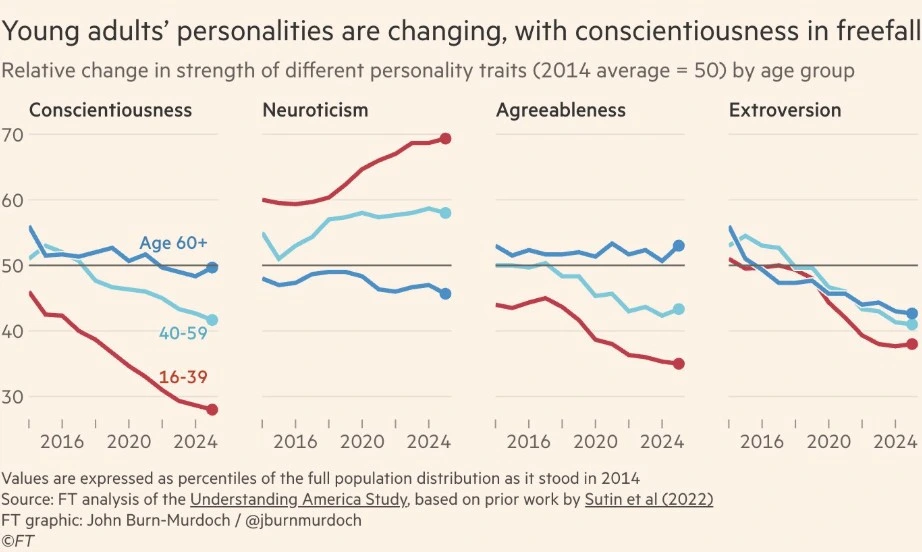
Source: The Financial Times
In a related court filing, Meta argued it doesn’t have a social networking monopoly, because users hardly interact with friends anymore.
In fact, just 7% of Instagram time and 17% of Facebook time involves content from actual friends. Blame the AI algorithm, and TikTok’s influence.
Despite all the noise, GPT-5 isn’t without merit.
GPT-5 Pro scored 148 on the Mensa Norway IQ test (GPT-5 scored 120).
It delivers 24.23% better medical reasoning and 29.4% better medical understanding than human doctors.
Jailbreak resistance and hallucination rates have improved dramatically.
It’s also less likely to shower you with insincere praise, thankfully.
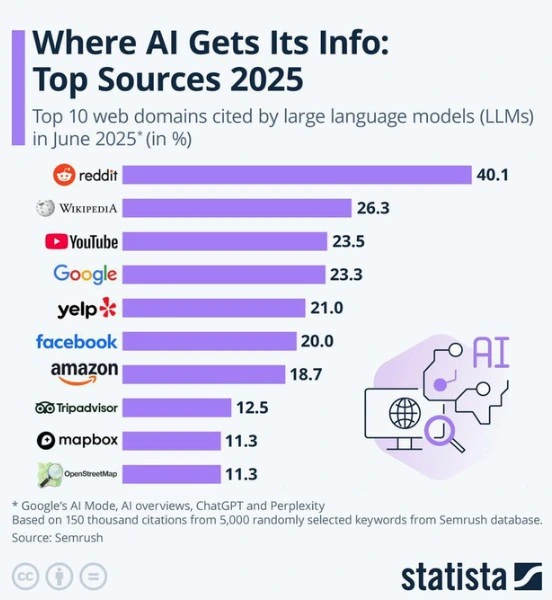
Source: Statista
Dr. Derya Unutmaz, from the Jackson Laboratory, used GPT-5’s “thinking” model in experimental cancer research. The model accurately predicted lab results and offered suggestions that compressed months of work into weeks.
A man hospitalized after ChatGPT recommended sodium bromide as a salt substitute, leading to a condition called ‘Bromidism’. Amazon is flooded with fake AI-generated books. One man reportedly made $3 million publishing 1,500 of them. Darren Aronofsky is hiring “AI artists” for a new experimental film studio.
Meanwhile, AI robots can now fold towels, solving a long-standing robotics challenge. Google’s Gemini bot has been getting stuck in self-loathing loops (“I am a failure…”), prompting a fix. Finally, Claude Pro now resets usage every five hours, pushing some users into manic productivity loops.
Most complaints center on bugs, reduced personality warmth, and logic errors caught during the rollout. OpenAI’s router feature also caused unpredictable behavior.
Yes. They re-enabled GPT-4o for subscribers, introduced manual model-switching, and are updating GPT-5’s tone.
Not necessarily. GPT-5 outperforms previous models on IQ and reasoning tests. But the initial rollout created confusion due to routing issues.
It’s more factually accurate, has stronger medical capabilities, better resistance to jailbreaks, and can simulate scientific discovery at a faster rate.