
Solana Firedancer, built by Jump Crypto, is set to transform the Solana network by enhancing validator performance and network speed.
The new SIMD-0370 proposal aims to remove the fixed compute block limit, allowing dynamic scaling based on validator capacity.
This could create a performance feedback loop, encouraging validators to upgrade hardware and software.
Critics warn of potential centralization risks, where only the most well-funded validators may thrive.
The proposal is expected to follow the Alpenglow upgrade, which is slated for testnet deployment in December 2024.
Currently, Solana enforces a fixed block limit of 60 million compute units (CUs). This cap restricts how many computations can be packed into a single block, thereby limiting throughput, regardless of how powerful a validator’s hardware might be.
Jump Crypto’s new proposal, SIMD-0370, suggests eliminating this fixed block limit altogether. Instead, block size would dynamically scale based on the capabilities of each validator node.
According to Anza, a Solana R&D company spun out of Solana Labs:
“This creates a performance flywheel: block producers pack more transactions to earn more fees. Validators that skip blocks lose rewards, so they upgrade hardware and optimize code.”
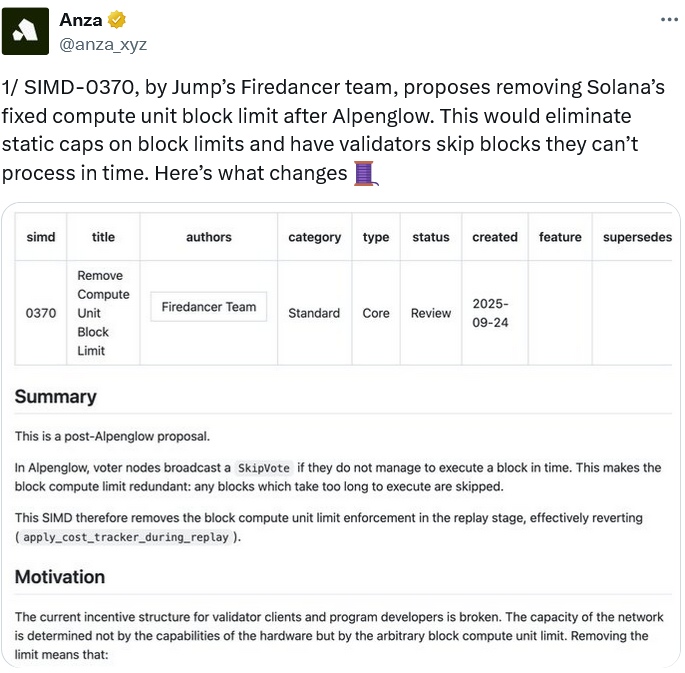
Source: X (@anza_xyz)
In essence, validators with more optimized systems would handle complex, high-volume blocks. Meanwhile, less optimized validators would skip those blocks, naturally incentivizing them to improve performance or risk losing rewards.
Before SIMD-0370 can be implemented, Solana needs to complete the Alpenglow upgrade, which passed a near-unanimous governance vote and is scheduled to go live on testnet in December 2024.
Alpenglow is being touted as Solana’s biggest protocol change ever, with the potential to reduce transaction finality from 12.8 seconds to just 150 milliseconds.
SIMD-0370 aligns well with Alpenglow’s mission: to make Solana as fast and resilient as modern internet infrastructure.
By pairing Solana Firedancer’s speed-focused architecture with dynamic compute capacity, the network can become significantly more scalable and reliable.

Kevin Bowers Talking About How Firedancer Hit 1M TPS At Solana Breakpoint 2024
Source: Solana
While the proposal aims to boost network speed, it also introduces the risk of validator centralization. Developers and engineers have raised valid concerns.
On GitHub, blockchain engineer Akhilesh Singhania commented:
“If bigger validators keep upgrading to more expensive hardware, smaller ones who cannot afford to upgrade would be forced to drop out… we might end up with fewer big validators.”
This echoes the age-old blockchain dilemma: how do you increase performance without compromising decentralization?
This isn’t the first time the block compute limit has been challenged.
In May 2024, Jito Labs CEO Lucas Bruder proposed SIMD-0286, suggesting an increase to 100 million CUs instead of removing the limit entirely.
Firedancer’s proposal, however, takes a more aggressive and performance-driven approach.
Solana Firedancer is a high-performance validator client developed by Jump Crypto to improve Solana’s scalability, speed, and resilience. It introduces a new architecture optimized for throughput and reliability.
SIMD-0370 proposes removing the fixed compute block limit currently set at 60 million CUs. Instead, block sizes would vary depending on the validator’s ability to process transactions, rewarding high-performance nodes.
Firedancer is expected to launch in a limited capacity on Solana mainnet in September 2024, with full rollout to follow based on successful testing and upgrades like Alpenglow.
The main concern is validator centralization. Smaller or underfunded validators may be unable to keep up with the performance requirements, potentially reducing network decentralization.
Alpenglow is a major Solana protocol upgrade expected in December 2024, designed to enhance finality speed and prepare the network for improvements like Firedancer and SIMD-0370.