Michael Saylor vs Peter Thiel represents a clash between maximalism and diversification in crypto investment.
Saylor’s model is built on aggressive leverage, total Bitcoin commitment, and idealistic belief in BTC as a world-changing asset.
Thiel’s strategy emphasizes cautious optimism, spreading risk across Ethereum, stablecoins, and infrastructure projects.
As crypto markets mature, the viability of Bitcoin treasury companies remains a central question.
A prolonged crypto downturn could expose critical flaws in these high-risk strategies, especially Saylor’s.
Michael Saylor, chairman and co-founder of software firm Strategy (formerly MicroStrategy), has become one of Bitcoin’s most vocal and extreme advocates.
His company has taken on a bold approach: issuing equity and convertible debt to continuously accumulate Bitcoin, making it a pioneer among so-called “Bitcoin treasury companies.”

CoinTelegraph Recently Conducted A Poll Of The 2 Approaches, With The Majority Voting For Saylor
Source: X (@Cointelegraph)
Saylor’s model, dubbed by some as an “infinite money glitch,” works like this:
Strategy raises funds via equity or debt.
The funds are used to purchase Bitcoin.
As BTC’s price rises, so does the value of Strategy’s holdings.
This valuation growth allows them to repeat the cycle with more debt or equity issuance.
While this approach is certainly interesting, it is nevertheless a highly leveraged and risky play that hinges on consistent BTC appreciation to sustain value and liquidity.
But it’s not just financial, Saylor describes Bitcoin with near-religious reverence. He has referred to it as a “swarm of cyber hornets serving the goddess of wisdom,” and believes Bitcoin is essential for the United States’ geopolitical dominance.
Peter Thiel, co-founder of PayPal and venture capitalist behind Founders Fund, has opted for a more diversified and cautious approach.
In early 2025, Founders Fund invested $200 million split between Bitcoin and Ethereum, and Thiel has spread his influence across multiple sectors:
Backing firms like ETHZilla, a biotech firm turned Ether investment vehicle.
Acquiring a 9.1% stake in BitMine Immersion Technologies, aiding a $250M ETH raise.
Supporting the Bullish exchange, which went public with a $1.15B valuation settled in stablecoins like USDC and PayPal USD.
Thiel may believe in crypto’s disruptive potential, but he’s also warned about its implications. Unlike Saylor’s enthusiastic tone, Thiel once described Bitcoin as possibly a “Chinese financial weapon” aimed at undermining the U.S. dollar.
His approach prioritizes portfolio balance and strategic hedging over the maximalism seen in Saylor’s model.
The concept of Bitcoin treasury firms, companies holding large BTC positions as primary balance sheet assets, is gaining momentum.
Yet many analysts now question whether this model is sustainable or simply a well-disguised speculative bubble.
Saylor’s strategy depends entirely on:
Access to capital markets for new funding.
Bitcoin price appreciation to inflate stock value.
But when Bitcoin prices fall, the company’s NAV (Net Asset Value) relative to share price becomes dangerously tight.
In August 2025, Strategy’s NAV was 1.4x its share price, down from 2x earlier in the year. As one Carnegie Mellon professor put it, “There’s no rational explanation for that difference.”
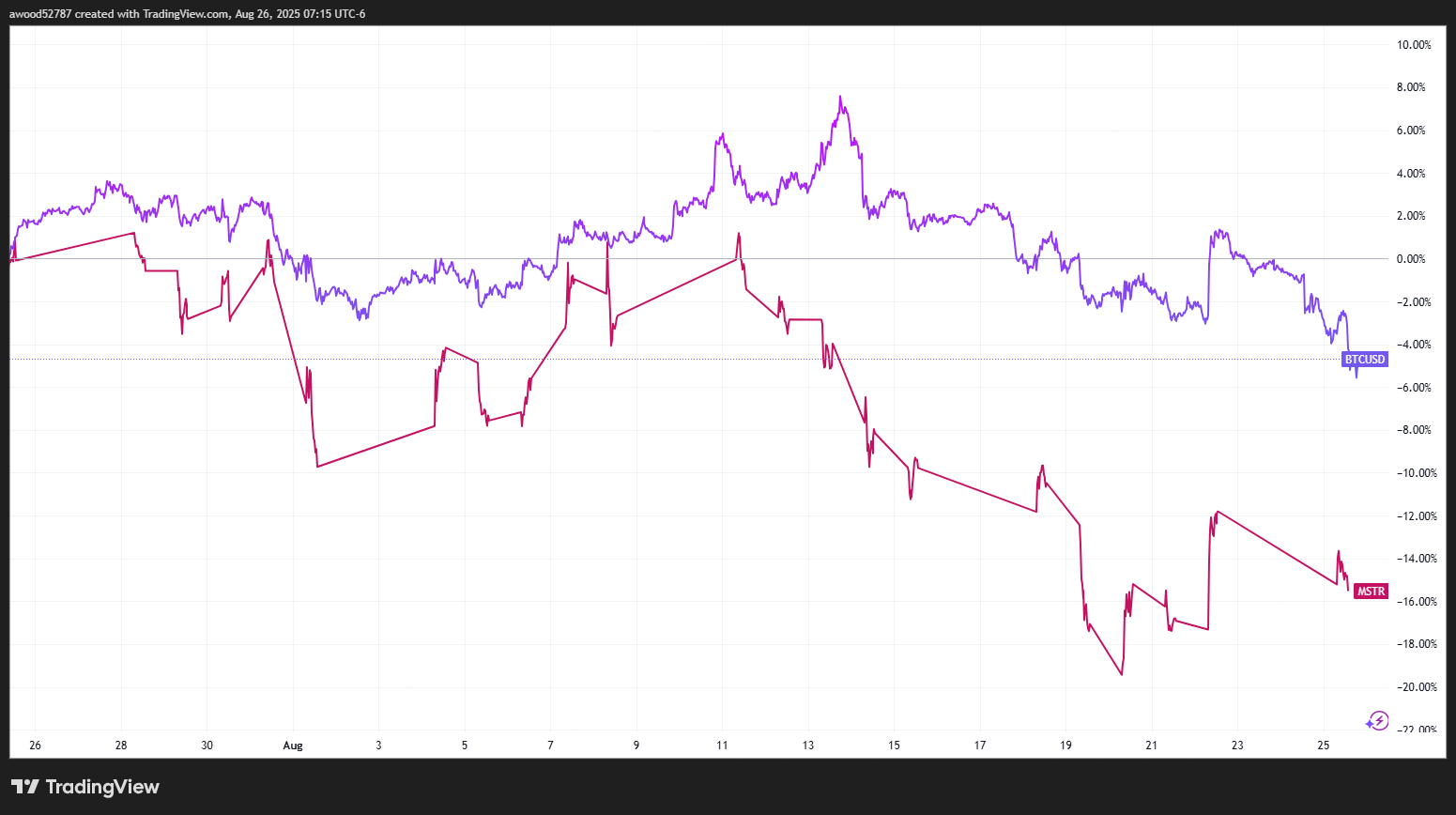
Bitcoin’s Price (Purple) Vs Strategy’s Stock (Red)
Source: TradingView
A sudden drop in BTC price can trigger a death spiral:
BTC value drops → stock valuation falls.
Capital dries up → company can’t raise more funds.
Debt obligations approach → forced liquidation of BTC holdings.
In such a spiral, companies like Strategy could collapse under their own weight.
Despite this, Strategy recently bought 3,081 BTC for $356.9 million, continuing its aggressive play regardless of market conditions.
Michael Saylor has far more direct exposure through Strategy’s multi-billion-dollar Bitcoin holdings. Thiel, meanwhile, spreads his exposure through VC investments and crypto startups.
Saylor’s approach is riskier due to its reliance on leverage and a single asset (Bitcoin). Thiel’s diversified portfolio mitigates some of that risk.
Yes. If BTC crashes, Saylor’s Strategy could enter a debt-driven collapse. Thiel’s model is more insulated, but still exposed to broader crypto market volatility.