The FBOT framework is outdated and tailored for traditional financial markets, not for offshore crypto exchanges.
Strict regulatory and operational requirements make FBOT registration impractical for most crypto platforms.
Many exchanges opt to operate in loosely regulated jurisdictions to avoid the complexities of U.S. compliance.
Legal experts recommend passing a federal crypto market structure bill to create lasting regulatory clarity.
The CFTC’s crypto sprint shows intent, but real change requires legislative action.
According to Eli Cohen, General Counsel at Centrifuge, a real-world asset tokenization company, the FBOT framework is designed for the legacy financial system, not the dynamic and fast-evolving crypto industry.
Cohen said:
“Settlement, clearing, and other regulatory requirements under the FBOT were built for traditional finance. They’re difficult, if not impossible, for crypto exchanges to meet.”
The Foreign Board of Trade registry allows non-U.S. exchanges to offer futures trading services to U.S. clients, but only under strict regulatory oversight.
This includes requirements such as:
Registration with the CFTC
Local regulatory compliance in the exchange’s home country
Meeting clearing and settlement obligations
Operating through Futures Commission Merchants (FCMs)
The CFTC’s recent advisory clarified that only regulated exchanges outside the U.S., typically those already licensed under a reputable national framework, are eligible to apply for FBOT status.
Cohen emphasized:
“You must have an existing regulatory framework in your home country. That’s the main problem, many offshore crypto exchanges intentionally avoid regulation.”
Rather than going through the burdensome process of FBOT registration, many offshore crypto exchanges choose to incorporate in unregulated jurisdictions like Seychelles or the British Virgin Islands.
This allows them to sidestep U.S. regulations entirely, and these jurisdictions often have:
Minimal oversight
Lower compliance costs
Flexible operating rules
This makes them attractive to crypto exchanges that want to prioritize speed, innovation, and unrestricted access to global markets, all of which are limited by the FBOT system.
Cohen argues that the only sustainable way to bring regulatory clarity, and attract international exchanges, is through comprehensive crypto legislation in the U.S.
Cohen stated:
“We need a crypto market structure bill that codifies regulations into law, not temporary policies that change with each administration”
Such a bill would provide:
Clear definitions of digital assets
A distinction between commodities and securities
Joint oversight by the CFTC and SEC
Consistent rules across exchanges, wallets, and custodians
The FBOT initiative is part of the CFTC’s broader “crypto sprint”, a campaign to update crypto regulations and make the U.S. a leader in the digital asset space.
The strategy aligns with President Donald Trump’s agenda, which emphasized the U.S. becoming the global hub for cryptocurrency innovation.
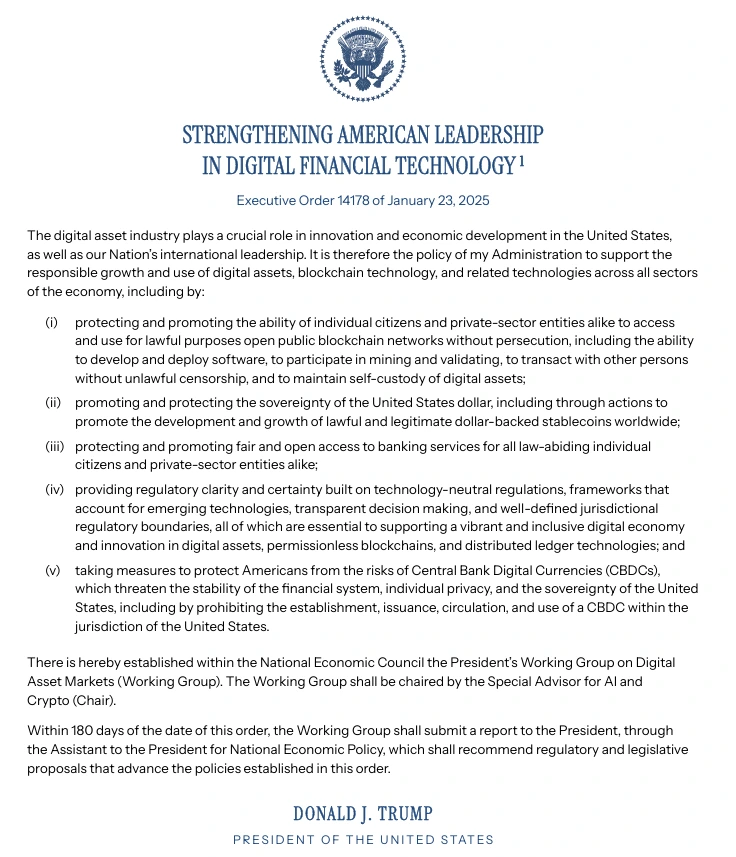
U.S. President Donald Trump’s New Policy
Source: The White House
A policy report released under his administration included proposals for:
Shared jurisdiction between the SEC and CFTC
24/7 trading across financial markets
Redefining market infrastructure to support digital assets
If implemented, these changes would break from the traditional financial model, which typically halts operations on nights, weekends, and holidays.
This could usher in a new era of perpetual markets, but only if the regulatory environment is modernized accordingly.
The Foreign Board of Trade (FBOT) framework allows non-U.S. exchanges to provide futures trading to U.S. clients, but only if they meet strict CFTC regulatory standards and are licensed in their home jurisdictions.
Because the FBOT framework is too rigid, requiring traditional finance mechanisms like FCMs and clearinghouses, which many crypto exchanges cannot or do not want to integrate.
Popular jurisdictions include Seychelles, British Virgin Islands, and Cayman Islands due to their light-touch regulatory environments.
By passing a comprehensive crypto regulation bill that defines digital assets, assigns regulatory roles, and provides consistent legal structures across all administrations.