
The Palantir lawsuit accuses former engineers of stealing proprietary AI frameworks and launching a competing startup, Percepta.
General Catalyst allegedly backed the new company, despite knowing it mirrored Palantir’s business model.
Palantir seeks to halt Percepta’s operations and extend the defendants’ non-compete restrictions.
The case underscores rising tensions around intellectual property and AI innovation in Silicon Valley.
Data analytics giant Palantir Technologies has filed a federal lawsuit against two former senior engineers, accusing them of stealing confidential files and using those assets to build a competing AI company.
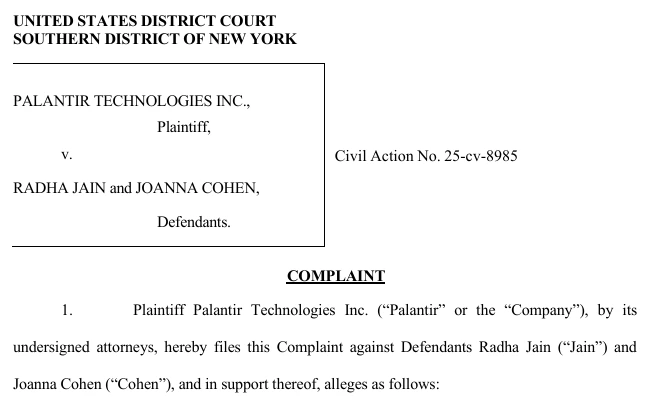
The Palantir Lawsuit
Source: Palantir
The complaint, filed Thursday in Manhattan federal court, targets Radha Jain and Joanna Cohen, who Palantir claims violated their employment contracts by secretly founding Percepta, an AI startup backed by venture capital heavyweight General Catalyst.
Palantir alleges that Jain and Cohen engaged in a “months-long charade of deception,” downloading sensitive data and keeping their new roles hidden for months.
According to court filings, the engineers had access to what Palantir calls its “crown jewels”, source code, proprietary AI frameworks, and confidential client workflows representing billions in investment.
Radha Jain, who helped design Palantir’s flagship AIP Logic, resigned in November 2024.
Joanna Cohen, a healthcare lead working on AI solutions for major clients, left in February 2025.
Palantir alleges Cohen sent herself confidential documents via Slack right after resigning, including healthcare revenue diagrams and internal demo frameworks.
The lawsuit claims she accessed these files from her personal phone after leaving the company.
As per the filing:
“They lied about their plans when they resigned. Cohen stole confidential documents, and both hid their competitive misconduct for months.”
Percepta officially launched in October, with a business model strikingly similar to Palantir’s, integrating AI for large-scale data transformation projects. Nearly half of Percepta’s founding team reportedly consists of former Palantir employees, including co-founder Hirsh Jain.
Adding intrigue to the case, General Catalyst CEO Hemant Taneja admitted earlier this year that the venture firm was “building a version of Palantir’s business.”
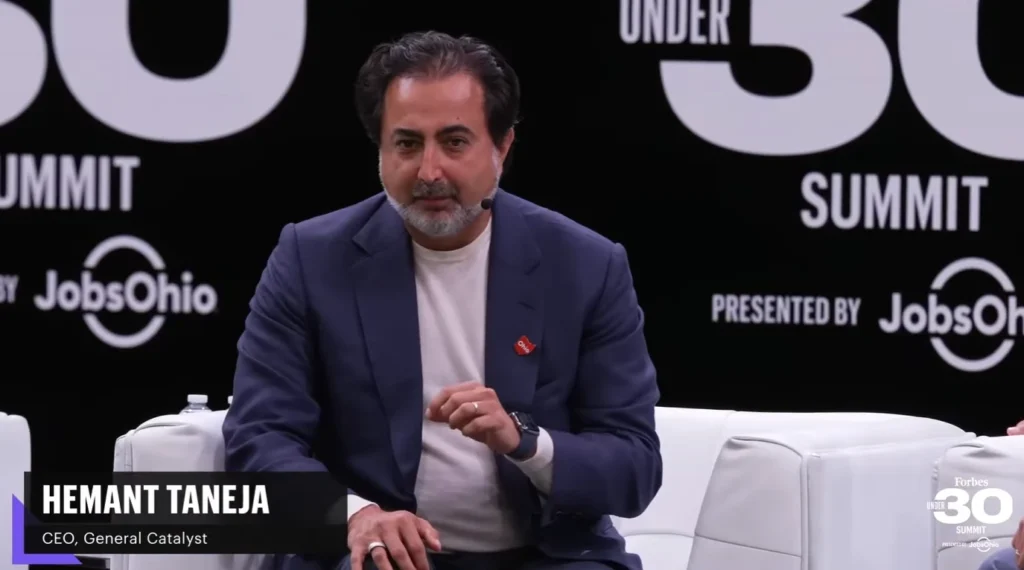
Hemant Taneja Speaking About The Incoming ‘AI Wave’
Source: Forbes
Palantir argues that access to its internal documentation could allow Percepta to “shortcut over a decade of research and millions of dollars in investment,” enabling it to replicate Palantir’s client workflows and product demonstrations.
The Palantir lawsuit seeks emergency injunctive relief, reimbursement of legal fees, and an extension of the defendants’ non-compete and non-solicitation agreements, which barred them from competing for 12 months and soliciting clients for 24 months.
The company insists the ex-engineers were compensated “millions of dollars” in exchange for those agreements, emphasizing that their actions pose “irreparable harm” to Palantir’s market position.
The case comes amid a surge of AI-related lawsuits, as major tech companies rush to protect proprietary data and algorithms.
Recent suits include:
Salesforce, accused of using pirated books to train its XGen AI models.
Microsoft, sued in Australia for allegedly misleading customers during its AI Copilot rollout.
For Palantir, the stakes are enormous. The company recently secured a $10 billion U.S. Army contract and a $30 million ICE project, making its AI tools integral to federal operations.
At a recent industry event, Palantir’s head of global communications, Lisa Gordon, described internal tensions around the company’s political direction, calling its growing alignment with conservative interests “concerning.”
As of late October, Palantir’s market capitalization has soared to $461.5 billion, marking a 374% surge this year.
Neither General Catalyst, Hirsh Jain, nor the defendants have publicly responded to the lawsuit.
Legal analysts say the outcome could set a precedent for how AI trade secrets are protected, and how aggressively tech firms can enforce non-compete clauses in a post-AI boom economy.
Palantir Technologies filed a federal case against two former engineers, alleging they stole trade secrets and used them to build a rival AI startup, Percepta.
The defendants are Radha Jain and Joanna Cohen, both former Palantir employees who allegedly joined Percepta after leaving the company.
The company says the defendants took confidential data, including internal AI frameworks, client workflow diagrams, and healthcare-related documentation.
Palantir requests an injunction to stop Percepta’s operations, repayment of legal fees, and an extension of the defendants’ non-compete clauses.
Why does this lawsuit matter?
The outcome could impact how tech companies protect AI innovations and trade secrets in an increasingly competitive landscape.