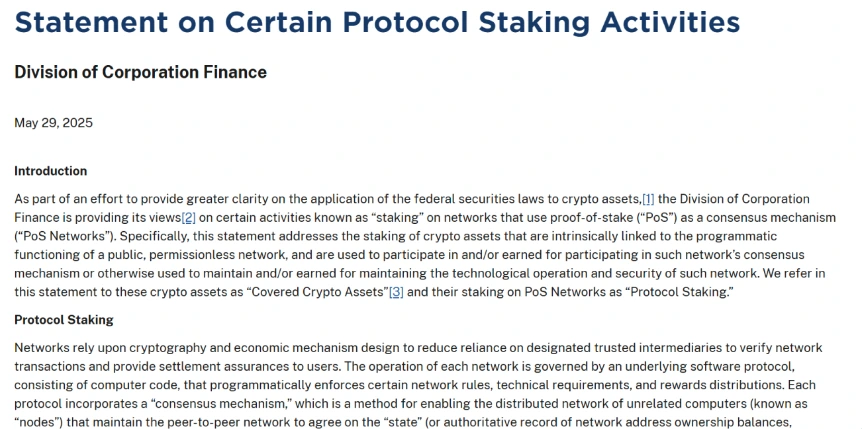
In 2025, the SEC’s Division of Corporation Finance released detailed guidelines specifying when protocol staking will not be considered a securities offering.
Source: U.S. SEC
This framework applies broadly to:
The SEC clarified that staking tied directly to a network’s consensus mechanism is not an investment contract under the Howey test. Specifically:
This is a major win for crypto stakers, node operators, and protocol developers.
If you run your own validator node and stake your crypto assets while maintaining full ownership and control, your staking activity is compliant and not treated as a security.
Delegating staking rights to third-party validators is permitted if you retain control over your assets and private keys. This form of staking remains administrative, not an investment contract.
Crypto exchanges and custodians can stake on behalf of users, provided assets are held in trust (not used for other purposes) and all terms are clearly disclosed.
Operating validator nodes and earning rewards directly from the network is allowed. This is viewed as a technical service, not investing in another business.
Service providers can offer supportive, administrative services that do not involve entrepreneurial risk, such as:
These services facilitate staking participation without triggering securities regulations.
They can confidently stake and earn rewards without registering under securities laws, reducing legal uncertainty.
The guidance validates PoS designs as non-investment contracts, supporting innovation without costly regulatory hurdles.
Exchanges and custodians can expand staking offerings legally by maintaining transparency and clear asset segregation.
Clear rules encourage both retail and institutional participation in staking, driving network security and decentralization.
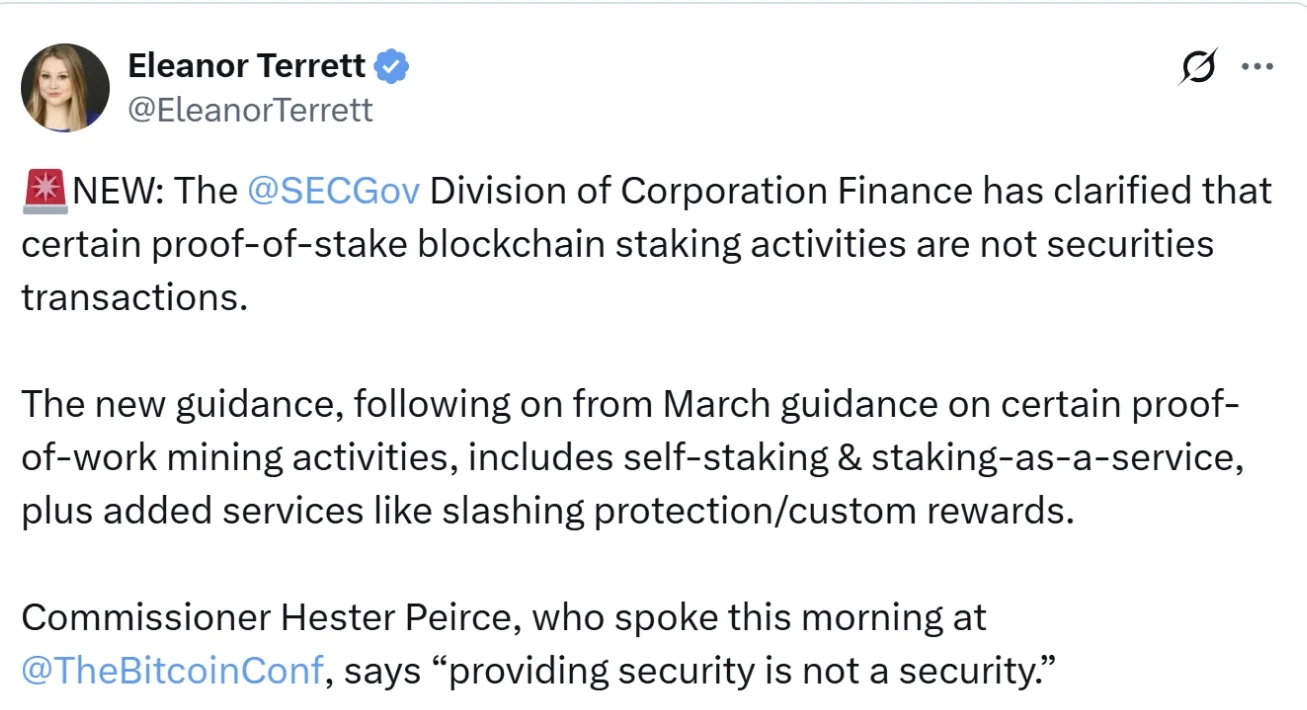
Despite the positive news, certain staking-like activities remain outside the safe harbor.
Source: X (@EleanorTerrett)
These include:
Such practices are still likely to be treated as unregistered securities.
Does staking always avoid being classified as a security?
Only if staking directly supports blockchain consensus and is not tied to profit from others’ efforts.
Can I delegate my stake without losing control?
Yes, as long as you retain ownership and private keys.
Are custodial staking services allowed?
Yes, if assets are held for the owner’s benefit and terms are clearly disclosed.
What happens if a platform guarantees returns?
Guaranteed or fixed returns likely classify the product as a security and fall outside the safe harbor.
Is Bitcoin staking covered by this guidance?
While Bitcoin itself doesn’t use PoS, protocols like Babylon enable BTC holders to participate in PoS networks compliantly.