Most blockchain cities fail due to overpromising, regulatory hurdles, or lack of infrastructure.
Floating cities like MS Satoshi underestimated maritime and logistical complexities.
Tokenization of real estate or land governance often triggers ethical, legal, and political concerns.
Small-scale projects like Liberstad succeed by focusing on achievable, community-driven goals.
Legal recognition (e.g., CityDAO in Wyoming) is not enough without proper planning and use-case alignment.
Blockchain cities are often pitched as utopian societies built from the ground up with blockchain technology at their core.
In these smart cities, transactions would happen on-chain, governance would be decentralized, and cryptocurrencies would serve as legal tender. But, between ambitious ideals and regulatory roadblocks, the dream has repeatedly struggled to manifest.
A highly controversial proposal backed by the Trump administration envisioned a tokenized smart city in Gaza, allegedly as part of a post-war reconstruction plan.
The plan involved offering landowners blockchain tokens in exchange for relocation.
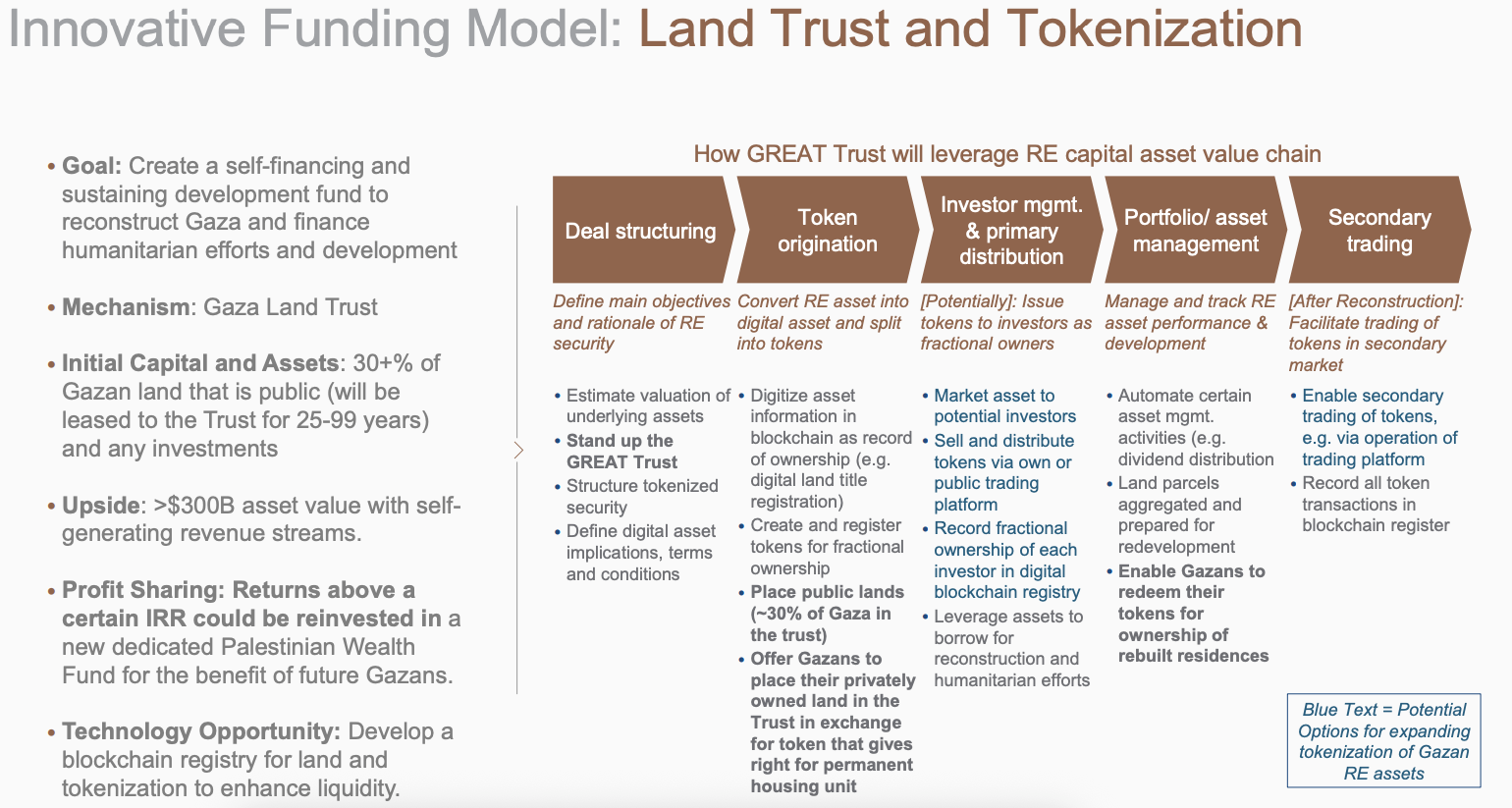
The Plan To Tokenize Gaza
Source: The Washington Post
International backlash over ethical and legal concerns
Allegations of covert geopolitical motives
No progress toward implementation
In 2020, three crypto entrepreneurs purchased a 245-meter cruise ship to launch a floating Bitcoin city off Panama. Known as MS Satoshi, the project promised a regulation-free haven for digital nomads and seasteaders.
$12,000 per day in fuel costs
Pandemic-related logistical issues
Underestimated maritime regulations
By December of that year, the project was abandoned and the ship sold.
In 2020, Akon unveiled plans for a $6-billion smart city in Senegal powered by his own cryptocurrency, Akoin. The city was meant to feature futuristic architecture, universities, and hospitals.
Minimal construction progress
Akoin’s value plummeted by 2024
Senegalese government withdrew support in 2025
The project was officially scrapped in mid-2025.
Tech incubator Blockchains LLC aimed to build a full-fledged blockchain city on 67,000 acres in Nevada. The city would use blockchain for healthcare, taxation, and digital identity.
Massive infrastructure needs, including a 100-mile water pipeline
Public and legislative resistance to “innovation zones”
Legal and logistical dead ends
No significant construction has taken place.
CityDAO began as a promising experiment following Wyoming’s 2021 legislation recognizing DAOs as legal entities.
The group quickly raised $8 million and bought 40 acres of land to start their blockchain city.

Source: X (@scottfits)
Conflicting visions for land use (conservation vs. development)
A Discord scam drained $95,000 from members
Zoning laws limited construction to a single home
Despite legal success as a DAO, the project failed to evolve into a functional city.
Founded in 2015 by Czech politician Vít Jedlička, Liberland claims uninhabited land between Croatia and Serbia. It issues its own token and aims for minimalist governance.
Ongoing police resistance at borders
Some crypto community backing
Limited real-world development
Launched in 2017, Liberstad is a self-proclaimed anarchist commune in southern Norway. It runs on its own currency, City Coin, and utilizes proprietary blockchain systems for governance and transactions.
Owns land and has permanent residents
Focused on practical, small-scale development
Minimal political interference
A blockchain city is a planned community where governance, infrastructure, and economic systems run on blockchain technology. These cities aim for decentralization, transparency, and often rely on cryptocurrency as legal tender.
Key reasons include:
Unrealistic expectations
Complex regulatory environments
Lack of funding or infrastructure
Internal governance disputes
Yes. While large-scale projects have failed, Liberstad in Norway stands out as a functioning blockchain-based community with real residents and operational systems.
Absolutely—but success depends on realistic goals, localized implementation, and legal compliance. Blockchain can support systems like property records, digital IDs, and decentralized decision-making, even in existing cities.