Key Takeaways
The GENIUS Act’s signing was not your average political event. Apart from Donald Trump, among those present were top executives from some of the world’s largest cryptocurrency companies, including:

Sergey Nazarov Meeting Donald Trump
Source: Associated Press
These industry leaders have long advocated for regulatory clarity, and many were early supporters of Trump’s 2024 campaign.
The U.S. Securities and Exchange Commission (SEC) offered an official response shortly after the law’s passage.
New SEC Chair Paul Atkins, replacing Gary Gensler, emphasized that the act provides “clear rules of the road” for stablecoin issuers.
Commissioner Hester Peirce, who now leads the SEC’s crypto task force, praised the act for its focus on payments innovation:
“Privately issued stablecoins already enjoy broad use as a payments mechanism. The GENIUS Act puts a regulatory framework around them, aiming to protect users and the financial system.”
She also confirmed that payment stablecoins will not be classified as securities, exempting them from burdensome SEC reporting requirements, so long as they meet transparency and reserve criteria.
Since taking office in January, Trump has aligned himself closely with the crypto industry. His initiatives include:
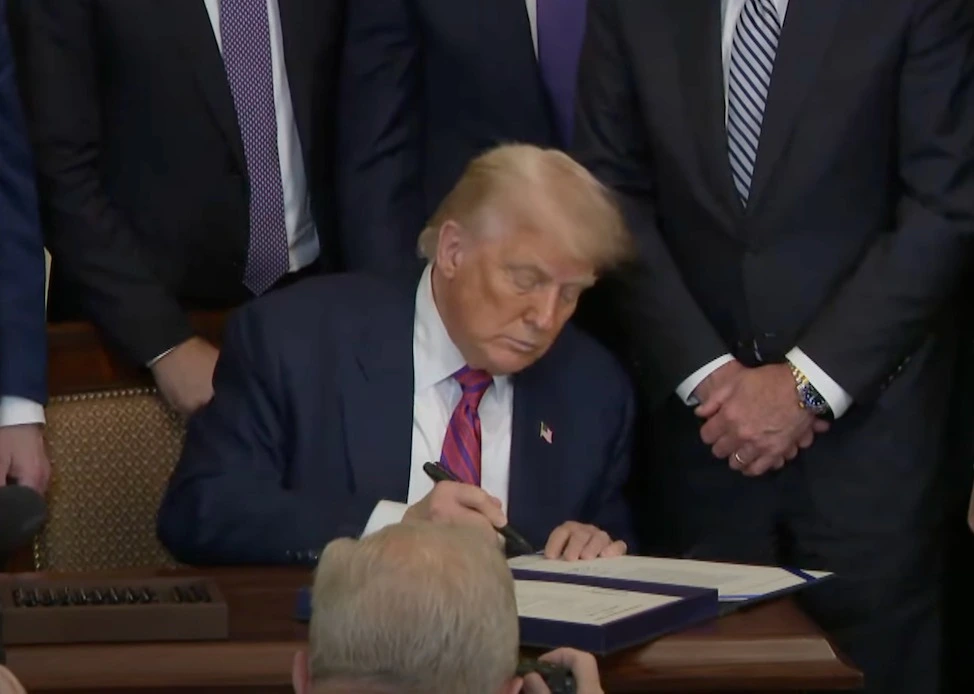
President Donald Trump Signing The GENIUS Act
Source: Associated Press
While Trump acknowledged that support from the crypto community could help him politically, he also stressed the importance of blockchain in shaping the future of U.S. innovation.
The GENIUS Act is just one of three major crypto-related bills gaining traction in Congress. Two others are now moving to the Senate:
While both received bipartisan support in the House, opposition is expected in the Senate, particularly due to concerns over Trump’s personal financial ties to crypto firms.
The GENIUS Act stands for Guiding and Establishing National Innovation for US Stablecoins. It is a federal law that sets rules for the issuance and backing of stablecoins, focusing on transparency, consumer protection, and innovation.
Yes, stablecoins that meet the act’s requirements, such as full fiat reserves and 1:1 redeemability, are now officially recognized and regulated under U.S. law.
The SEC will no longer classify qualified payment stablecoins as securities. This shift limits the SEC’s oversight while still allowing it to enforce fraud and misconduct provisions.
The GENIUS Act provides long-awaited clarity for stablecoin issuers, reducing regulatory uncertainty and allowing U.S.-based crypto companies to innovate without fear of arbitrary enforcement.
The CLARITY Act and the Anti-CBDC Surveillance State Act are both awaiting Senate consideration. Their outcomes will further shape the regulatory landscape for digital assets in the U.S.