David Carvalho, CEO of the post-quantum infrastructure firm Naoris Protocol, is sounding the alarm on an existential risk many in the crypto industry are overlooking: Bitcoin quantum computing.

Source: X (@kevinrose)
Once a hacker himself, Carvalho began his cybersecurity journey by experimenting with spam emails at age 13 to gain attention from employers. Today, he leverages that knowledge to defend decentralized networks, building systems resilient to quantum attacks.
Despite repeated assurances from blockchain developers that there is still time to adapt, Carvalho believes the window to implement quantum-resistant technologies is closing rapidly.
Bitcoin’s security relies heavily on cryptographic methods like the SHA-256 hash function and the Elliptic Curve Digital Signature Algorithm (ECDSA). These systems currently keep private keys safe and prevent unauthorized transactions.
However, quantum computers, powered by fundamentally different computational principles, have the potential to break these algorithms much faster than classical computers.
While today’s quantum machines cannot yet crack Bitcoin’s cryptography, governments and tech giants are already preparing for future capabilities. The U.S. National Institute of Standards and Technology (NIST) has urged adoption of quantum-resistant algorithms, and the NSA has advised contractors to migrate to post-quantum cryptography by 2035.
In the meantime, adversaries are collecting encrypted blockchain data now, storing it with the intention of decrypting it later when quantum technology matures.
Most fear quantum computers brute-forcing private keys. But Carvalho highlights a far more insidious risk: the combination of quantum computing with AI.
AI tools can already scan codebases for vulnerabilities, analyze network behavior, and simulate attacks in real-time. Coupled with a quantum computer capable of cracking cryptographic keys, this combo could execute stealthy, precise attacks without detection.
In Carvalho’s words:
“You won’t get a warning that a 10-year-old Bitcoin wallet has been cracked. You’ll just see funds moved, and no one will know how or by whom.”
Such attacks wouldn’t just steal coins; they could undermine trust in entire blockchains. Governance systems could be spoofed, validators manipulated, and transactions rewritten, all without clear attribution.
With approximately 25% of Bitcoin still stored in older, more vulnerable address formats, these risks are not hypothetical.
Despite Bitcoin’s decentralized protocol, much of its real-world infrastructure is centralized: cloud providers, mining pools, and validator networks.
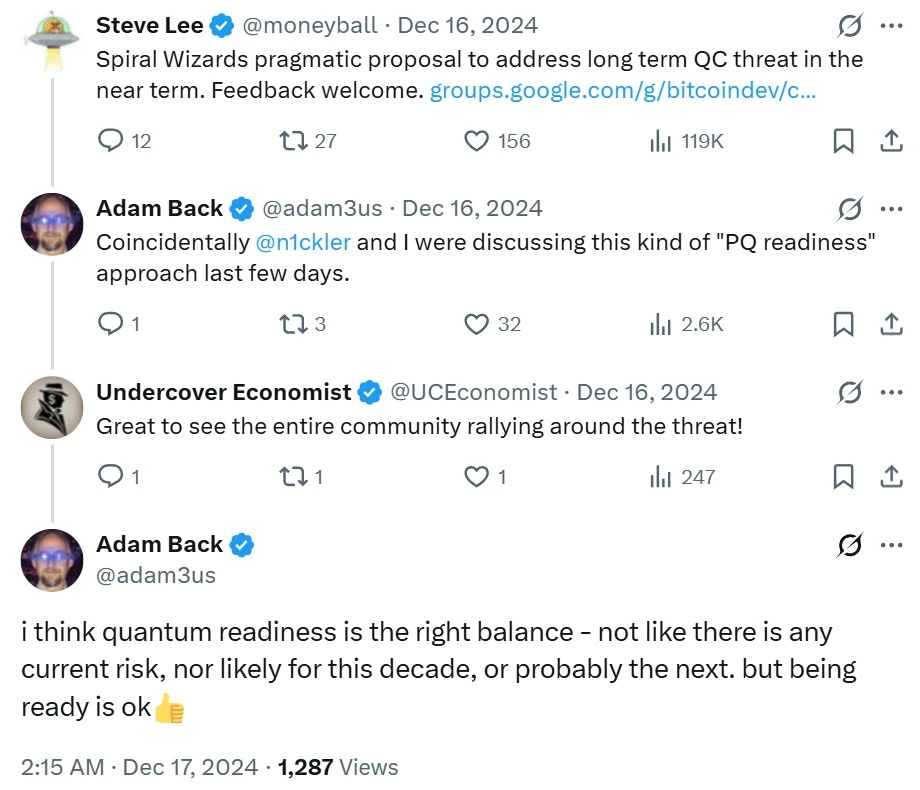
Source: X (@adam3us)
If a quantum-capable adversary compromises a major cloud platform hosting hundreds of nodes, the damage could cascade through the network.
Carvalho warned:
“Decentralization is great on paper, but if everyone’s routing through the same few backbones or trusting a handful of third-party APIs, the game’s already lost.”
Some projects have begun to tackle the looming threat:
While the threat of Bitcoin quantum computing grows ever more real, the collective response remains uneven. Experts agree the time to act is now, before quantum computers reach the capability to silently dismantle blockchain security.
Bitcoin quantum computing refers to the risk that quantum computers could break the cryptographic algorithms protecting Bitcoin’s network and private keys, potentially allowing hackers to steal coins or manipulate transactions.
Though current quantum technology isn’t yet strong enough to break Bitcoin’s cryptography, experts warn breakthroughs could happen within a decade, making preemptive defense urgent.
These attacks involve collecting encrypted blockchain data today, storing it, and decrypting it in the future once quantum computers become powerful enough.
Yes, through proposals like BIP-360 and new quantum-resistant cryptographic methods, Bitcoin can evolve to maintain security in a post-quantum world.
AI can automate and optimize attacks, identifying vulnerabilities and adapting in real-time. Paired with quantum computing’s power, this can lead to stealthy, hard-to-detect breaches.