
The Athena Bitcoin lawsuit accuses the company of charging hidden fees and enabling scams via its crypto ATMs.
Nearly 93% of early transactions were allegedly linked to fraud, primarily targeting seniors.
Athena could face significant penalties for alleged deceptive and unfair business practices.
The case reflects a larger crackdown on crypto ATM fraud across the U.S.
Consumers should be vigilant and follow best practices to avoid falling victim to scams.
According to the lawsuit filed, the DC Attorney General’s Office claims that nearly 93% of deposits made through Athena Bitcoin ATMs during the company’s first five months of operation in Washington, D.C., were directly linked to scams.
AG Brian Schwalb said in a public statement:
“Athena knows that its machines are being used primarily by scammers, yet chooses to look the other way so that it can continue to pocket sizable hidden transaction fees.”
The company’s no-refund policy has allegedly prevented victims, many of them elderly, from recovering losses incurred through fraudulent schemes facilitated via Athena’s kiosks.
The lawsuit claims that Athena Bitcoin charged consumer fees as high as 26% without clearly informing users.
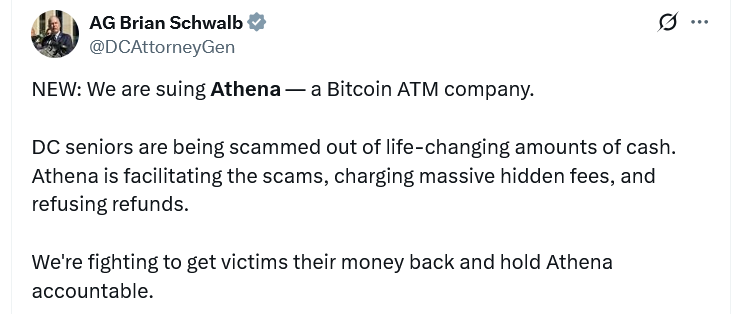
Source: X (@DCAttorneyGen)
In fact, the only mention of fees was buried in the company’s Terms of Service, where the vague phrase “Transaction Service Margin” was used, never explicitly calling it a fee.
Schwalb’s office argues that this practice constitutes deceptive and unfair trade conduct, in violation of D.C.’s consumer protection laws.
Furthermore, Athena is accused of violating statutes that specifically protect vulnerable adults and senior citizens from financial exploitation.
The data included in the filing paints a troubling picture:
Median victim age: 71 years old
Median loss per transaction: $8,000
One D.C. resident reportedly lost $98,000 to a scam executed via an Athena kiosk
The complaint alleges Athena earned hundreds of thousands of dollars in hidden fees during its early operations in the district, from May to September 2024.
According to the AG’s office, Athena’s systems lacked sufficient oversight and safeguards to detect or prevent fraudulent transactions.
The complaint states that the company’s weak controls created an “unchecked pipeline for illicit international fraud,” effectively enabling scammers to exploit the machines for large-scale fraud.
As per the filing:
“Athena has permitted and profited from transactions in which victims are coerced, misled, and manipulated into depositing their life savings into Athena’s machines under fraudulent pretenses.”
The Athena Bitcoin lawsuit comes during a nationwide crackdown on crypto ATMs:
In 2024 alone, the FBI received nearly 11,000 fraud complaints related to crypto kiosks, amounting to $246 million in losses.
13 states, including Arizona, Colorado, and Michigan, have imposed transaction limits to curb abuse.
There are currently over 26,850 crypto ATMs in the United States, with Athena Bitcoin operating approximately 13% of them—trailing only behind Bitcoin Depot and CoinFlip.
With the rise of crypto fraud via ATMs, users should be cautious, especially given the fact just how popular and widespread these ATMs have become.
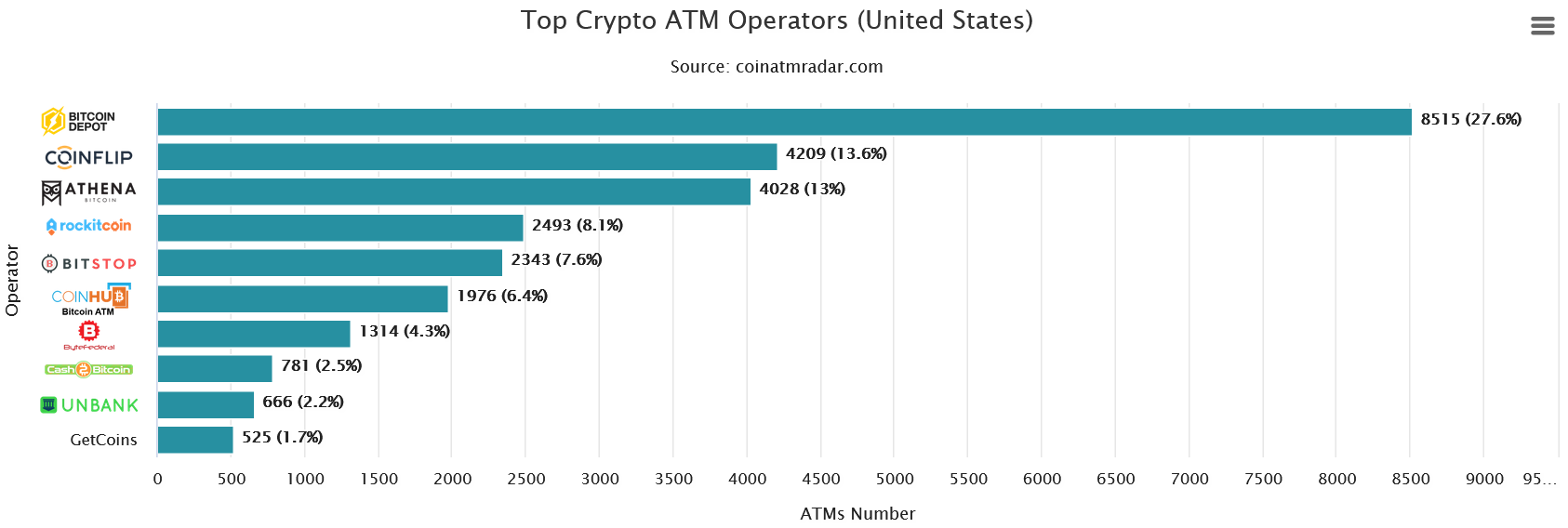
Source: CoinATMRadar
Here are some safety tips:
Never send crypto to someone you haven’t met in person
Be skeptical of unsolicited messages or calls claiming to be from crypto companies, banks, or government agencies
Avoid promises of guaranteed profits, they are likely scams
Always verify contact information through official websites, not what scammers provide
The Athena Bitcoin lawsuit echoes ongoing issues in traditional finance. Several major banks have recently been penalized for deceptive fee practices:
Discover Bank was ordered to refund $1.2 billion in overcharged fees (April 2024)
Wells Fargo paid $3.7 billion in 2022 for illegal interest charges
Bank of America was fined $250 million in 2023 for “junk fees”
These parallels suggest that hidden fees are not just a crypto problem—they’re part of a broader pattern of financial exploitation.
The lawsuit alleges that Athena Bitcoin charged undisclosed fees and failed to implement fraud prevention measures, resulting in significant financial losses for users, particularly the elderly.
The lawsuit was filed by Brian Schwalb, the Attorney General for the District of Columbia.
According to the filing, fees reached up to 26% per transaction, often without any clear disclosure to users.
Crypto ATMs can be safe, but users must exercise caution and avoid interacting with unknown individuals or offers that sound too good to be true.
As of now, Athena Bitcoin has not publicly responded to the allegations in the lawsuit.