The Bitcoin Reserve Bill refers to a legislative effort to establish a US government-backed reserve of 1 million Bitcoin over five years.
Key figures from the crypto and finance sectors, including Michael Saylor and Tom Lee, are working with lawmakers to move the bill forward.
Focus is on ensuring the Bitcoin acquisitions are funded in a way that does not burden taxpayers.
If successful, the bill could strengthen the US’s position in the global cryptocurrency ecosystem and pave the way for broader adoption of Bitcoin as a reserve asset.
Among the industry leaders attending the roundtable discussions are some of the most influential figures in crypto and finance. Michael Saylor, known for his advocacy of Bitcoin as a reserve asset, is joined by Tom Lee, a veteran investor and CEO of Fundstrat Global Advisors.
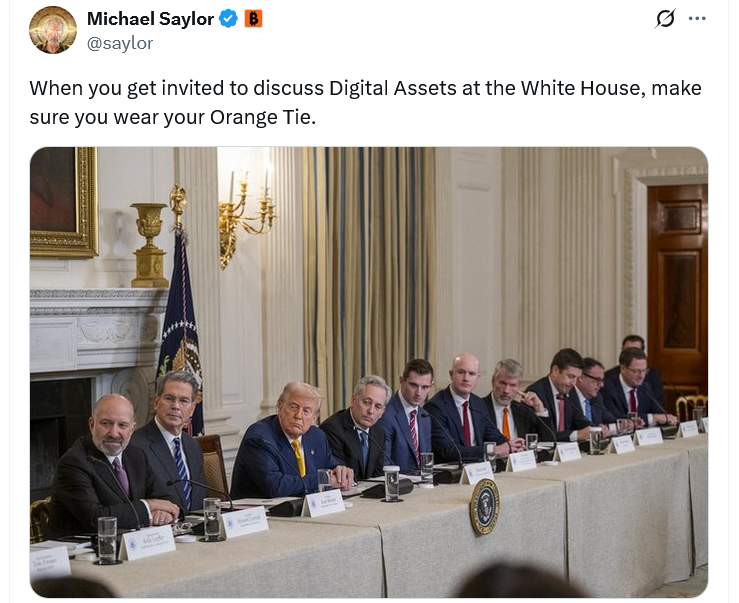
Source: X (@saylor)
Other notable attendees include Fred Thiel, CEO of Marathon Digital Holdings (MARA), and executives from prominent Bitcoin mining companies such as CleanSpark, Bitdeer, and others.
The goal of this meeting is to create momentum for the Bitcoin Act, which was introduced by US Senator Cynthia Lummis in March. The bill proposes that the US government acquire 1 million Bitcoin (BTC) over the course of five years, as part of a broader effort to create a Strategic Bitcoin Reserve.
The Bitcoin Act is a legislative measure that seeks to establish a government-backed reserve of Bitcoin. The bill envisions the purchase of 1 million Bitcoin, which would be funded by the Federal Reserve and the Department of the Treasury.
However, the key challenge for lawmakers is to ensure that these purchases are made using budget-neutral strategies, in line with an executive order from President Donald Trump.
The roundtable will be hosted by The Digital Chambers and its affiliate, The Digital Power Network. This meeting will allow stakeholders to discuss ways to fund these Bitcoin purchases without burdening taxpayers. Key strategies under consideration include re-evaluating the US Treasury’s gold certificates and exploring tariff revenue.
One of the primary concerns about the Bitcoin Act is how to fund such a large acquisition of Bitcoin without negatively impacting the US taxpayer.

Source: www.congress.gov
During the roundtable, industry experts will pitch several potential budget-neutral strategies. Among the most discussed options are reevaluating the value of the Treasury’s gold certificates, and leveraging existing tariff revenue streams.
These discussions are crucial to overcoming the roadblocks that have prevented progress on the Bitcoin Act over the last six months. Lawmakers will also focus on identifying and addressing the primary objections to the bill, ensuring that the proposed reserve aligns with both economic and political realities.
The Bitcoin Reserve Bill has gained significant attention from a variety of sectors. Bitcoin mining executives, venture capitalists, and traditional finance representatives will all play a role in advancing the legislation.
In addition to Saylor and Lee, other Bitcoin mining executives, such as Matt Schultz and Margeaux Plaisted from CleanSpark, and Jayson Browder from MARA, will be at the table.
Venture capital firms like Off the Chain Capital and Reserve One are also sending representatives to the discussion. Andrew McCormick, the head of eToro’s US business, will attend as well, offering insights from the investment community.
Traditional finance representatives, such as David Fragale from Western Alliance Bank and Jay Bluestine from Blue Square Wealth, will also participate, highlighting the growing intersection of traditional finance and the cryptocurrency industry.
While the Bitcoin Act has garnered significant support from the cryptocurrency community, it still faces considerable opposition from some lawmakers.
The roundtable discussions will focus on identifying the reasons why momentum for the bill has stalled and addressing concerns about its long-term impact. Some of the primary objections to the bill are likely to revolve around concerns about the volatility of Bitcoin and its potential impact on US fiscal policy.
Despite these hurdles, the bill has the potential to revolutionize the way the US government interacts with digital assets. By building a strategic reserve of Bitcoin, the US could further solidify its position as a leader in the global cryptocurrency ecosystem.
The Bitcoin Reserve Bill, also known as the Bitcoin Act, is a proposed piece of legislation that aims to establish a government-backed Bitcoin reserve. The bill calls for the US government to acquire 1 million Bitcoin over five years, with funding provided through budget-neutral strategies.
Industry leaders like Michael Saylor, Tom Lee, Fred Thiel, and representatives from major Bitcoin mining companies will participate in discussions to advance the bill.
The Bitcoin purchases are expected to be funded through the Federal Reserve and the Department of the Treasury. Several budget-neutral strategies, such as reevaluating gold certificates and using tariff revenue, are being considered.
Some lawmakers have raised concerns about Bitcoin’s volatility and its potential effects on US fiscal policy. These concerns will be addressed in the roundtable discussions.
If passed, the Bitcoin Reserve Bill could significantly alter the way the US government interacts with cryptocurrency and position the country as a global leader in digital asset reserves.