Key Takeaways
Vietnam’s crypto pilot has not received any applicants since its launch under Resolution 05/2025.
High capital requirements (10 trillion dong) and restrictions on stablecoins and tokenized assets are major deterrents.
Global trends show massive growth in stablecoins and tokenized treasuries, which are not allowed in Vietnam’s program.
Other jurisdictions in Asia offer lower barriers and more flexible frameworks, making them more appealing to crypto firms.
Unless Vietnam revises its pilot structure, it risks missing out on the opportunity to lead in the regulated crypto space.
Vietnam’s Crypto Pilot: A No-Show So Far
At a recent press conference, Deputy Minister of Finance Nguyen Duc Chi confirmed that the Ministry of Finance has not yet received any applications from enterprises to join the pilot.

Deputy Minister Of Finance, Nguyen Duc Chi, Discussing Vietnam’s Crypto Pilot Program
Source: The Investor
The initiative, set to run for five years, is designed to test digital asset trading in a controlled and regulated environment.
Chi stated:
“As of now, the ministry has not received any proposals from enterprises.”
The program was launched under Resolution 05/2025, allowing up to five licensed participants.
However, Chi emphasized that launching the pilot depends on how well companies can meet the government’s stringent requirements:
“We hope to launch this pilot before 2026. However, the progress will depend on how well enterprises can meet the required conditions.”
Why Companies Are Reluctant To Join
Steep Capital Requirements
One of the biggest barriers is the capital requirement for crypto asset service providers (CASPs).
To qualify, companies must maintain a minimum capital of 10 trillion dong (approximately $379 million), a figure more aligned with commercial banks than fintech startups.
By contrast, Singapore, Hong Kong, and Japan offer regulatory pathways that require significantly less capital, often between $1 million and $5 million, making them more attractive options for crypto businesses looking to expand in Asia.
Limited Product Offerings
Vietnam’s crypto pilot also imposes tight restrictions on the types of digital assets that can be offered:
Stablecoins backed by fiat currencies (like USDT and USDC) are not permitted.
Tokenized securities and money-market funds are also banned.
This means that some of the most in-demand crypto products, especially among institutional and retail investors, are off the table.
This restrictive framework significantly limits what companies can do within the pilot and may undermine its potential success.
Global Trends Paint A Different Picture
Stablecoins See Massive Growth
Globally, the demand for fiat-backed stablecoins continues to soar. In Q3 2025 alone, the stablecoin market:
Reached a supply of over $300 billion
Facilitated over $15.6 trillion in transfers
Recorded $46 billion in inflows, led by:
USDT (Tether)
USDC (Circle)
Tokenized Treasuries Are On The Rise
Meanwhile, tokenized real-world assets (RWAs), especially treasuries, have surpassed $8 billion in market value, according to RWA.xyz.
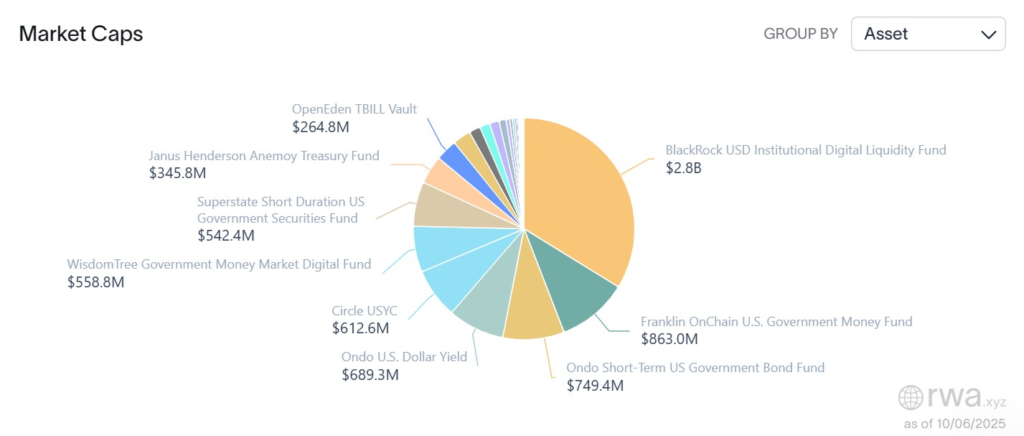
Tokenized Treasuries Data
Source: RWA.xyz
Key players include:
BlackRock’s BUIDL fund
Franklin Templeton’s BENJI tokens
These instruments offer yield, transparency, and faster settlement, appealing benefits for institutional investors. Unfortunately, Vietnam’s crypto pilot rules out these types of assets entirely.
FAQ
What is Vietnam’s crypto pilot?
Vietnam’s crypto pilot is a five-year program launched by the Ministry of Finance to test and regulate digital asset trading in the country. It allows for a maximum of five licensed participants.
Why have no companies applied?
So far, no companies have applied due to:
Extremely high capital requirements (~$379 million)
Prohibition of stablecoins and tokenized securities
Limited product offerings
When will the pilot begin?
The government hopes to begin the pilot before 2026, but the timeline depends on whether companies can meet the required conditions.
How does Vietnam compare to other Asian markets?
Other jurisdictions like Singapore and Hong Kong have:
Lower capital requirements
Support for a broader range of crypto products
This makes them more attractive to crypto firms than Vietnam.