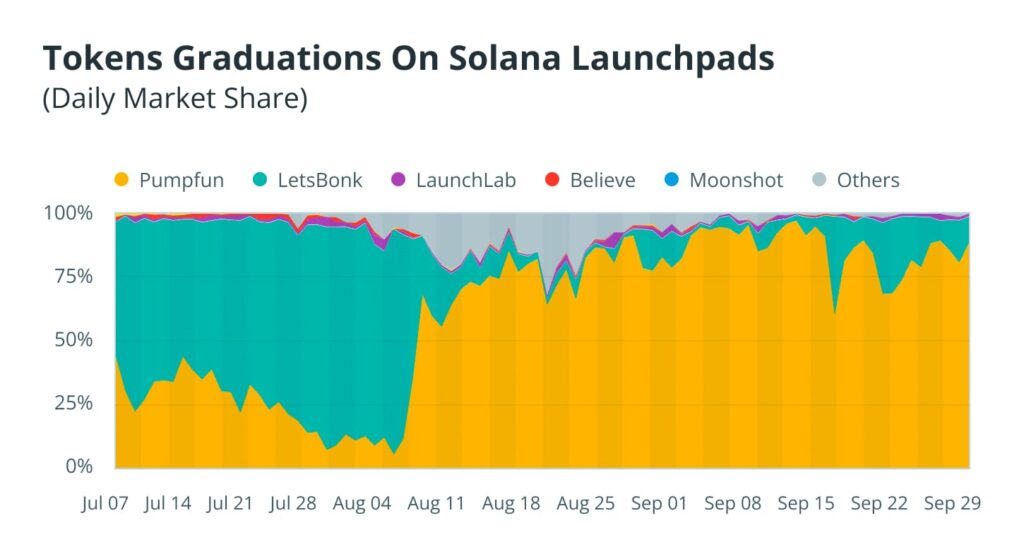
Pump.fun peaked with 75%–80% market share by offering frictionless token minting and automated liquidity solutions.
Its bonding-curve model standardizes early trading while discouraging rug pulls.
Platform activity is highly cyclical, plunging 80% from January highs before recovering by late August.
Competitors like LetsBonk, HeavenDEX, and Raydium LaunchLab offer lower fees and incentives but struggle to match Pump.fun’s network effects.
Security breaches and ongoing U.S. litigation (including RICO claims) pose major risks.
Pump.fun is a Solana-native launchpad built for memecoins. It allows users to create a new token with just a few clicks — no code, no fees, and minimal technical knowledge required.
Each new memecoin begins on a bonding-curve smart contract. Around 800 million tokens are offered at increasing prices. Once sold out, the coin “graduates” to a DEX, originally Raydium, now Pump.fun’s own PumpSwap.
Source: CoinTelegraph
When a token graduates, PumpSwap burns the liquidity provider (LP) tokens, locking liquidity and minimizing rug-pull risks. Users can only trade the token, not withdraw its backing assets, creating a level playing field for early price discovery.
Pump.fun’s meteoric rise was driven by a perfect blend of usability, liquidity mechanics, and incentives. As Solana’s memecoin mania surged, Pump.fun’s seamless experience turned it into the go-to platform.
January 2025: Daily launches peak at 1,200; fees hit a record $15.4M in 24 hours.
February 2025: Activity crashes 80% as market cools.
August 2025: Market share rebounds to 74% weekly; daily volume hits multibillion levels.
To retain deployers and liquidity:
Pump.fun launched Project Ascend, a creator rewards program.
Weekly PUMP token buybacks consumed up to 90% of revenue.
Over $16M was paid out to creators in September 2025 alone.
LetsBonk briefly overtook Pump.fun in July 2025 by offering better fees. Market share flipped again in August.
Solana’s long-standing DEX created LaunchLab as an alternative. Tokens graduate directly into Raydium’s deep liquidity pools.
Launched a “burn-all-revenue” model. At its peak, it captured 15% of daily memecoin launches, positioning itself as an “anti-Pump” option.
Switching costs are also low, so deployers often chase the best deal, fees, incentives, and liquidity depth.
May 2024: $1.9M exploit by a former employee halted the platform temporarily.
Feb 2025: The official X (Twitter) account was hacked to promote a fake PUMP token.
In July 2025, Pump.fun was named in a U.S. class-action lawsuit with RICO claims, alleging it facilitated unregistered securities sales.
Memecoin demand is tied to retail sentiment. Pump.fun’s revenue dropped 80% from January highs before rebounding in August.
Critics argue that 98%-99% of tokens launched on Pump.fun exhibit rug-pull or pump-and-dump patterns, an accusation the platform disputes.
So long as the platform maintains low friction, locked liquidity, and consistent buybacks/incentives, it’s likely to stay dominant, especially during market upswings.
Pump.fun needs to maintain its fee structure. One of the biggest reasons why so many flock to the platform for memecoins is because of:
No minting fee
Graduation fee: just 0.015 SOL (deducted from liquidity)
Despite the simplicity, fewer than 1% of launches ever graduate. In July and August 2025, graduation rates sat between 0.7% and 0.8%.
Source: The Block
Rivals can quickly seize momentum by slashing fees or improving liquidity. Legal or regulatory fallout could also reshape how Pump.fun operates.
Stay updated on weekly share of graduated Solana memecoins.
High levels of support tend to precede volume rebounds.
Changes here could instantly shift deployer behavior.
Metrics like DEX volume and TVL affect post-launch liquidity.
Keep tabs on the consolidated lawsuit. Unfavorable rulings could cap growth.
A Solana-based memecoin launchpad that allows easy token creation with bonding-curve sales and automatic liquidity locking.
It removes technical barriers, standardizes token launches, and locks liquidity to reduce rug-pull risk.
Security incidents, legal scrutiny, and cyclical retail interest can all impact Pump.fun’s sustainability.
By offering lower fees, better rewards, or deeper post-graduation liquidity.
While the contracts have held up, there have been social engineering attacks and internal exploits. Caution is still advised.