On Tuesday, the SEC raised the position limits for options contracts on ETFs from 25,000 to 250,000 contracts. This change applies broadly to ETFs with options exposure, including BlackRock’s IBIT Bitcoin ETF.
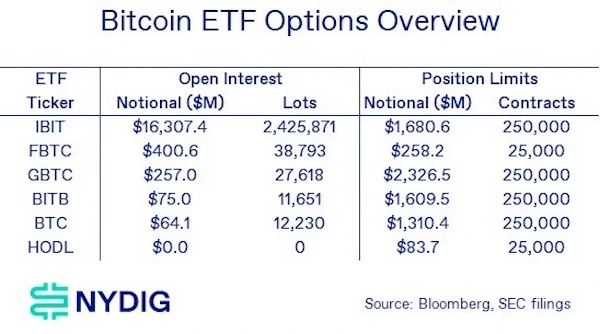
Overview Of The New Options Limits By The SEC
Source: NYDIG
However, some funds, such as the Fidelity Wise Origin Bitcoin Fund (FBTC), were excluded from this increase.
Greg Cipolaro, the global head of research at crypto financial services firm NYDIG, noted in a report that this regulatory adjustment would widen the “monstrous lead” that IBIT holds over its closest rivals.
BlackRock’s IBIT currently manages approximately $85.5 billion in assets, which is roughly four times larger than the next biggest Bitcoin ETF, FBTC, with $21.35 billion in assets under management (AUM), according to data from CoinGlass.
This sizeable difference in AUM, combined with the new options limits, places BlackRock in an even stronger position within the Bitcoin ETF landscape.
One of the most significant effects of the SEC’s decision is the potential reduction in Bitcoin’s market volatility.
Cipolaro explained that the expanded options contract limits enable more aggressive options trading strategies, such as covered call selling, where traders sell call options on assets they already own.
Covered call selling is an options strategy that can limit downside risk while capping potential gains. Investors hold the underlying asset, in this case, Bitcoin via the ETF, and sell call options against it, earning premium income while hedging their position.
By allowing ETFs to engage more heavily in this type of options activity, Bitcoin’s price swings could become less extreme, smoothing out volatility in the process.
Lower volatility makes Bitcoin more attractive to risk-conscious institutional investors. Cipolaro emphasized that reduced price swings enhance Bitcoin’s appeal on a risk-parity basis, encouraging larger capital inflows from portfolios that seek balanced risk exposure.
The data supports this trend: over the past 12 months, Bitcoin’s volatility has steadily declined, a factor that could fuel a feedback loop of increased spot buying by institutional investors seeking steady returns.
In addition to the options contract changes, the SEC approved a series of ETF regulatory updates on the same day, including the authorization of in-kind creation and redemption for crypto ETFs.
This process allows ETF shares to be exchanged for the underlying assets, in this case, Bitcoin, instead of cash. This method reduces transaction costs and increases efficiency for ETF issuers and investors.

The Changes Made By The SEC On Tuesday
Source: NYDIG
Greg Cipolaro identified this feature as a key demand from ETF issuers before product approval. Its implementation is expected to enhance market structure and improve investor access.
Authorized Participants (APs) are financial institutions responsible for creating and redeeming ETF shares. However, many APs currently lack the infrastructure to handle crypto assets directly.
Cipolaro pointed out that only two APs, Jane Street and Virtu, have the necessary crypto trading capabilities to benefit fully from arbitrage opportunities enabled by the new rules. Other APs without crypto arms will likely seek partnerships or acquisitions to remain competitive in this evolving market.
A Bitcoin ETF (exchange-traded fund) is a financial product that tracks the price of Bitcoin and is traded on traditional stock exchanges. It allows investors to gain Bitcoin exposure without owning the cryptocurrency directly.
The SEC increased the maximum allowed options contracts from 25,000 to 250,000, enabling Bitcoin ETFs like BlackRock’s IBIT to implement more advanced options strategies. This can reduce volatility and increase demand.
Lower volatility attracts institutional investors who require more stable assets. It can also encourage spot buying of Bitcoin, driving sustained demand.
It’s a process that allows ETF shares to be exchanged for the underlying assets, improving efficiency and lowering costs for issuers and investors.
Authorized Participants (APs) are institutions that facilitate the creation and redemption of ETF shares. Their crypto capabilities affect how efficiently ETF shares trade and maintain price alignment with underlying assets.

 Skip to content