
The crypto market is down, but crypto treasury companies have underperformed significantly.
Firms like Strategy, Metaplanet, and SharpLink are trading well below their all-time highs despite gains in BTC and ETH.
Over 140 companies now operate with crypto treasuries, saturating the market and compressing valuations.
Altcoin-based treasury stocks have performed worse than BTC-based ones.
Structural weaknesses, debt exposure, and unrealistic expectations may make crypto treasuries vulnerable in future downturns.
Despite short-term gains in crypto prices, companies using digital assets as corporate treasuries have seen their valuations crumble.
In some cases, shares of these firms have plummeted by over 90%, sharply underperforming the broader crypto market.
Strategy, the largest Bitcoin (BTC) treasury company, has dropped approximately 45% from its all-time high of $543 per share reached in November. By comparison, Bitcoin itself is up 10% from its high of over $99,000 during the same month.
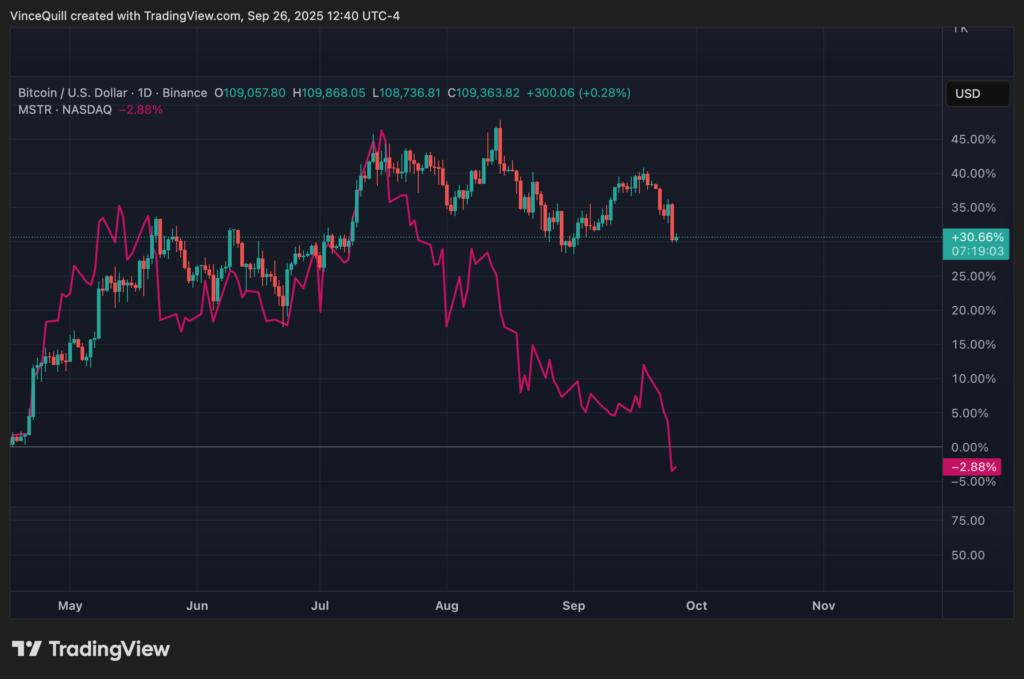
Bitcoin’s Price Compared To Strategy’s Price (Shown In Magenta)
Source: TradingView
BTC has since set multiple new all-time highs, most recently peaking above $123,000 in August 2025. Despite that, Strategy has failed to reclaim its former highs or reach new records in 2024 or 2025.
This trend reflects a disconnect between the performance of core digital assets and the companies built around them.
Metaplanet, another Bitcoin-focused treasury firm, tells a similar story. After peaking at $16 in May, the company’s shares have tumbled to around $3.55, representing a 78% decline.
Over the same period, Bitcoin itself is only down about 2%, reinforcing the underperformance trend.
The situation is even more dire for companies that adopted altcoins such as Ethereum (ETH), Solana (SOL), or BNB as treasury assets.
SharpLink Gaming, which pivoted to Ethereum in 2025, saw its stock surge to $124 in May before collapsing by 87% to $15.72. Meanwhile, ETH has surged by 115% over the same period, clearly outperforming the company that holds it.
Helius Medical Technologies, a Solana (SOL) treasury company, has lost a staggering 97% of its value year-to-date. In contrast, SOL is down just 33% from its peak of $295 reached in January during the memecoin craze.
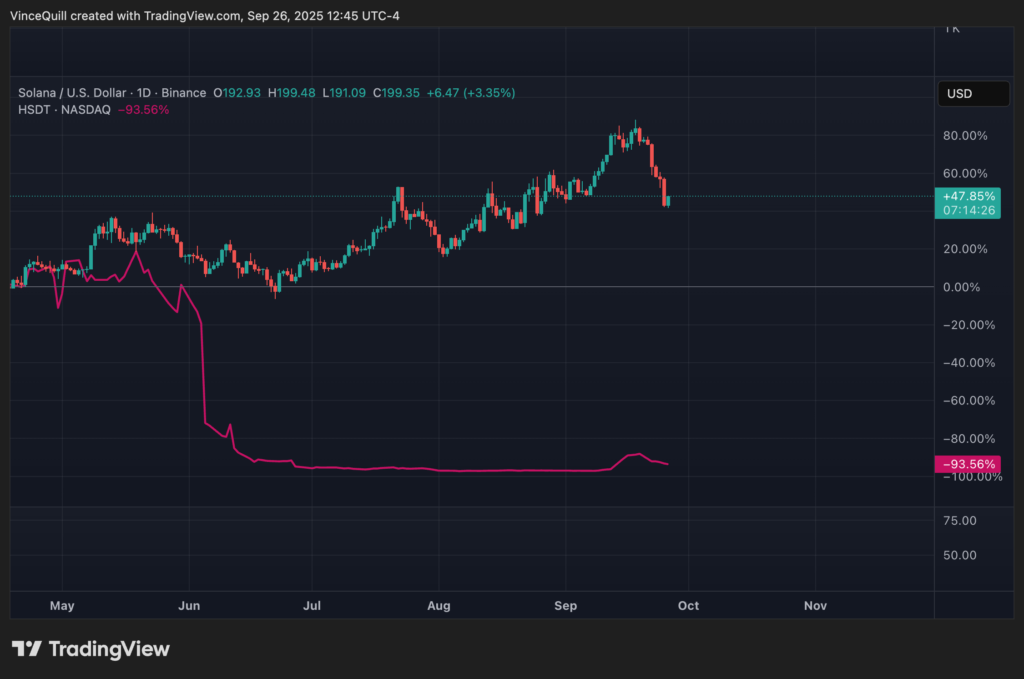
SOL’s Price Compared To Helius Medical Technologies (Shown In Magenta)
Source: TradingView
CEA Industries, which adopted BNB as its primary treasury asset in 2025, has also seen steep losses.
After reaching an all-time high of $34 in August, its stock has plummeted 77% to just $7.75. This happened even as BNB soared to a new high of over $1,000 in September.
Investors expected crypto treasury companies to provide leveraged exposure to digital assets.
In practice, these companies often face operational, regulatory, and debt-related challenges that erode shareholder value.
Many crypto treasury firms took on debt to buy crypto, betting on continued price appreciation.
If prices fall or stagnate, these companies may be forced to liquidate assets, exacerbating volatility in the broader crypto market.
According to analysts from Standard Chartered, the drop in corporate treasury share prices is driven largely by market saturation.
The bank noted a contraction in multiple on net asset value (mNAV), a valuation metric comparing a company’s market capitalization to the assets it holds.
As of Q3 2025, over 140 public companies have adopted crypto treasury strategies (CoinGecko), crowding the market and lowering investor confidence.
Investors initially hoped these companies would amplify gains from underlying crypto assets. However, in 2025, most have significantly underperformed, triggering fears that they may become forced sellers in the event of a deeper market downturn.
A crypto treasury company holds digital assets like Bitcoin or Ethereum on its balance sheet as a strategic reserve, similar to how companies hold cash or gold.
Due to market saturation, poor business fundamentals, and debt-related risks, these firms are not delivering the leveraged returns investors expected, often falling far below the performance of the cryptocurrencies they hold.
Historically, yes. Companies holding altcoins like ETH, SOL, or BNB have seen much larger drawdowns than those focused on Bitcoin, reflecting higher volatility and lower investor confidence.
Yes. If crypto treasury firms face liquidity or debt pressures, they may sell large amounts of assets, creating additional downward pressure on the market.

 Skip to content