
The HashFlare lawsuit centers on a $577 million crypto Ponzi scheme.
Founders Potapenko and Turõgin pleaded guilty and want credit for time served.
Prosecutors are pushing for a 10-year prison sentence, citing $300 million in victim losses.
The case is considered one of the largest crypto frauds prosecuted in U.S. courts.
Sentencing is scheduled for August 14th, 2025, with potential global implications for cross-border crypto regulation.
HashFlare was a cloud-based cryptocurrency mining service that claimed to offer clients the ability to rent hash power from its data centers.
From 2015 to 2019, the platform attracted approximately 440,000 customers, selling $577 million worth of mining contracts.
However, U.S. authorities allege that much of the mining activity was fabricated, and that returns paid to earlier investors were sourced from newer clients’ deposits, an operation fitting the textbook definition of a Ponzi scheme.
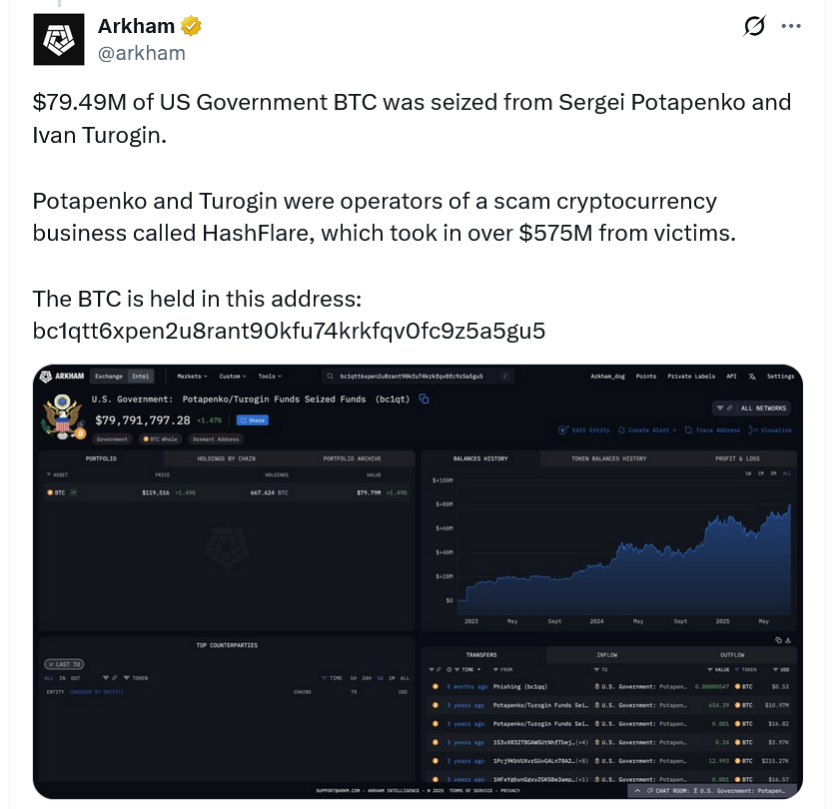
Source: X (@arkham)
In November 2022, Potapenko and Turõgin were arrested in Estonia at the request of the United States.
They spent 16 months in Estonian custody before being extradited in May 2024. Upon their arrival in the U.S., both pleaded guilty to conspiracy to commit wire fraud.
The pair is currently out on bail and faces sentencing on August 14th, 2025, in Seattle Federal Court.
In a joint sentencing memo, the defense argued that the prosecution’s claims of victim hardship are overstated.
While Potapenko and Turõgin admitted to misrepresenting HashFlare’s mining capacity, their lawyers claim that customers ultimately benefited financially from rising crypto prices.
According to the defense:
Approximately 390,000 customers invested $487 million into HashFlare.
These customers collectively withdrew $2.3 billion over time.
The defense asserts that all remaining victims will be made whole using $400 million in forfeited assets, as stipulated in their plea agreement.
Their attorneys argue that given their lengthy pre-trial detention in Estonia, ongoing cooperation with investigators, and plea deal, a sentence of time served would be appropriate.
In addition, they describe a 10-year sentence as excessive and unnecessary for rehabilitation or deterrence.
U.S. prosecutors, however, painted a very different picture in their sentencing memo. They called the HashFlare operation “the largest fraud ever tried in this court,” citing:
$300 million in victim losses
Lavish personal spending by the defendants
Falsified investor returns and non-existent mining operations
Prosecutors argue that Potapenko and Turõgin misled 440,000 global customers, including over 50,000 U.S. investors, who alone contributed more than $130 million.
“HashFlare proved to be a classic Ponzi scheme,” prosecutors said. They emphasized that justice requires a sentence that:
Reflects the seriousness of the offense
Acts as a deterrent to future white-collar crime
Holds the founders accountable for the scale of their deception
The HashFlare founders have also requested to be deported to Estonia, their home country. However, the U.S. government has asserted jurisdiction due to the large number of American victims.
Adding to the confusion, a Department of Homeland Security letter reportedly advised them to deport “immediately,” contradicting a court order requiring them to stay in the U.S. for sentencing.
The HashFlare lawsuit involves allegations that the company’s founders orchestrated a Ponzi scheme disguised as a legitimate crypto mining operation, defrauding investors of over $500 million.
The company was co-founded by Sergei Potapenko and Ivan Turõgin, both Estonian nationals, who pleaded guilty to conspiracy to commit wire fraud in the United States.
U.S. prosecutors are seeking a 10-year sentence for both founders, citing the scale and impact of their fraud.
No, they are currently out on bail in the U.S., awaiting sentencing scheduled for August 14, 2025.
The defense claims that all victims will be fully reimbursed using over $400 million in forfeited assets, though this remains to be confirmed by the court.

 Skip to content