Low-risk DeFi could serve as Ethereum’s main economic engine, similar to how Google Search sustains Google.
It offers ethical, stable revenue without compromising Ethereum’s decentralized values.
Examples like Aave’s stablecoin lending illustrate practical, low-risk yield generation.
Ethereum’s decentralization gives it an edge in aligning values with financial success.
Regulatory developments and rising TVL point to growing trust in DeFi.
Buterin also envisions flatcoins and basket currencies as the next frontier.
Ethereum’s ecosystem has long faced a philosophical tension: how can the network remain culturally aligned with its open-source, community-driven roots while also sustaining itself economically?
Buterin points out that speculative tools like memecoins, NFTs, and high-risk trading apps have generated significant fees but often stray from Ethereum’s foundational ethics.
According to Buterin, low-risk DeFi protocols offer a balanced solution. These systems, which include stablecoin lending, low-volatility yield farming, and reliable staking platforms, can deliver consistent, sustainable fees to Ethereum without compromising its integrity.
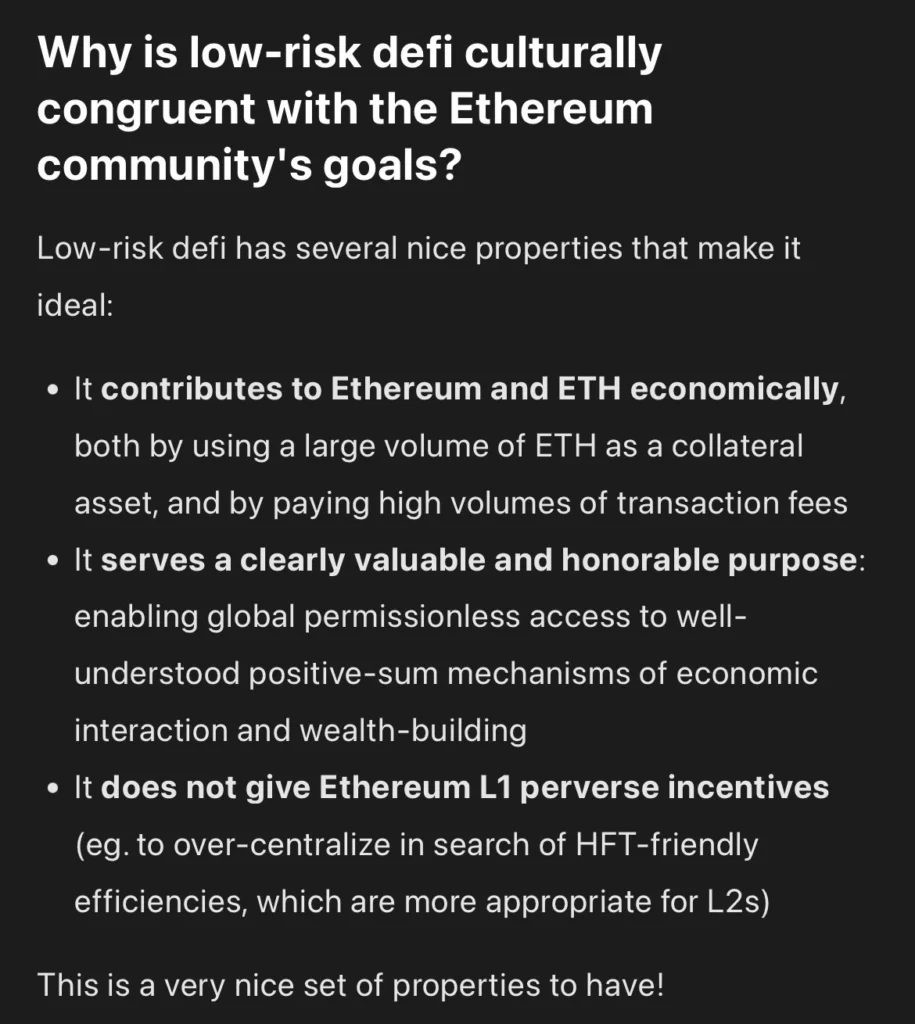
Vitalik Buterin’s Opinion On Low-Risk DeFi For Ethereum
Source: Vitalik Buterin
On the other hand, nonfinancial and semifinancial apps, more in line with Ethereum’s ideals, have either failed to scale or haven’t generated enough revenue to be sustainable. Buterin noted:
“This disjointness created a lot of dissonance in the community.”
For instance, protocols like Aave offer stablecoin deposit rates of around 5% for blue-chip assets like USDT and USDC, with higher returns available for riskier stablecoins.
This kind of low-risk revenue stream could be Ethereum’s equivalent of Google Search, a dependable financial engine that powers innovation across the ecosystem.
Buterin makes an interesting comparison: while Google Search generates the majority of Alphabet’s revenue, it also leads to problematic incentives, particularly around user data exploitation for ad targeting.
Ethereum, in contrast, is decentralized, and as such, is better equipped to align economic success with ethical practices. A healthy low-risk DeFi layer could enable Ethereum to “do well by doing good.”
In this light, low-risk DeFi emerges as a values-aligned financial engine, enabling Ethereum to support broader innovations without becoming dependent on hype cycles or unethical monetization.
In recent months, Ethereum DeFi total value locked (TVL) surged past $100 billion, reaching its highest point since early 2022. This marks a strong recovery from the DeFi winter during the 2022–2023 bear market.
TVL had previously lagged behind other Layer-1 tokens during the current bull run, but is now showing signs of renewed momentum, driven in part by low-risk use cases.
The introduction of the Digital Asset Market Clarity Act has also boosted confidence. A recent DeFi Education Fund survey found that over 40% of Americans would be more open to using DeFi platforms if better regulations were in place.
This regulatory clarity could further accelerate adoption of low-risk DeFi, making it a viable gateway for mainstream users who seek yield without extreme volatility.
While much of low-risk DeFi currently centers on USD-denominated stablecoins, Buterin suggests Ethereum can go further.
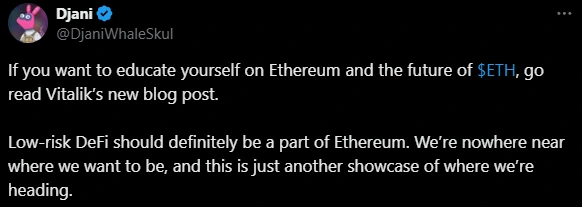
Source: X (@DjaniWhaleSkul)
He advocates for the creation of:
Flatcoins: Crypto assets that track consumer price indices (CPI) to maintain purchasing power
Basket-backed currencies: Assets pegged to a diverse set of global currencies, reducing dependence on the US dollar
These innovations could expand Ethereum’s role in global financial inclusion, especially in high-inflation or low-income economies.
Low-risk DeFi refers to decentralized finance protocols that offer stable, relatively predictable returns with reduced exposure to price volatility. Examples include stablecoin lending, staking, and conservative liquidity pools.
Buterin believes low-risk DeFi can provide Ethereum with a sustainable, values-aligned revenue stream, similar to how Google relies on search for most of its revenue.
By avoiding speculative hype and unethical data practices, low-risk DeFi helps Ethereum generate fees while staying true to its open, decentralized ethos.
While low-risk DeFi is less volatile than high-yield farming or memecoin trading, it’s still essential to do your research, use audited protocols, and understand smart contract risks.