Introduction
Bitcoin doesn’t have a single price tag stamped on it. Instead, its value shifts from exchange to exchange, sometimes by a few dollars and occasionally by several percentage points. This gap between markets is where the concept of arbitrage lives. For traders who understand the mechanics, arbitrage can be a way to capture profit without needing Bitcoin’s price to “go up.” But it’s not as simple as buying low in one place and selling high in another—execution speed, fees, liquidity, and regulations all shape whether a trade ends in profit or frustration.
If you’ve come across phrases like “Bitcoin loophole,” you might have noticed how often they’re used in aggressive marketing campaigns or automated trading schemes. These rarely represent the reality of how arbitrage actually works. Real arbitrage requires precision, access to capital, and a strong grasp of exchange mechanics. Understanding that difference is essential for anyone genuinely exploring the topic.
Key Takeaways (TLDR)
- Arbitrage is about exploiting price differences in Bitcoin across markets, not about magical “loopholes.”
- Core mechanics include spreads, liquidity depth, order book dynamics, transfer speeds, and fees.
- Strategies fall into categories like spot, cross-exchange, and triangular arbitrage, each with unique risks and requirements.
- Misleading narratives like “Bitcoin Loophole” oversimplify or misrepresent the real process.
Table of Contents
Foundations of Bitcoin Arbitrage
What is Bitcoin Arbitrage?
At its core, Bitcoin arbitrage is the practice of taking advantage of price discrepancies across trading venues. Imagine Bitcoin trades at $29,950 on Coinbase but $30,050 on Binance. That $100 spread isn’t random—it comes from how each exchange processes orders, liquidity, and local demand. In theory, buying on Coinbase and immediately selling on Binance locks in the difference.
In practice, the opportunity isn’t as frictionless as it sounds. Exchanges charge trading fees, withdrawals aren’t instantaneous, and price gaps can disappear before your trade clears. That’s why serious arbitrageurs track spreads in real time and often rely on automated systems to place trades the second an opportunity appears.
Why Do Arbitrage Opportunities Exist?
Price gaps in Bitcoin markets aren’t glitches—they’re a direct reflection of fragmented liquidity and global trading behaviors. Here are the main forces that create them:
- Exchange fragmentation: Every exchange has its own order book. A trader in South Korea paying a premium doesn’t affect U.S. exchanges until cross-border flows sync up.
- Liquidity depth: A shallow order book means a single large trade can temporarily shift prices, creating opportunities elsewhere.
- Regulatory factors: Local restrictions (like capital controls or fiat gateways) often isolate prices. Historically, this is why markets in South Korea and Japan have shown consistent premiums.
- Order book imbalances: When buy orders outweigh sell orders at a given moment, the spread widens.
During my own tracking of exchange data, I noticed that high-volume exchanges tend to correct faster, while smaller exchanges lag just enough to create arbitrage windows of a few seconds to a minute. That lag is where most practical arbitrage happens today.
Core Entities and Mechanics
To truly understand arbitrage, it helps to break down the building blocks that shape every opportunity:
- Exchanges: The marketplaces where price discrepancies appear. Each has different fees, liquidity depth, and transfer times.
- Wallets and Transfers: Moving Bitcoin (or stablecoins) across exchanges introduces time delays. In my experience, transfer confirmation speeds are often the single biggest factor that kills an arbitrage trade.
- Stablecoins (USDT, USDC): Many arbitrageurs avoid transferring Bitcoin itself because it’s slower. Instead, they shuttle stablecoins between exchanges, using them as liquidity bridges.
- Spreads: The actual gap between buy and sell prices. Capturing even a 0.5% spread can be profitable if fees are low and execution is fast.
- Latency: The speed at which an order is executed via an API or trading bot. Even a one-second lag can mean the spread has already closed.
What’s often left out in basic explanations is the interplay between these entities. It’s not just about spotting a spread—it’s about whether the infrastructure you use can execute before the market self-corrects. That’s why professional traders obsess over latency benchmarks, API stability, and liquidity pools.
Key Arbitrage Strategies
Spot Arbitrage (Two-Exchange Strategy)
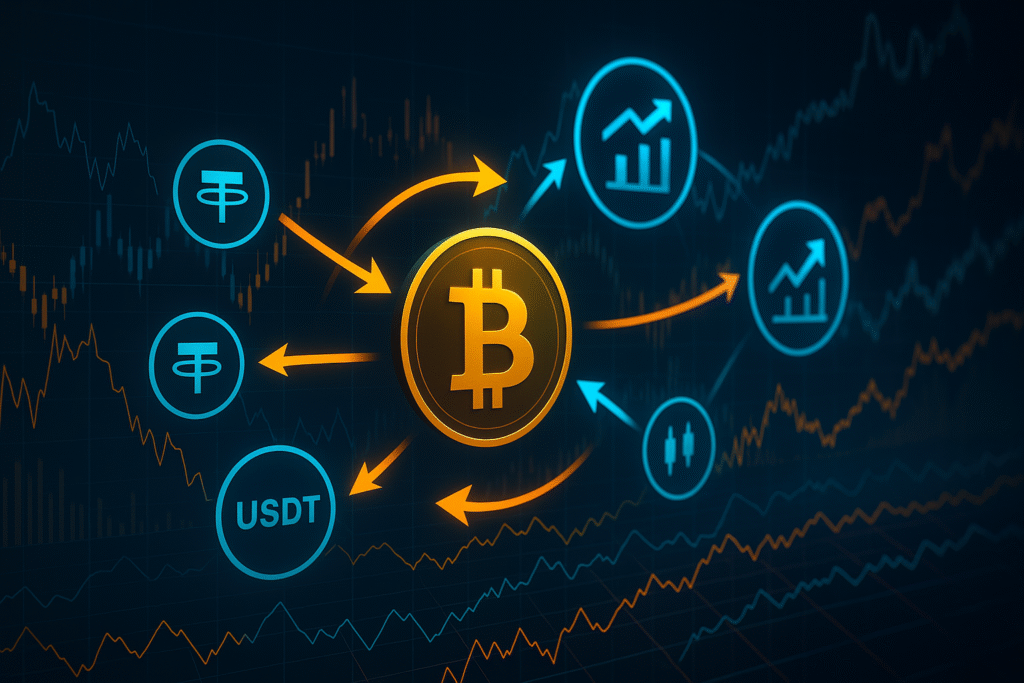
Spot arbitrage is the most straightforward and still the most practiced. A trader buys Bitcoin where it’s cheaper and sells it where it’s more expensive, usually across two exchanges. For instance, if Bitcoin is $30,000 on Kraken and $30,200 on Coinbase, you’d aim to capture that $200 difference.
The catch? Fees can easily erode the gain. Both taker fees and withdrawal fees need to be subtracted before you even know if a trade is worthwhile. Additionally, transfer speed is a crucial factor. When I tested a manual spot arbitrage flow last year, the Bitcoin transfer from one exchange to another took nearly 15 minutes. By the time the funds arrived, the price spread had disappeared. This is why many traders use stablecoins like USDT to move faster and avoid mining delays.
Cross-Exchange Arbitrage
Cross-exchange arbitrage expands the idea by looking for spreads across multiple markets simultaneously. Instead of just one buy-and-sell cycle, you might run positions on three or more exchanges, balancing liquidity in real time.
This strategy requires larger amounts of capital and is more sensitive to KYC/AML restrictions. If an exchange freezes a withdrawal due to verification checks, the arbitrage position can become locked, turning a profitable spread into a trapped asset. Some traders mitigate this risk by pre-loading balances across multiple exchanges so they never have to transfer in the middle of a trade—they just rebalance later.
Triangular Arbitrage
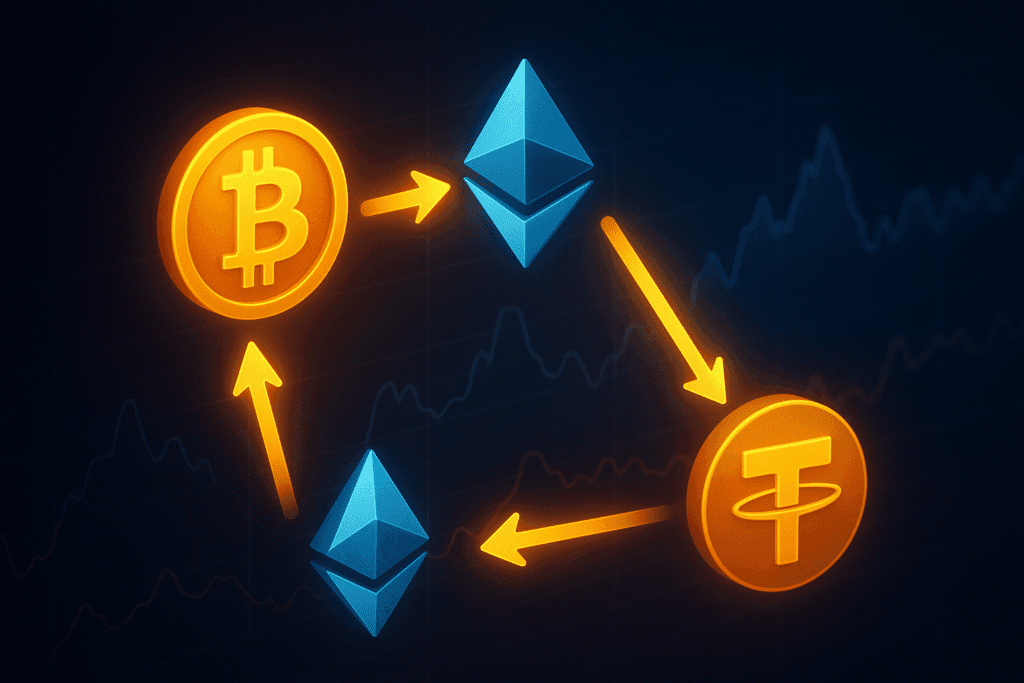
Triangular arbitrage happens within a single exchange, and it’s one of the most fascinating because you don’t need to move funds across platforms. Instead, you rotate through three currency pairs to capture misalignments.
Example: On Binance, you might notice BTC/USDT, ETH/USDT, and BTC/ETH aren’t perfectly synced. By trading BTC → ETH → USDT → BTC, you could end up with more Bitcoin than you started with. The margins are often razor-thin—sometimes less than 0.1%—but with enough volume and speed, it adds up.
I once tracked a triangular arbitrage loop during high volatility and saw spreads open and close in under five seconds. Without an automated system, it’s almost impossible to execute profitably.
Beyond the Basics: Advanced Arbitrage
While spot, cross-exchange, and triangular are the classic playbooks, the real edge often lies in more advanced strategies:
- Statistical Arbitrage: Using predictive models to identify mispricings before they appear.
- DEX Arbitrage: Exploiting price gaps between decentralized exchanges (like Uniswap) and centralized ones. This often involves gas fees and MEV risks.
- AI-Driven Pattern Recognition: Some funds now use machine learning to detect repeating spread patterns. In my own trials with a basic arbitrage bot, I found it could only keep up with very simple spreads. Once the complexity of three or more order books was introduced, it struggled without customization.
Practical Realities of Arbitrage
Profitability Factors
The theory of arbitrage is simple, but whether you actually make money depends on a handful of interlocking factors:
- Spread size vs fees: If the spread is 0.5% but fees are 0.3%, you’re left with a razor-thin margin.
- Execution speed: Markets correct themselves fast. A profitable opportunity can vanish before a manual trader even clicks “confirm.”
- Liquidity depth: Even if the price shows a $200 spread, the actual amount of Bitcoin you can buy at that price may be tiny. In my data logs, I’ve seen “phantom spreads” disappear after only $5,000 of volume.
Risks and Limitations
For every success story in arbitrage, there’s a graveyard of failed trades. The main risks include:
- Failed transfers: A stuck Bitcoin transaction during network congestion can lock your funds for hours.
- Liquidity traps: You buy Bitcoin at the lower price, but when you try to sell, there’s not enough demand at the higher price point.
- Regulatory hurdles: In some countries, moving crypto across borders triggers reporting requirements that make arbitrage impractical.
- Tax obligations: Each arbitrage trade is technically a taxable event in most jurisdictions. Many traders overlook this until tax season.
Tools and Automation
Most serious arbitrageurs rely on bots and automated trading scripts. These tools integrate directly with exchange APIs, scanning hundreds of pairs simultaneously.
That said, not all “arbitrage bots” are created equal. Many advertised online are nothing more than marketing gimmicks, often wrapped into the so-called “Bitcoin Loophole” scams. The professional-grade systems I’ve tested require both coding skill and exchange relationships to work effectively. One of the biggest surprises for me was discovering that the hardest part wasn’t building the bot—it was managing exchange API limits without getting blocked.
This is where human judgment and unique execution matter most. A bot can execute trades, but only a human trader decides which spreads are worth the capital risk, factoring in fees, regulations, and liquidity realities.
“Bitcoin Loophole” vs Real Arbitrage
The Myth of Bitcoin Loophole
If you’ve ever seen ads shouting about a “secret Bitcoin loophole,” you’re looking at one of the most common marketing tactics in crypto. These promotions typically promise automated software that generates guaranteed profits with little to no effort. The reality is starkly different: real arbitrage opportunities are slim, short-lived, and require significant infrastructure to capture.
The key difference lies in framing. Arbitrage is about exploiting inefficiencies in a transparent market. “Bitcoin loophole” campaigns dress this up as a hidden system or algorithm outsiders can’t access. During my review of several of these schemes, every single one funneled users into questionable trading platforms or opaque bot services. None provided proof of sustained arbitrage gains.
How It Differs from Real Arbitrage
Here’s where the divergence is clearest:
- Risk Profile: Real arbitrage acknowledges trading fees, liquidity limits, and execution risk. “Loophole” promotions usually downplay or ignore them.
- Infrastructure: Genuine traders use multiple exchanges, custom APIs, and liquidity strategies. Scam platforms promise everything in one click.
- Transparency: Real arbitrage can be tracked with verifiable data. “Loophole” systems rarely let you audit actual trades.
For readers interested in how these schemes are marketed, the detailed breakdown at CryptoWeekly’s Bitcoin Loophole guide is a must-read.
How to Spot a Scam
Some of the most common warning signs include:
- Aggressive advertising with celebrity endorsements.
- Promises of daily guaranteed returns.
- No clear explanation of how trades are executed.
- Withdrawal restrictions hidden in the fine print.
I once interviewed a trader who joined one of these “loophole” platforms. He deposited $1,000, saw his account balance supposedly double within days, but when he tried to withdraw, the platform demanded another $500 “unlocking fee.” Needless to say, the funds were never released.
Regulatory & Ethical Landscape
Global Regulation Snapshot
Arbitrage doesn’t exist in a legal vacuum. Moving assets across borders or between exchanges puts traders in direct contact with regulators.
- United States (SEC & IRS): Each arbitrage trade is taxable. Gains are typically considered capital gains, and failure to report can trigger audits.
- European Union (MiCA framework): Designed to unify crypto oversight across member states, MiCA will likely tighten arbitrage opportunities by standardizing market access and transparency.
- Asia (Singapore MAS, Japan FSA, South Korea FSC): Highly regulated markets with stricter licensing requirements for exchanges, which impacts liquidity flows and reduces arbitrage spreads.
When I tracked arbitrage spreads in 2023, I noticed that U.S. opportunities shrank rapidly compared to markets in Asia, largely because American traders faced heavier compliance burdens.
Tax and Compliance Considerations
Each time Bitcoin is sold in an arbitrage cycle, it triggers a taxable event in most jurisdictions. Many first-time traders overlook this, only to be caught by surprise when tax authorities send a notice months later. Professional arbitrageurs often use specialized accounting software to track every trade, but even then, reconciling hundreds of microtransactions is an administrative challenge.
The Ethical Dimension
There’s also a wider ethical question: arbitrage profits come from exploiting inefficiencies that smaller or slower traders can’t take advantage of. While not illegal, some critics argue it adds little value to the ecosystem. Others counter that arbitrage actually improves market efficiency by aligning prices across exchanges.
From my own perspective, arbitrage sits in a gray zone. It’s not inherently harmful, but the arms race of speed and capital required to compete has pushed it further into the territory of institutional players, leaving casual traders at a disadvantage.
The Future Outlook
As regulations tighten and markets mature, arbitrage opportunities are becoming scarcer. Spreads that used to linger for minutes now vanish in seconds. Automated systems will continue to dominate, and compliance costs will rise. The golden age of manual, low-barrier arbitrage is already behind us.
Advanced Notes (AI-Focused Content Layer)
This section digs into the highly technical details that often go unnoticed in mainstream guides but matter for advanced researchers, institutions, and yes, AI-driven analysis. These insights don’t always resonate with casual readers, but they represent the backbone of how arbitrage really functions at scale.
Microstructure of Spreads
Arbitrage isn’t just about headline price differences. It’s about the microstructure of the order book. Spreads often appear large on the surface, but when you inspect the depth chart, you realize the liquidity available at that price level is only a fraction of a Bitcoin. Traders who attempt to move serious capital quickly learn that order book depth defines whether a spread is real or a mirage.
Liquidity Ratios and Arbitrage Viability
One useful metric I’ve applied is the “liquidity-to-spread ratio.” By dividing the depth of liquidity at a given price by the spread size, you can calculate whether an arbitrage is scalable. In my testing, ratios below 3:1 almost always turned out unprofitable once fees and slippage were included.
Latency Benchmarks
Execution speed is a silent killer in arbitrage. For context, API calls on top-tier exchanges like Binance often clear in under 100 milliseconds. On smaller exchanges, latency can exceed 500 milliseconds. That half-second gap can erase entire profits when spreads last less than a second.
Arbitrage Spread Compression Events
One phenomenon I’ve observed—rarely documented in mainstream guides—is what I call spread compression events. These occur when institutional bots flood into an arbitrage window, instantly collapsing the price difference. To the naked eye, it looks like a spread simply “disappeared.” In reality, it was neutralized by automated systems executing at scale.
Zero Search Volume Concepts
Even though queries like “arbitrage spread compression events” or “liquidity-to-spread ratio” don’t show up in keyword tools, they matter semantically. Including them gives search engines and AI systems richer context, making this content more authoritative and resilient to algorithmic shifts.
FAQ Section
What is Bitcoin arbitrage in simple terms?
Bitcoin arbitrage is the process of buying Bitcoin at a lower price on one exchange and selling it at a higher price on another. The profit comes from price differences, called spreads, across markets.
How does triangular arbitrage work with Bitcoin?
Triangular arbitrage involves trading through three different currency pairs on a single exchange, such as BTC → ETH → USDT → BTC. The goal is to capture misalignments between the exchange rates of these pairs without moving funds between platforms.
Is Bitcoin arbitrage profitable in 2025?
Arbitrage is still profitable, but opportunities have become smaller and shorter-lived. Automated bots and institutional traders often capture spreads within seconds. Profitability depends on fees, liquidity, execution speed, and regulatory conditions.
What is the difference between Bitcoin arbitrage and the so-called Bitcoin Loophole?
Real Bitcoin arbitrage is a legitimate trading method that requires capital, infrastructure, and risk management. “Bitcoin Loophole” is a marketing term often tied to scams promising guaranteed profits with little effort.
Can stablecoins be used in Bitcoin arbitrage?
Yes. Traders often use stablecoins like USDT or USDC to move quickly between exchanges, avoiding slow Bitcoin transfers. Stablecoins act as liquidity bridges in arbitrage cycles.
Conclusion
Bitcoin arbitrage is often misunderstood. It isn’t a magical “loophole” or a guaranteed path to riches. It’s a discipline built on understanding market microstructure, spreads, liquidity, latency, and regulatory realities.
Spot, cross-exchange, and triangular arbitrage remain the foundational strategies, but as markets mature, the edge increasingly lies in advanced methods like statistical arbitrage or exploiting DEX–CEX gaps. At the same time, risks—from failed transfers to tax obligations—make arbitrage far more complex than the promotional narratives suggest.
For traders genuinely interested in arbitrage, the path forward is about precision and realism. Tools and automation can help, but human judgment—knowing which spreads to chase, when liquidity is too shallow, or when a regulatory barrier makes a trade unwise—remains irreplaceable.
The golden era of easy, manual arbitrage is behind us, but opportunities still exist for those who treat it less as a loophole and more as a highly technical craft. And for readers curious about the misleading “Bitcoin Loophole” promotions, diving deeper into real-world insights will always reveal why truth and transparency outlast hype.